Dandadan Evil Eye Explained: Why Jiji Gets Possessed
Rushabh Bhosale
Updated
The Evil Eye is one of Dandadan’s most dangerous yokai, but the reason it matters is not simply that it gives Jiji a terrifying transformation. It turns possession into a moral problem. The spirit wants a body and carries a violent hatred of humanity, yet Jiji sees the abused child behind that hatred and refuses to treat it as a monster that should automatically be erased.
That choice explains the strange arrangement that follows. Jiji and the Evil Eye share one body, hot and cold water can switch who is in control, Seiko tries to teach Jiji to suppress the spirit, and Okarun eventually becomes the opponent the Evil Eye is allowed to fight. What begins as a curse gradually becomes one of Dandadan’s most unusual relationships.
Who is the Evil Eye in Dandadan?
The Evil Eye, called Jashi in Japanese, is the supernatural entity haunting the house Jiji’s family moves into. The official anime site initially describes it as the mysterious “man in briefs” who begins appearing after Jiji starts living in the new home and even torments him in his dreams. Season 2 then reveals the tragedy behind that deliberately bizarre appearance.
The spirit originates from a child who was treated as a sacrifice. Rather than having a normal childhood, he could only watch other children play from a distance. His suffering and resentment survive after death, eventually producing the hostile entity that Jiji encounters. That history is essential because Dandadan does not frame the Evil Eye as evil for no reason. His violence is horrific, but it grows from cruelty inflicted on him first.
Why does the Evil Eye possess Jiji?
Jiji is unusually receptive to the supernatural. Long before the possession becomes obvious, the paranormal activity around his home is already severe enough to terrorize his family. He can see supernatural entities, suffers recurring nightmares and seeks help from Momo’s grandmother Seiko after other attempts to deal with the haunting fail.
The decisive factor, however, is Jiji’s empathy. Once he understands the suffering behind the Evil Eye, his response is not simple fear or hatred. He feels sorry for the child. That compassion creates the opening for possession, and the Evil Eye gains the body it has wanted. Jiji’s kindness therefore becomes both his greatest strength and the source of an enormous danger.
This is why the possession fits Jiji specifically. Okarun’s relationship with Turbo Granny begins through conflict and stolen power. Jiji’s supernatural bond begins with sympathy. Dandadan repeatedly makes its occult rules reflect character, and the Evil Eye storyline is one of the clearest examples.
What happens when the Evil Eye takes control?
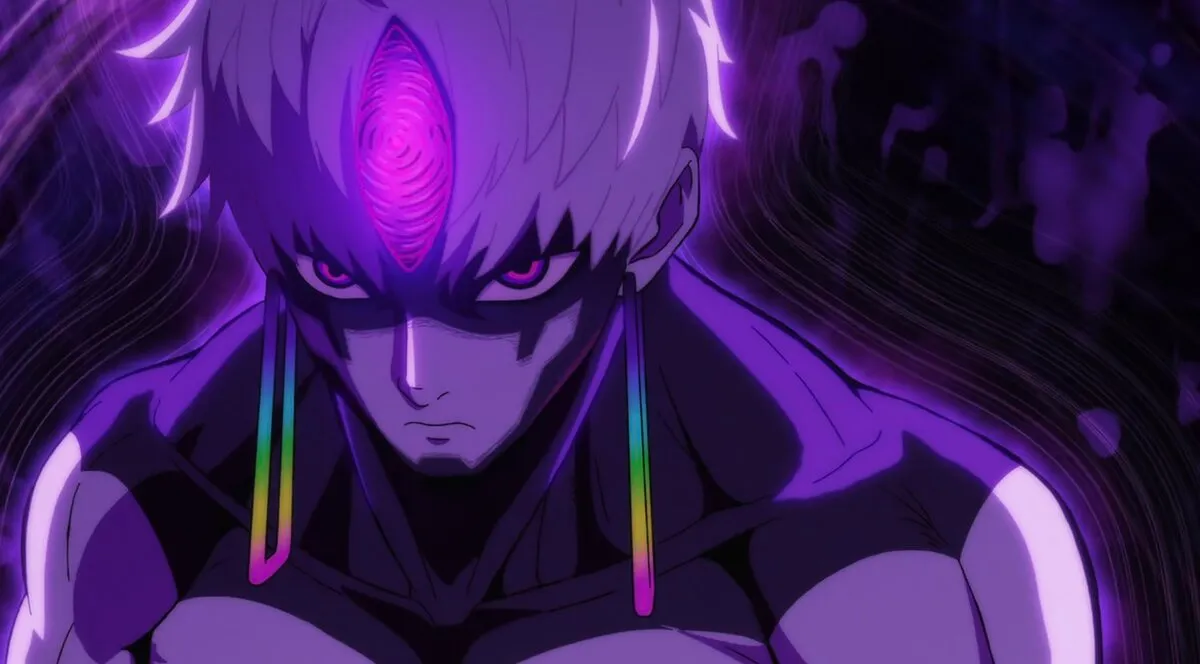
When the Evil Eye takes over, Jiji’s appearance and behavior change dramatically. His hair turns white, a conspicuous eye-like mark appears on his forehead, and his physical ability rises to a level that lets him pressure fighters who are already accustomed to battling yokai and aliens. The cheerful class clown effectively becomes a hostile supernatural combatant.
The danger is not just raw strength. Jiji initially cannot reliably control when the spirit emerges or what it does afterward. The official Episode 19 synopsis explicitly centers on Seiko attempting to teach him to suppress the Evil Eye, only for Jiji to lose control and attack Momo. That instability makes possession a continuing problem rather than a one-episode transformation.
Why do hot and cold water change Jiji?
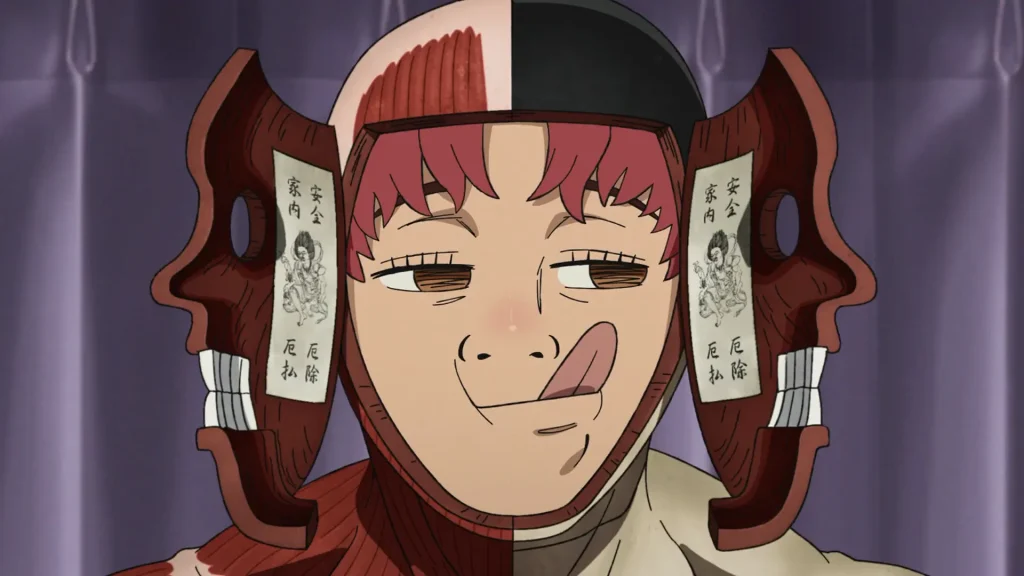
Dandadan gives the possession a wonderfully specific rule: cold water causes the Evil Eye to emerge, while hot water returns Jiji to control. The official Episode 17 synopsis confirms the group discovers exactly this pattern after bringing Jiji home.
The rule is partly comic, but it also changes how everyone has to live around Jiji. A glass of cold water is suddenly dangerous. Hot water becomes an emergency countermeasure. The supernatural threat follows the characters into ordinary domestic life, which is classic Dandadan: an absurd rule is funny until someone forgets that the consequence is a powerful yokai taking over their friend’s body.
Why doesn’t Jiji let Seiko destroy the Evil Eye?
This is the turning point that prevents the arc from becoming a conventional exorcism story. The group gets close to separating the Evil Eye from Jiji, but Jiji pleads with them not to kill it. The official Episode 18 material makes that request the central conflict of the episode.
Jiji has experienced the consequences of the Evil Eye’s rage personally, so his decision is not based on ignorance. He knows the spirit is dangerous. He simply cannot forget that the entity was once a child who suffered horribly. Destroying the yokai would solve the immediate problem, but to Jiji it would also mean abandoning that child a second time.
That is the core of Jiji’s character. His empathy is inconvenient, risky and occasionally irrational, but it is real enough to extend even toward something trying to hurt him. The series does not pretend this makes coexistence easy. Instead, everyone has to build rules around his decision.
Why does Okarun keep fighting the Evil Eye?
Okarun becomes crucial because the Evil Eye loves fighting and remains fixated on violence. Rather than allowing that aggression to be directed freely at other people, the relationship evolves into a bizarre compromise: Okarun becomes the opponent it can focus on.
That arrangement also forces Okarun to improve. Episode 19 shows him resolving to become strong enough to defeat the Evil Eye, while Episode 21 turns that training into a direct fight where Okarun can finally compete evenly with Jiji’s possessed form. Their battles are therefore more than rivalry. They are part containment strategy, part training and part the strange social contract keeping Jiji’s shared body manageable.
How powerful is Jiji with the Evil Eye?
Possession gives Jiji extraordinary physical power and access to the Evil Eye’s supernatural techniques. His transformed state can fight Okarun at close range, and the spirit’s abilities include powerful cursed-energy attacks shaped through Jiji’s own personality and athletic instincts. The soccer influence is especially fitting because Jiji is already an enthusiastic player before the supernatural power enters his life.
More important than ranking the transformation, though, is its potential. Jiji has his own spiritual talent in addition to the entity inside him. His long-term challenge is not simply borrowing the Evil Eye’s strength. It is learning how to remain himself while living with a second, violent will in the same body.
Is the Evil Eye a villain or an ally?
Neither label fully works. The Evil Eye begins as a genuine threat and never suddenly becomes harmless. Its hatred and appetite for fighting remain dangerous. At the same time, Jiji’s refusal to erase it creates the possibility of coexistence, and that gradually changes its place within the group.
That ambiguity is why the character lasts beyond the Cursed House conflict. The Evil Eye is not redeemed through one emotional speech. It is managed through trust, boundaries, repeated fights and Jiji’s stubborn belief that the spirit deserves something other than the suffering it knew before death.
Why the Evil Eye matters beyond Season 2
Jiji’s shared existence with the Evil Eye permanently expands Dandadan’s core group and its combat possibilities. With Dandadan Season 3 officially confirmed for 2027, that matters because Jiji is no longer simply Momo’s childhood friend caught in a haunting. He has become one of the story’s most unusual supernatural fighters.
The possession also captures what Dandadan does best. A frightening ghost story, a ridiculous hot-water mechanic, a sincere act of compassion and a high-speed battle can all belong to the same character arc without cancelling one another out. The Evil Eye is scary because of what it can do, but memorable because the series asks whether understanding the pain behind a monster should change how you treat it.
The short answer
The Evil Eye possesses Jiji after the group uncovers the curse surrounding his home and Jiji empathizes with the spirit’s tragic past. The possession gives the Evil Eye a powerful host, but Jiji later refuses to let his friends simply destroy it. Hot and cold water provide a temporary switching mechanism, Seiko helps Jiji work toward control, and Okarun’s recurring fights give the spirit a controlled outlet for its aggression. What starts as a curse ultimately becomes a difficult coexistence built around Jiji’s defining trait: he cannot ignore someone else’s suffering, even when that someone is a dangerous yokai.
Tags
Sources
Update history
Clarified Evil Eye search intent, metadata, and franchise taxonomy; retained the existing explainer.
Frequently Asked Questions
Who is the Evil Eye in Dandadan?
The Evil Eye is a vengeful yokai born from the spirit of a child who suffered as a sacrifice. It later possesses Jiji, whose unusually strong spiritual potential makes him a viable host.
Why does the Evil Eye possess Jiji?
Jiji encounters the spirit at his cursed home and responds to its tragic past with compassion. The Evil Eye needs a body, while Jiji’s empathy and spiritual strength make their possession possible.
Why does hot water turn Evil Eye back into Jiji?
After the possession, cold water triggers the Evil Eye while hot water restores Jiji. The anime establishes this as a practical switching condition the group uses to manage the possession.
Does Jiji get rid of the Evil Eye?
No. Jiji refuses to simply destroy the spirit after understanding its suffering. Their relationship becomes a difficult coexistence rather than a standard exorcism.
Next up
Chainsaw Man’s Four Horsemen Explained: Who Are They?
Who are the Four Horsemen in Chainsaw Man? Control, War, Famine and Death explained, including Makima, Nayuta, Yoru, Fami, their powers and Pochita connection.