What Is Nen in Hunter x Hunter? The 6 Nen Types Explained
Nen is the power system that changes Hunter x Hunter from an adventure about talented fighters into a world where information, preparation and self-imposed rules can matter as much as raw strength. In simple terms, Nen is the technique of controlling aura, the life energy produced by living beings. A skilled user can keep that aura around the body, suppress it, increase its output and eventually shape it into highly personal abilities.
The system can look complicated because the series introduces several layers of terminology. The easiest way to understand it is to separate three ideas: the four basic principles of Nen, a person's natural Nen affinity, and the individual ability that person develops. Once those pieces are separated, fights involving Gon, Killua, Kurapika, Hisoka and Chrollo become much easier to follow.
What exactly is Nen?
Every living person has aura, but most people cannot consciously perceive or control it. Nen training teaches a person to open, regulate and shape that aura. This means Nen is not a collection of unrelated supernatural powers. The strange abilities seen later in Hunter x Hunter all grow from the same underlying resource.
That shared foundation is important. A fighter with an unusual ability still has to manage aura output, defense, concentration, range and conditions. This is why apparently simple abilities can defeat more spectacular ones when the user understands the matchup better.
The four principles: Ten, Zetsu, Ren and Hatsu
Ten is the practice of keeping aura flowing around the body instead of allowing it to disperse. It forms the foundation of Nen defense and gives a trained user a stable aura layer.
Zetsu closes the flow of aura. Because the user's presence becomes much harder to detect, Zetsu is valuable for concealment and recovery. The trade-off is serious: suppressing aura also removes much of the protection Nen normally provides.
Ren increases the amount and intensity of aura a person produces. Where Ten is about maintaining control, Ren is about generating a stronger output. It supports both offensive pressure and stronger defensive use of aura.
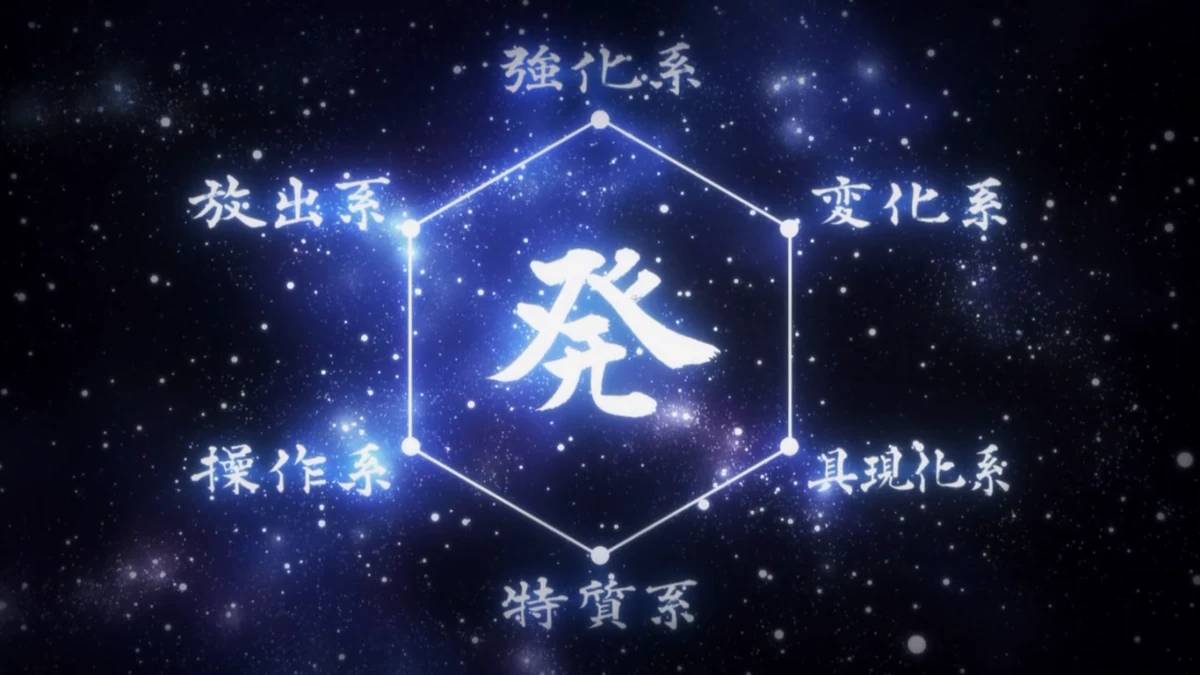
Hatsu is the personal expression of Nen. It is where a user's affinity, personality, training and chosen conditions begin turning aura into an individual fighting style. Hatsu should not be treated as simply another word for a named special move. It is the principle through which Nen is expressed in a distinctive way.
What are the six Nen types?
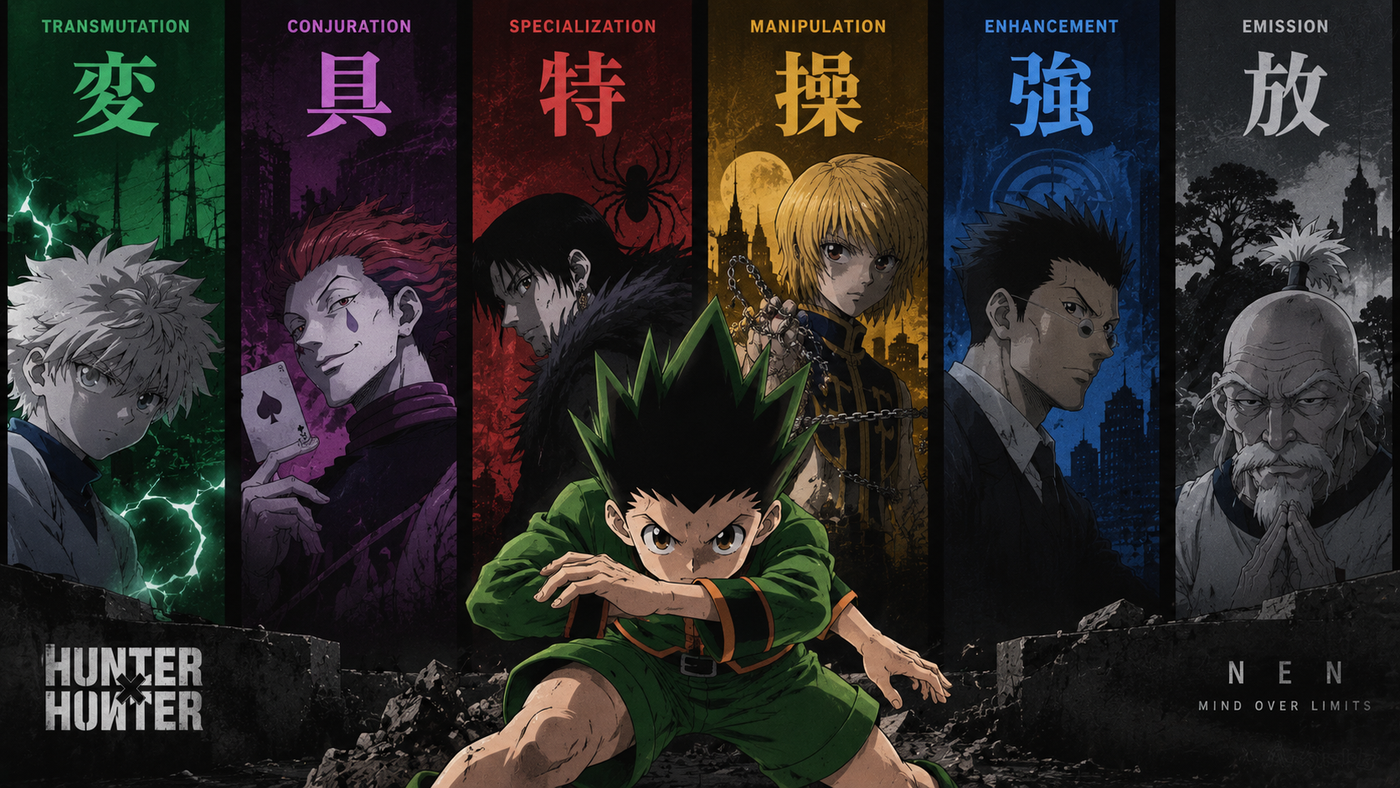
Nen users are commonly grouped into six affinities: Enhancement, Transmutation, Emission, Conjuration, Manipulation and Specialization. An affinity does not hand someone a predetermined power. It describes the area in which that person's aura is naturally most efficient.
Enhancement
Enhancers excel at strengthening existing physical qualities or objects. Gon is the clearest early example. Enhancement can appear straightforward compared with more elaborate categories, but efficiency in basic offense and defense makes it extremely reliable.
Transmutation
Transmuters change the properties of their aura so that it behaves like something else. Killua gives his aura electrical properties, while Hisoka's Bungee Gum famously combines elastic and adhesive characteristics. The aura is not simply becoming ordinary electricity or rubber; it is being made to imitate useful properties.
Emission
Emitters are naturally suited to maintaining aura after it leaves the body. That makes the category useful for ranged attacks and abilities that must operate away from the user. The important idea is separation: aura can be projected while retaining enough power and control to remain useful.
Conjuration
Conjurers use aura to create material objects. Kurapika's chains are the best-known example. Conjured objects can carry unusual rules, but creating something useful requires far more than imagining a convenient weapon. Training, familiarity and conditions shape what the ability can realistically accomplish.
Manipulation
Manipulators control targets, which can include objects and living beings depending on the ability. The conditions for gaining control are often crucial. A manipulator may need to attach an object, make contact or satisfy another requirement before the ability takes effect.
Specialization
Specialization covers abilities that do not fit cleanly into the other five categories. Chrollo's Skill Hunter is a prominent example because stealing and using other people's abilities does not behave like a conventional application of Enhancement, Emission or the other standard affinities. Specialist abilities therefore vary enormously.
Why Nen affinity matters
A Nen user is not necessarily locked out of every category except their natural one. The system instead emphasizes efficiency. Categories positioned closer to a person's affinity are generally easier to use effectively than categories farther away. This is why understanding your natural type matters when developing an ability.
Hunter x Hunter repeatedly rewards characters who build around what they can do efficiently rather than trying to imitate someone else's strengths. The category chart is therefore less like a rigid class system in a game and more like a map of where training gives the best return.
How restrictions and vows make Nen stronger
One of Nen's defining ideas is that limitations can increase an ability's effectiveness. A user can deliberately impose a condition, restriction or serious risk on how a power works. The more meaningful the restriction is to that person, the more significant the resulting effect can become.
Kurapika demonstrates the principle dramatically by restricting Chain Jail to members of the Phantom Troupe and attaching a lethal consequence to breaking that rule. The strength does not come from finding a loophole in the system. It comes from accepting genuine risk and narrowing how the ability may be used.
This mechanic is one reason Hunter x Hunter battles rarely reduce to a simple question of who has more energy. Discovering an opponent's activation condition or restriction can completely change a fight.
Advanced Nen techniques: Gyo, In, En, Shu, Ko and Ryu
After the four fundamentals, users learn applications that combine and redistribute aura. Gyo concentrates aura into a particular body part, commonly the eyes, to improve perception. In conceals aura and can hide Nen constructs from ordinary sight. En extends aura around the user as a detection field, allowing skilled practitioners to sense what enters it.
Shu coats an object with aura, effectively treating it as an extension of the user's body. Ko concentrates a huge amount of aura into one point for maximum force but leaves other areas dangerously exposed. Ryu is the rapid redistribution of aura during combat, allowing a fighter to shift the balance between attack and defense as a battle changes.
Why Nen is such a flexible power system
Nen remains useful far beyond the arcs in which Gon and Killua first learn it. Later parts of the story use increasingly specific abilities, information battles and conditions, including material connected to the Hunter x Hunter Dark Continent storyline and the Succession Contest.
The system scales without needing every new character to fire a larger attack than the last. A seemingly modest ability can become terrifying in the correct situation, while an overwhelmingly powerful technique can carry restrictions that create exploitable weaknesses. Knowledge is therefore part of combat power.
The simplest way to remember Nen
If all the terminology starts blending together, remember the hierarchy. Nen is the overall system for controlling aura. Ten, Zetsu, Ren and Hatsu are its four major principles. The six affinities describe how a person's aura is naturally suited to being used. Individual abilities then emerge from those foundations, shaped by training, personality and restrictions.
That structure is what makes Hunter x Hunter's Nen system feel complex without being random. The abilities can become extremely strange, but they still operate within a framework where efficiency, conditions, aura control and tactical information matter. Understanding those rules is the key to understanding why Hunter x Hunter's best battles work the way they do.
Tags
Sources
Frequently Asked Questions
What is Nen in Hunter x Hunter?
Nen is the technique of sensing, controlling and using aura, the life energy produced by living beings.
What are the six Nen types?
The six main affinities are Enhancement, Transmutation, Emission, Conjuration, Manipulation and Specialization.
What is the difference between Nen and Hatsu?
Nen is the overall aura system. Hatsu is one of its four major principles and is the personal expression of a user's aura, often forming the basis of an individual ability.
Next up
Why Is Maomao Resistant to Poison in The Apothecary Diaries?
Why can Maomao handle poison in The Apothecary Diaries? Her resistance, self-experimentation, poison-taster role and limits explained.