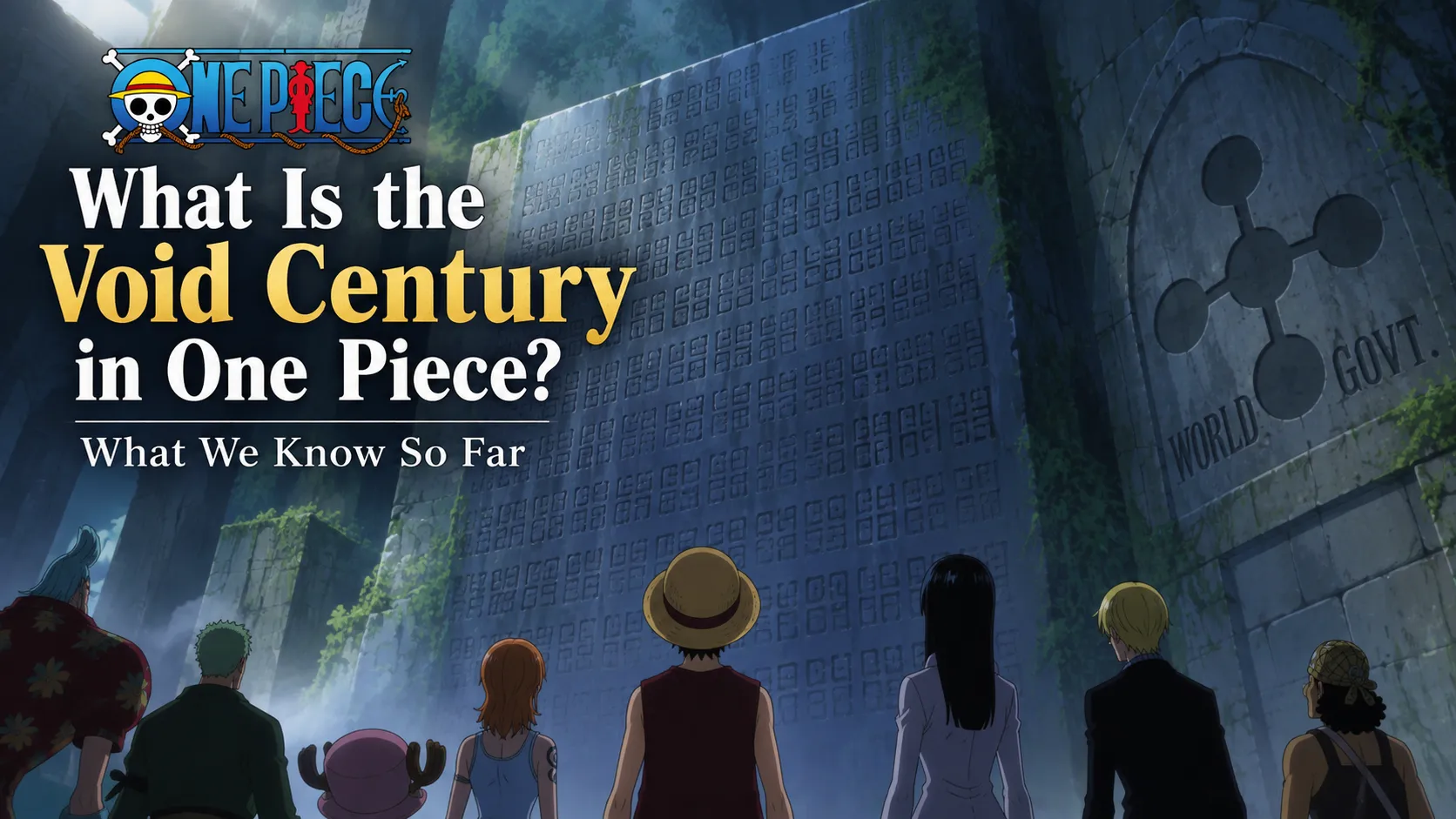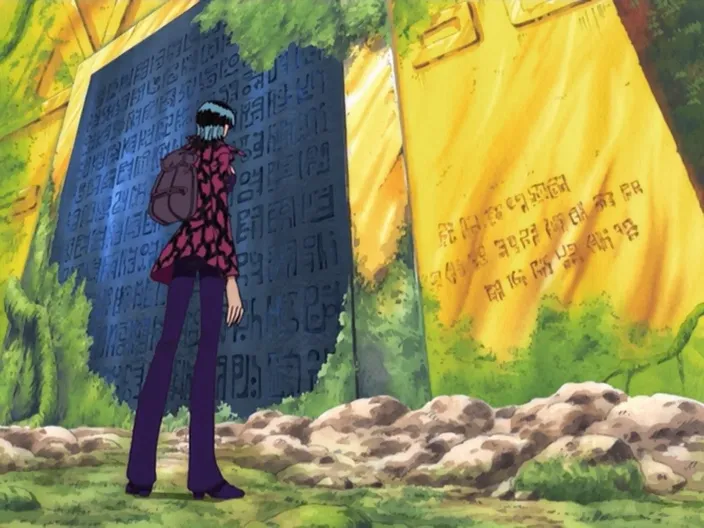

Poneglyphs are the ancient stone records that turn One Piece's treasure hunt into a mystery about the world's missing history. Most pirates chase the treasure through maps, rumors and brute force. The Road Poneglyphs provide something much more specific: clues needed to locate the final island, Laugh Tale. Ordinary Poneglyphs preserve information the World Government would rather remain forgotten.
That distinction explains why Nico Robin matters so much. She can decipher a script almost nobody understands, and the Straw Hats cannot simply sail farther until they stumble across the answer. This guide separates the different kinds of stones, explains the four red Road Poneglyphs, and distinguishes confirmed story information from popular fan theories. It discusses major events through Zou, Whole Cake Island and Wano, with a warning before later revelations.
What are Poneglyphs in One Piece?
Poneglyphs are exceptionally durable stone monuments inscribed in an ancient language. They were made to preserve messages across centuries, including information about the erased Void Century. Their physical resilience is crucial: destroying a normal paper archive is easy for a powerful regime, but suppressing knowledge carved into near-indestructible stone requires hiding the stones and silencing the people who can read them.
The inscriptions are not all copies of one secret. Different stones record different kinds of information, from historical testimony to directions toward something else. The Poneglyph Robin studies in Skypiea, for example, is part of a larger trail rather than a standalone solution. Crunchyroll's Episode 194 listing places her investigation at the center of that story.
The three useful categories: historical, instructional and Road Poneglyphs
Fans commonly distinguish historical stones, instructional stones and Road Poneglyphs. Historical inscriptions help reconstruct what happened long ago. Others point toward locations or objects, including the Ancient Weapons. The red Road Poneglyphs are different: they are specifically part of the navigation puzzle leading to Laugh Tale. This is a practical way to understand their functions, not a claim that every ordinary stone comes with an officially color-coded category label.
An important misconception is that every Poneglyph gives a piece of the final island's coordinates. Most do not. Some contribute to understanding the lost civilization, its allies or its enemies. The Road Poneglyphs alone supply the four essential location clues. For the wider historical context, read the Void Century and why its history was erased.
How do the four Road Poneglyphs lead to Laugh Tale?
Four Road Poneglyphs are needed to determine the location of Laugh Tale. Each red stone contains a location clue. The four points must be interpreted together to find the destination, a concept explained during the Zou arc. It is often simplified as drawing intersecting lines between four points on a map, but the series does not give viewers a complete usable real-world chart or precise mathematical coordinates to calculate themselves.
The critical lesson is that collecting just one or two red stones is not enough. A powerful crew might know several possible islands yet still lack the complete route. This makes the race for the Road Poneglyphs a strategic contest among major pirate crews rather than a conventional sprint. Crunchyroll's Episode 770 synopsis confirms the Kozuki connection and why the stones matter to the emperors.
Where are the Road Poneglyphs found?
The story identifies one Road Poneglyph on Zou, protected in the domain of the Mink tribe; another in Big Mom's possession in Totto Land; and another associated with Wano, where Kaido ruled. The Straw Hats acquire rubbings rather than hauling enormous stones aboard their ship. A rubbing copies the writing so that Robin can interpret it later. This is a much more realistic way for a traveling crew to collect the clues.
The fourth stone is the major unresolved piece in the established post-Wano search. It was once associated with Fish-Man Island during Roger's era, but its later whereabouts became uncertain. Treat internet maps that confidently place it on a specific island as theories unless a chapter explicitly confirms that location. New manga chapters may change the answer; the distinction between a historical sighting and a verified present location matters.
Why can Nico Robin read Poneglyphs?
Robin grew up on Ohara, an island of scholars who researched the forbidden ancient script and the Void Century. Their work was treated as a threat by the World Government, leading to Ohara's destruction. Robin survived and carried the ability to read the inscriptions into adulthood. Her expertise makes her more than the crew's archaeologist: she is essential to understanding what the Straw Hats discover.
The Government's hostility also shows why the script is politically dangerous. A stone cannot reveal its contents to a reader who does not know the language. Eliminating scholars and restricting research can keep a record effectively silent without physically destroying it. Robin's story reaches a turning point during Enies Lobby, covered in VIZ's Volume 41 listing.
Who created the Poneglyphs? The Kozuki family's role
The Kozuki clan of Wano is credited with carving the Poneglyphs centuries before the present story. This connects an isolated country to a global effort to protect historical testimony. It also explains why the Zou revelations are so important: the alliance between the Minks and the Kozuki family is not merely about a contemporary political struggle. Their shared history reaches back to the creation and preservation of the stones.
Do not confuse the ability to carve a stone with automatic knowledge of every message it contains. The original records were produced in a specific historical context; later descendants may know family traditions without personally being able to read the entire script. The anime's Zou explanation of the Kozuki family establishes this connection without answering every Void Century mystery.
How did Gol D. Roger reach Laugh Tale?
Roger's final voyage demonstrates the difference between sensing something extraordinary and actually decoding the stones. Kozuki Oden, who traveled with Roger, could read the ancient writing and helped his crew follow the trail. Roger's mysterious ability to perceive the 'voice' of things should not be mistaken for fluency in the ancient language. Oden's knowledge supplied the crucial translation.
The journey is dramatized in the Wano flashback and collected around One Piece Volume 96. Roger's achievement therefore depended on companions and information, not merely overwhelming strength. That is one reason Robin's place on Luffy's crew parallels Oden's role on Roger's ship without making the two characters identical.
What is the Rio Poneglyph?
The Rio Poneglyph refers to the complete historical truth sought by Robin. It is best understood as the full account assembled by following and interpreting the relevant inscriptions, not simply a fifth red stone that points to Laugh Tale. The distinction matters because finding the final island and understanding the world's past are related goals, but they are not identical questions.
Robin's personal dream is to learn what happened during the Void Century. Luffy's ambition is to become Pirate King. The narrative makes those ambitions intersect: the path to the last island carries the information Robin needs, while her ability to read it helps the crew advance. This also connects to Joy Boy's role in One Piece's larger mystery, without proving every theory about what the final treasure contains.
How do Poneglyphs connect to the Ancient Weapons?
Some inscriptions concern the Ancient Weapons, the legendary forces known as Pluton, Poseidon and Uranus. The Alabasta storyline establishes the danger of pursuing Pluton's location, while Skypiea contains a message connected to Poseidon. These records are evidence of how much power and historical knowledge the stones can preserve. They do not mean that every Poneglyph is a weapon manual.
The World Government's concern is understandable within the story's politics, though its methods are ruthless: knowledge of the past may reveal threats to the current order and information about devastating weapons. Readers looking for confirmed details rather than speculation can compare the three Ancient Weapons and what is actually confirmed.
Why can't the Straw Hats just follow a Log Pose?
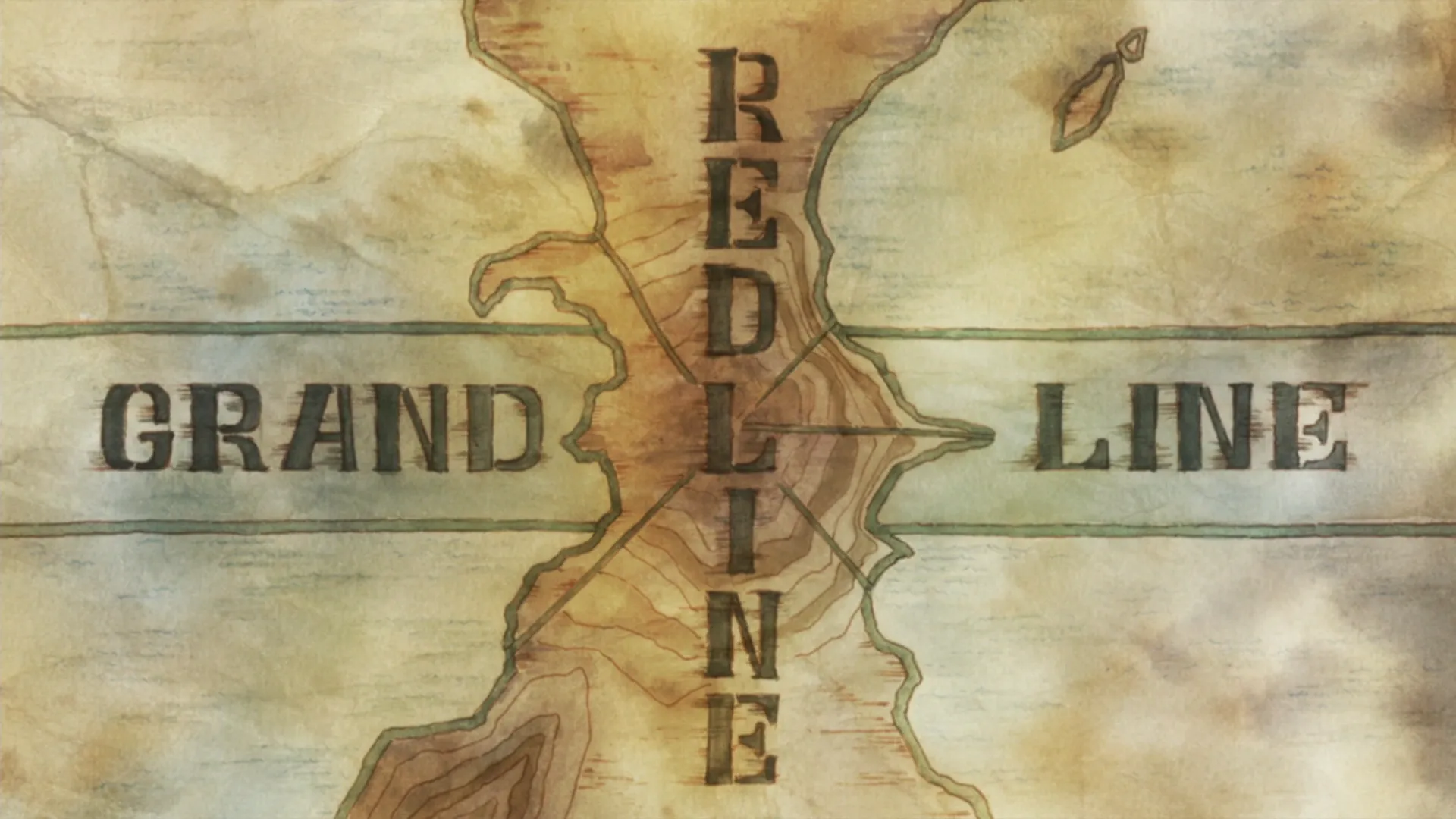
A Log Pose tracks the magnetic routes that guide ordinary travel through the Grand Line. It is not a universal treasure detector. Even a skilled navigator following the standard island chain does not automatically arrive at Laugh Tale. The Road Poneglyph system exists precisely because reaching the final destination requires special information beyond routine navigation.
This makes the distinction between Lodestar Island and Laugh Tale important. Lodestar is associated with the end of the conventional Log Pose journey, while Laugh Tale requires deciphering the red stones. Readers who are mixing up these two destinations can start with how the Grand Line and New World navigation work.
Spoiler-aware takeaway: what is still unknown?
Poneglyphs answer many questions but also preserve deliberate mysteries. The complete account of the Void Century, the full meaning of the ancient civilization's legacy, and the exact consequences of revealing that history should not be reduced to a single unverified fan theory. Even when new chapters disclose important clues, those clues need to be separated from interpretations circulated online.
The most reliable summary is simple. Ordinary Poneglyphs preserve fragments of lost knowledge. Four red Road Poneglyphs provide the special clues needed to locate Laugh Tale. Robin can read the script, the Kozuki family helped create the records, and Oden's translation was crucial to Roger. Together, these facts explain why the stones sit at the center of One Piece's endgame without pretending every remaining secret has already been solved.
Frequently asked questions
Frequently asked questions
What is a Poneglyph in One Piece?
A Poneglyph is a durable ancient stone inscription preserving historical information, instructions or, in the case of red Road Poneglyphs, location clues toward Laugh Tale.
How many Road Poneglyphs are there?
There are four red Road Poneglyphs. Their clues must be considered together to find Laugh Tale.
Can Luffy read Poneglyphs?
No. Nico Robin is the Straw Hat who can decipher the ancient script; Luffy cannot read it himself.
Where is the fourth Road Poneglyph?
Its former association with Fish-Man Island is known, but its later whereabouts are a major mystery in the post-Wano storyline. Treat proposed current locations as theories unless explicitly confirmed.
Can Roger read Poneglyphs?
Roger could perceive unusual voices, but Kozuki Oden read and interpreted the ancient inscriptions for his crew.
What is the difference between a Poneglyph and a Road Poneglyph?
Poneglyph is the broad term for the ancient stone records. Road Poneglyphs are four special red stones that provide clues to Laugh Tale.
Sources & references9 sources
- VIZ: One Piece series and official manga catalog
- VIZ: One Piece Volume 82, Zou and the Road Poneglyph revelation
- Crunchyroll: One Piece Episode 769, A Red Stone! A Guide to the One Piece!
- Crunchyroll: One Piece Episode 770, The Kozuki Family and the Poneglyphs
- Crunchyroll: One Piece Episode 194, I Made It Here!
- VIZ: One Piece Volume 96, Oden and Roger's voyage
- VIZ: One Piece Volume 105, after Wano
- VIZ: One Piece Volume 41, Robin and Enies Lobby
- Official Japanese One Piece franchise website