
The Four Horsemen are among the most important Devils in Chainsaw Man, but Tatsuki Fujimoto introduces them in a way that makes their relationship easy to miss at first. They are not a formal team with matching uniforms or a shared mission. They are four extraordinarily powerful Devils tied to fears that have shaped human civilization for as long as people have fought, starved, ruled one another and died.
The Four Horsemen are Control, War, Famine and Death.
Readers first meet the Control Devil without being told what she truly is. War and Famine become central to Part 2, while Death hangs over the story as the most ominous member of the group. Together, the Horsemen are deeply connected to Chainsaw Man himself, the erased concepts inside Pochita, and the struggle over what humanity's future should look like.
This guide explains each Horseman, what we know about their abilities, how the sisters are connected and why they matter.
Major Chainsaw Man manga spoilers follow.
Who Are the Four Horsemen in Chainsaw Man?
The Four Horsemen are Devils representing four enormous fears:
- Control/Conquest Devil — Makima, later reincarnated as Nayuta
- War Devil — Yoru
- Famine Devil — Fami/Kiga
- Death Devil — the Devil associated with humanity's fear of death
The concept draws on the Four Horsemen of the Apocalypse from the Book of Revelation: conquest, war, famine and death. Fujimoto adapts those ideas into Chainsaw Man's Devil system, where a Devil's existence and strength are connected to humanity's fear of the concept it embodies.
The manga frequently refers to the Horsemen in familial terms, especially as sisters. But being related does not mean they share the same goals. Their relationships are defined as much by conflict and manipulation as cooperation.
1. The Control Devil — Makima and Nayuta
The first Horseman introduced is also the one who dominates Part 1: the Control Devil.
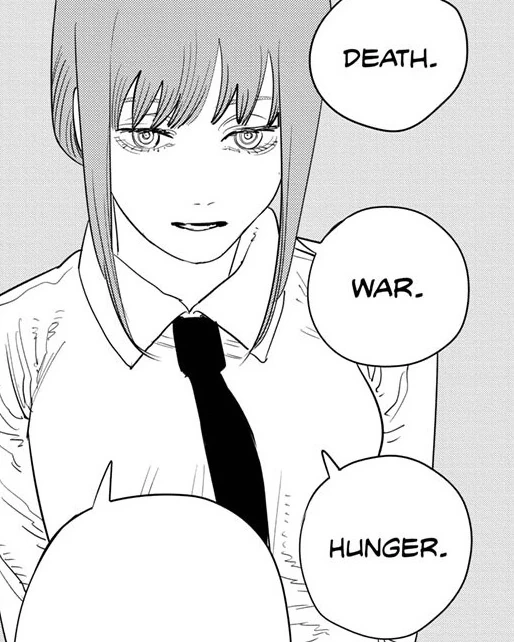
For most of the Public Safety Saga, readers know her simply as Makima.
Makima's entire worldview revolves around hierarchy. Her central ability allows her to control beings she considers beneath herself. That apparently simple condition becomes terrifying because Makima is exceptionally good at creating situations in which she can perceive others as inferior.
She can command humans, Devils, Fiends and hybrids. She can also exploit the abilities of beings under her control, turning her collection of subordinates into an enormous supernatural arsenal.
Makima's real objective is tied to Chainsaw Man's unique ability to erase Devils—and the concepts they represent—from existence by eating them.
She wants to defeat and control Chainsaw Man, then use that power to remove things she considers undesirable from the world.
That dream sounds almost utopian until you recognize the central contradiction: Makima wants to create a better world by giving herself the authority to decide which parts of reality deserve to exist.
Her version of peace is perfect control.
What Happens to Makima?
Denji eventually defeats Makima in a way that bypasses the assumptions underlying her defenses and her contract with Japan's prime minister. He then consumes her.
But killing a Devil does not necessarily erase the concept it embodies. Because Makima is not eaten by Chainsaw Man in the concept-erasing sense, the Control Devil reincarnates.
That reincarnation is Nayuta.
Kishibe entrusts Nayuta to Denji, giving him an opportunity to raise the new Control Devil differently. Pochita had explained that the Control Devil's dream was to form equal relationships, something Makima's nature made almost impossible for her to achieve.
Nayuta therefore represents one of Part 1's most important ideas: a Devil's nature matters, but environment and relationships matter too.
For a deeper look at how Makima's powers interact with bargains and other Devil abilities, AnimeSparks' guide to every major Chainsaw Man Devil contract breaks down the mechanics and costs behind the series' supernatural deals.
2. The War Devil — Yoru
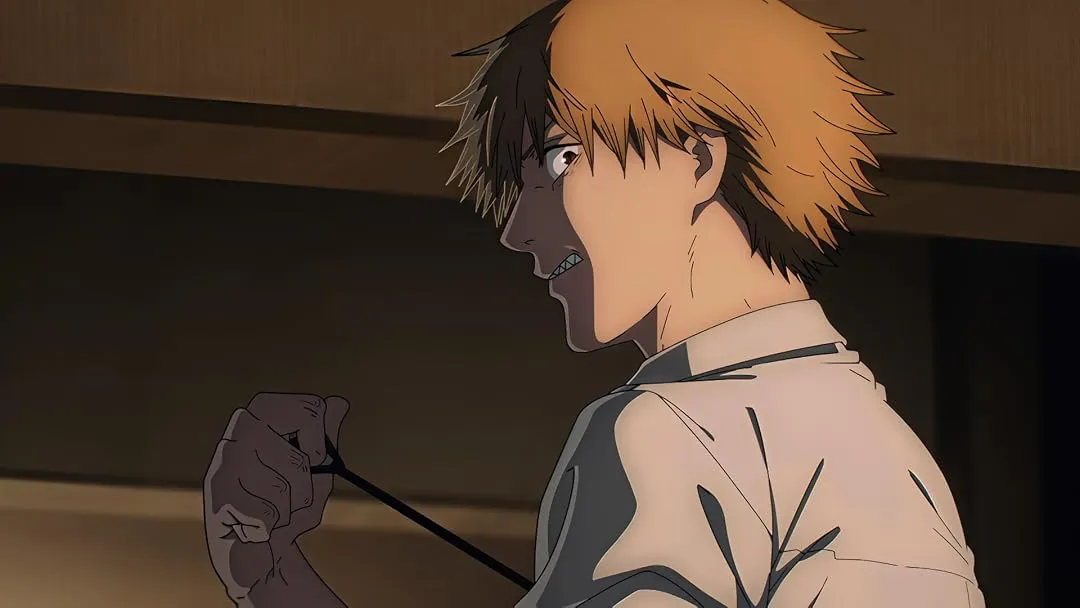
The War Devil, Yoru, becomes one of the defining characters of Chainsaw Man Part 2.
Yoru shares a body with Asa Mitaka, a socially isolated student whose life becomes entangled with the War Devil after a fatal encounter. Their arrangement creates one of Fujimoto's strangest character dynamics: Asa and Yoru can argue internally, fight for control and pursue goals that are not always compatible.
Yoru's core ability reflects the logic of war itself.
She can turn things she considers her property into weapons.
Objects can become weapons, but people can as well. The strength of those weapons is strongly connected to guilt. The more emotionally painful the sacrifice is, the more powerful the resulting weapon can become.
That makes Yoru's ability unusually dependent on relationships. She benefits from ownership and attachment, then weaponizes them.
It is one of the most characteristically Fujimoto power systems in the manga: emotionally cruel, mechanically flexible and inseparable from the character's psychology.
Why Does Yoru Hate Chainsaw Man?
Yoru's grudge against Chainsaw Man is personal and existential.
Chainsaw Man previously fought the Horsemen, and Pochita consumed concepts associated with war. Most importantly, the Nuclear Weapons Devil was eaten and erased.
The disappearance of nuclear weapons weakened the fear of war and, by extension, diminished Yoru.
Her goal is therefore not simply to kill Chainsaw Man. She wants to force him to vomit back up the concepts he erased, restoring weapons and fears that would make War powerful again.
This explains one of Part 2's recurring tensions: Pochita's ability does not merely kill Devils. It can rewrite the conceptual landscape on which other Devils depend.
3. The Famine Devil — Fami
The Famine Devil initially appears under the name Fami. In Japanese she is also associated with the name Kiga, derived from famine.
Fami is calmer and harder to read than Yoru. Where Yoru is openly aggressive and frequently emotional, Fami tends to manipulate circumstances from a distance.
Her power is built around starvation.
Fami can exert control over beings who are starving or deprived, a condition she can exploit by engineering situations that leave targets desperate. Like Makima, she turns an abstract fear into a form of domination—but the mechanism is different.
Control establishes hierarchy. Famine creates need.
Fami's role in Part 2 is especially important because she claims to be working against an approaching catastrophe connected to prophecy and the arrival of overwhelming terror.
But trusting a Horseman because she says she wants to save humanity would be a dangerous mistake in Chainsaw Man.
Fami repeatedly manipulates Asa, Yoru, Denji and other forces for her own plans. Even when her stated objective overlaps with humanity's survival, her methods make it difficult to know whether the future she wants is actually good for the people living in it.
4. The Death Devil — The Most Feared Horseman
The final Horseman is Death.
Of the four concepts, death has the strongest intuitive claim to being universally feared. War can disappear from someone's immediate life. Famine can be distant. A person may even imagine living outside another person's control.
Death is unavoidable.
That is why the Death Devil has long occupied a special position in fan discussions about Chainsaw Man. The fear of death is deeply embedded in many other fears: people fear violence because it can kill them, disease because it can kill them, falling because it can kill them and monsters because they can kill them.
Within the manga's logic, that makes Death an extraordinary conceptual threat.
Part 2 deliberately builds toward the Horseman's importance through prophecy, apocalypse imagery and Fami's plans. Rather than functioning as just another powerful enemy, Death represents the endpoint of the fear system itself.
Is the Death Devil a Primal Fear?
Death is naturally associated with one of humanity's oldest fears, which is why readers often connect the Death Devil with the Primal Fears.
Primal Fear Devils embody terrors so fundamental that humanity has feared them instinctively across history. Darkness and Falling demonstrate how absurdly powerful that class can be.
The important point is that “Horseman” and “Primal Fear” describe different kinds of categorization. Horseman identifies Death's place among the apocalypse-inspired sisters, while primal status concerns the nature and depth of the fear represented.
Whatever label is emphasized, Death's narrative position makes clear that ordinary Devil standards are not enough to describe the threat.
Why Are the Four Horsemen So Powerful?
In Chainsaw Man, Devils become stronger through fear.
The Horsemen represent concepts with enormous historical and psychological weight. Human societies have always confronted conflict, hunger, domination and mortality.
But their strength is not merely a matter of how scary their names sound.
Each Horseman's ability expresses her concept in a flexible way:
Control turns perceived inferiority into obedience. War turns ownership and guilt into weapons. Famine exploits starvation and deprivation. Death represents the fear underlying mortality itself.
That flexibility is why Horsemen can be more dangerous than Devils with apparently straightforward destructive powers. Their abilities operate through relationships, conditions and ideas.
Are the Four Horsemen Sisters?
Yes, the manga frames the Horsemen as sisters, although this should not be interpreted like an ordinary human family.
Yoru and Fami recognize one another, and the Horsemen share history surrounding Chainsaw Man. Their familial terminology communicates that they belong to a distinct connected group of Devils.
Their personalities, however, could hardly be more different.
Makima seeks an ordered world she can control. Yoru wants to restore War's lost strength and settle her score with Chainsaw Man. Fami operates through long-term schemes. Death occupies the catastrophic endpoint around which much of Part 2's tension gathers.
They are a family in mythology and Devil taxonomy—not a stable alliance.
Did the Four Horsemen Fight Chainsaw Man Before the Story?
Yes. One of the most important pieces of Pochita's history is his battle against the Four Horsemen and the Weapon Devils in Hell.
Chainsaw Man disappeared during that conflict and later ended up on Earth in the weakened dog-like form Denji encounters at the beginning of the story.
That battle helps explain why the Horsemen are so interested in him.
Pochita is not merely another strong Devil. His ability to erase concepts threatens the foundations of their identities and power.
For War, this is explicit: Chainsaw Man consumed concepts that weakened her. For Control, Pochita's erasure ability represented the tool Makima wanted to use to construct her ideal reality.
The Horsemen's relationship with Chainsaw Man is therefore simultaneously personal, strategic and existential.
Why Can the Horsemen Remember Devils Chainsaw Man Erased?
One of the strangest aspects of the Horsemen is their connection to erased concepts.
When Chainsaw Man eats certain Devils, humanity can lose not only the Devil but the very concept associated with it. History and memory adjust around the absence.
Yet powerful beings such as Makima demonstrate awareness of concepts that have disappeared, including things ordinary humans no longer remember.
This gives the Horsemen a perspective on reality that most characters do not possess. They can understand that the current world is not necessarily the only version of reality that has existed.
That fact makes Pochita terrifying even to beings of their level. If Chainsaw Man can erase something as fundamental as a feared concept, then no Horseman's place in reality is completely secure.
Are Makima and Nayuta the Same Person?
No.
Makima and Nayuta are different incarnations of the same Devil, the Control Devil.
Devils cycle between Earth and Hell when killed. They generally do not return as the exact same individual with an intact human-style life history.
Nayuta therefore inherits the Control Devil's fundamental nature and abilities, but she is not simply Makima resurrected with a younger body.
That distinction is essential to Denji's decision to raise her. If Nayuta were inevitably destined to become Makima again, there would be little point in giving her a different childhood.
Instead, the story asks whether affection and equality can produce a different Control Devil.
Are Asa and Yoru the Same Person?
No. Asa Mitaka and Yoru are separate consciousnesses sharing one body.
Yoru took over Asa's body under unusual circumstances and can assume control, while Asa continues to think, feel and make decisions of her own.
Their relationship becomes increasingly complicated because Yoru's weapon ability depends on ownership and guilt, while Asa is exactly the kind of person who forms intense, painful attachments.
That makes their partnership more than a convenient supernatural setup. Asa's emotional life directly affects the War Devil's capacity for violence.
Which Four Horseman Is the Strongest?
The safest answer is Death.
Makima was enormously dangerous because of her planning, contracts and ability to control powerful beings. Yoru's ceiling rises dramatically when war becomes more feared and when she can create sufficiently powerful weapons. Fami's schemes demonstrate enormous reach.
But death is the most universal concept represented by the group.
That does not mean every fight in Chainsaw Man can be solved by ranking abstract fear levels. Fujimoto constantly introduces conditions, contracts and strange interactions that make matchups unpredictable. Still, if the question is which Horseman should possess the greatest natural fear-based foundation, Death is the obvious candidate.
Four Horsemen vs. Primal Fears: What Is the Difference?
The Four Horsemen and Primal Fears are not interchangeable categories.
The Four Horsemen are a specific group based on Control/Conquest, War, Famine and Death.
Primal Fears are Devils representing instinctive fears embedded deeply enough in humanity that their power exists on another level. Darkness and Falling are prominent examples.
A Devil's category tells us something about its concept, but Chainsaw Man does not operate like a rigid RPG class system. The truly important questions are how feared a concept currently is, what conditions its ability requires and how Fujimoto chooses to exploit that ability in the story.
Why the Four Horsemen Matter to Chainsaw Man's Bigger Story
The Horsemen connect Part 1 and Part 2 more tightly than almost any other element.
Part 1 appears, for much of its runtime, to be Denji's tragic relationship with Makima. Only later do we understand that Makima belongs to a much larger mythology surrounding Pochita.
Part 2 expands that mythology.
War enters Denji's world through Asa. Famine manipulates events from the background. Death becomes central to the apocalyptic threat hanging over the story. Meanwhile, the Control Devil's legacy remains inseparable from Denji's personal life.
The result is that the Four Horsemen are not four bosses waiting in sequence.
They represent four different answers to the same question: what happens when a fear becomes powerful enough to shape the world rather than merely threaten the people inside it?
That is also why the Horsemen fit so naturally beside the series' Devil-contract system. If you want to understand how bargains, prices and borrowed Devil abilities work around these larger forces, read our Chainsaw Man Devil Contracts explained. For a broader look at why the series deliberately feels so emotionally hostile and unstable, our Chainsaw Man review explores Fujimoto's approach to violence, emptiness and character psychology.
Final Answer: Who Are Chainsaw Man's Four Horsemen?
The Four Horsemen are Control, War, Famine and Death, four extraordinarily important Devils modeled on the Horsemen of the Apocalypse.
Control first appears as Makima and later reincarnates as Nayuta. War is Yoru, who shares Asa Mitaka's body and can turn what she owns into weapons. Famine is Fami, a manipulator whose powers and plans revolve around deprivation and starvation. Death represents the fear of death and occupies the most ominous position among the sisters.
All four are connected to Chainsaw Man because Pochita's concept-erasing ability can alter the world they inhabit—and has already erased things that affected their power.
That is what makes the Horsemen bigger than a collection of strong Devils. They sit at the intersection of Chainsaw Man's mythology, Denji's personal tragedy and the question underlying the entire Devil system: if fear determines what becomes powerful, what happens when the most fundamental fears begin fighting over reality itself?
Frequently asked questions
Frequently asked questions
Who are the Four Horsemen in Chainsaw Man?
The Four Horsemen are the Control/Conquest Devil, War Devil, Famine Devil and Death Devil. Major incarnations include Makima and Nayuta for Control, Yoru for War and Fami for Famine.
Is Makima one of the Four Horsemen?
Yes. Makima is the Control Devil, one of Chainsaw Man's Four Horsemen. After her death, the Control Devil reincarnates as Nayuta.
Is Yoru one of the Four Horsemen?
Yes. Yoru is the War Devil and one of the Four Horsemen. She shares a body with Asa Mitaka and wants Chainsaw Man to restore concepts he previously erased, including nuclear weapons.
Who is the strongest Four Horseman in Chainsaw Man?
Death has the strongest natural claim because fear of death is exceptionally fundamental and widespread. However, Chainsaw Man battles depend heavily on ability conditions, contracts and changing levels of fear, so raw conceptual strength does not guarantee every matchup.
Are the Four Horsemen Primal Fears?
Four Horsemen and Primal Fears are different classifications. The Horsemen are Control, War, Famine and Death, while Primal Fears represent instinctive fears such as Darkness and Falling. Death's relationship to primal fear is especially important, but the categories themselves should not be treated as synonyms.
Why do the Four Horsemen care about Chainsaw Man?
Pochita can erase Devils and their associated concepts by eating them. He previously fought the Horsemen and erased concepts that affected them, making Chainsaw Man both a threat and a potential tool for reshaping reality.