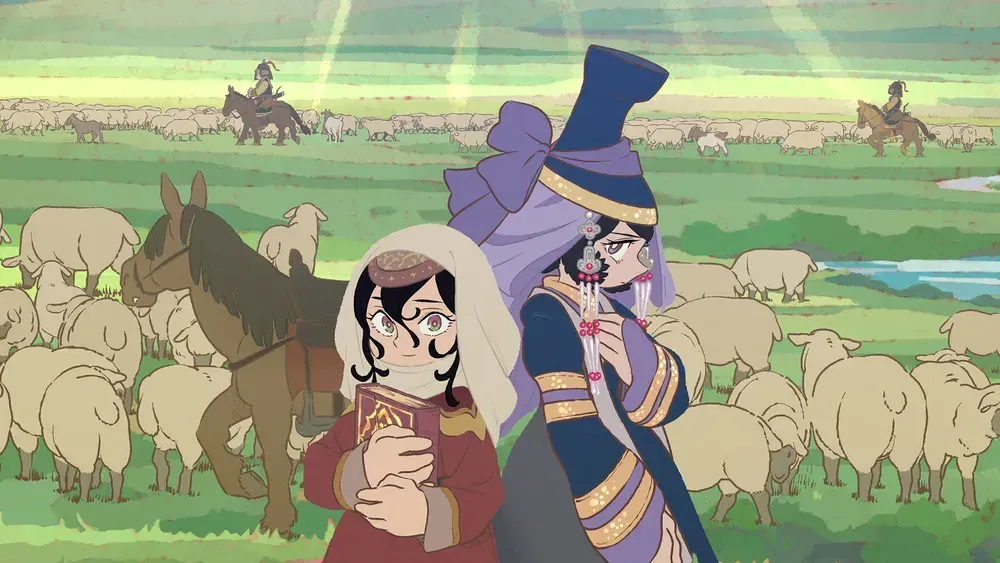

Jaadugar: A Witch in Mongolia introduces itself with the language of witchcraft, but its central character does not command spirits, cast spells, or possess a supernatural gift. Sitara’s power is knowledge: the ability to learn, remember, interpret, and apply what others overlook.
That distinction is the foundation of the series. Set against the violence and political expansion of the 13th-century Mongol Empire, Jaadugar treats knowledge not as a comforting ideal but as a dangerous form of leverage. Books can be stolen. Scholars can be killed. Medical understanding can save a life, alter a negotiation, or make an enslaved girl useful to people who would otherwise ignore her existence.
The anime’s most compelling idea is therefore not that intelligence can overcome strength. It is that intelligence becomes strength only when someone understands the system in which it must operate.
Sitara’s Education Is a Survival System
Sitara begins from a position of extreme vulnerability. She loses her mother, is displaced from her homeland, and enters a world in which her future is determined by people with greater wealth, status, and physical power. When she is taken in by a scholarly household, learning gives her more than information. It gives her a method for understanding an unstable world.
This matters because Jaadugar does not present education as a montage that transforms Sitara into an effortless prodigy. Knowledge is accumulated through relationships, discipline, observation, and loss. What she learns is inseparable from the people who teach her and the circumstances in which those lessons become necessary.
Medical technique, language, mathematics, and natural philosophy all have practical value, but their deeper importance is psychological. They teach Sitara that reality can be examined. Even when violence appears arbitrary, its causes, motives, and consequences can be studied.
That outlook becomes a form of resistance. Empires rely not only on armies but also on the belief that their power is total and incomprehensible. Sitara survives by refusing that belief. She watches, identifies patterns, and searches for the pressure points hidden inside apparently absolute authority.
The Series Rejects the Fantasy of Neutral Knowledge
Many stories treat knowledge as morally pure: the more a character learns, the closer they move toward truth and justice. Jaadugar is more cautious. Information has no automatic moral direction. The same knowledge can heal a patient, strengthen an army, improve administration, or help one faction destroy another.
That ambiguity is essential to Sitara’s journey. Her intelligence does not place her outside politics. It draws her deeper into them.
A person who understands medicine becomes valuable to rulers. A person who can read multiple languages becomes valuable to diplomats and conquerors. A person who remembers the customs, rivalries, and ambitions of a court becomes valuable to anyone seeking influence. Sitara’s abilities increase her agency, but they also make her visible to more powerful people.
Visibility is dangerous for someone without formal status. Every demonstration of competence can create an opportunity, but it can also create suspicion. The title “witch” captures this double edge. It describes the fear produced when a woman’s understanding exceeds the categories available to those around her.
Töregene Turns Knowledge Into Political Force
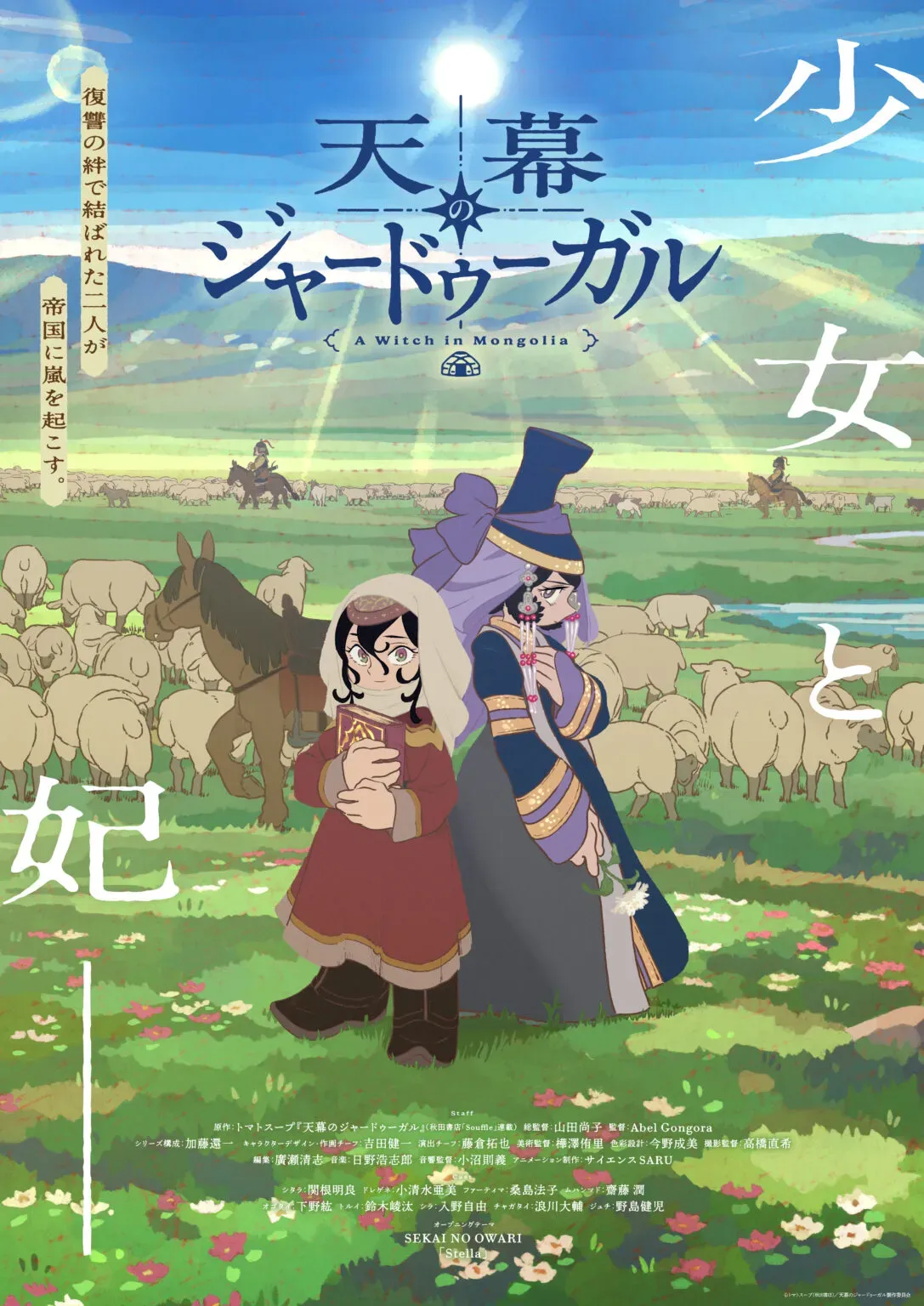
Sitara’s eventual relationship with Töregene is what allows Jaadugar to move from a survival narrative into a political one. Sitara has information and analytical ability. Töregene has proximity to imperial power, experience within the court, and a deep understanding of resentment.
Their alliance is not important merely because two women oppose a male-dominated empire. It matters because each possesses what the other lacks.
Sitara can recognize possibilities that court politics has trained others to ignore. Töregene understands that a correct idea is useless unless it can be introduced at the right time, through the right person, for a purpose that powerful figures are willing to accept.
This is the series’ clearest argument about political intelligence. Knowing what should happen is different from knowing how to make it happen.
Töregene also complicates the idea of empowerment. Her position gives her influence, but it does not free her from the imperial structure. She has been shaped and wounded by the same institution she learns to manipulate. Her power is real, yet conditional. She must operate through marriage, succession, alliances, and access rather than direct command.
Sitara and Töregene therefore do not stand outside the empire as uncomplicated rebels. They move within it, using its contradictions against itself.
Science SARU Makes Thought Visually Dramatic
Jaadugar is produced by Science SARU, with Naoko Yamada serving as executive director, Abel Góngora as director, Kenichi Yoshida as character designer and animation chief, Kanichi Kato handling series composition, and Koshiro Hino composing the music.
That creative team is especially well suited to a story in which observation matters as much as action. The challenge of adapting Jaadugar is not simply depicting battles, journeys, and imperial spaces. It is making the process of thinking visually legible.
A historical drama built around intelligence can easily become static if every important development is delivered through explanation. Animation offers other tools: a delayed reaction, an object held in frame, a shift in posture, a glance between characters who understand more than they can safely say.
Naoko Yamada’s work has long emphasized physical detail and emotional implication. Jaadugar benefits from that sensitivity because Sitara’s position often requires restraint. She cannot always speak openly. Her intelligence must be visible in how she listens, what she notices, and when she decides to act.
The series’ landscapes also serve an intellectual purpose. The vastness of the Mongolian steppe is not only scenic. It establishes the scale of the political world Sitara has entered. Individual lives appear small against that geography, yet the story insists that decisions made by individuals can still redirect history.
History Is a Structure, Not Just a Backdrop
Historical anime often uses the past as an aesthetic package: architecture, costumes, weapons, and famous names create atmosphere while the characters behave according to modern genre conventions. Jaadugar takes a more demanding approach.
Its setting determines what kinds of power are available.
Sitara’s gender, enslavement, ethnicity, education, and social position are not decorative character details. They shape where she can go, who will listen to her, and what price she may pay for being noticed. Likewise, the Mongol Empire is not simply a large enemy force. It is a political system containing military expansion, family rivalry, administration, trade, law, and competing visions of rule.
This structural approach makes the story more than a revenge drama. Revenge gives Sitara and Töregene emotional direction, but history creates the limits within which that desire must operate.
The result is a more unsettling kind of conflict. There may be no single enemy whose defeat repairs the world. Political systems survive through institutions, incentives, and succession. To challenge an empire, the protagonists must understand not only who holds power but how power reproduces itself.
Why Medicine Matters So Much
Medicine is one of the clearest examples of knowledge becoming power in Jaadugar. It exists at the intersection of science, trust, vulnerability, and access.
A ruler may command thousands of soldiers but still become helpless before illness. A court may dismiss an enslaved girl until she possesses information that no one else can provide. Medical knowledge temporarily rearranges hierarchy because the body does not respect political rank.
Yet that rearrangement is never permanent. Saving an important person may earn protection, but it may also bind the healer to the interests of the powerful. Expertise can open a door without determining what waits on the other side.
Jaadugar understands that this is what makes knowledge politically dangerous. It reveals dependence. The powerful prefer to appear self-sufficient, but every empire relies on translators, physicians, administrators, craftspeople, messengers, and scholars. Sitara’s intelligence exposes the hidden labor beneath imperial grandeur.
The Meaning of “Witch”
The word “witch” suggests a woman whose abilities are interpreted as unnatural because society cannot comfortably explain or control them. In Jaadugar, that label becomes a political description rather than a supernatural one.
Sitara’s knowledge appears magical to people who do not understand its origins. More importantly, it threatens people who benefit from limiting who is allowed to know.
Calling an intelligent woman a witch can be a way of converting expertise into suspicion. It isolates her, makes her achievements seem illegitimate, and allows authority to treat her as a danger rather than a participant in public life.
But the title also carries defiance. Sitara’s “witchcraft” is the accumulated result of teaching, memory, curiosity, and disciplined thought. What looks mysterious is often simply knowledge denied to most people.
The anime’s title therefore contains its central conflict. The world sees a witch. The audience sees the education, trauma, and labor that produced her abilities.
Jaadugar’s Most Important Question
Jaadugar: A Witch in Mongolia is not asking whether knowledge is stronger than violence in a simple contest. Violence can burn libraries, destroy cities, and kill the people who carry irreplaceable understanding.
The more difficult question is whether knowledge can survive violence long enough to reshape the systems that produced it.
Sitara’s strength lies in preservation and application. She carries lessons forward after the world in which she learned them has been shattered. Every time she uses that knowledge, she prevents destruction from having the final word.
That does not make her invincible. It makes her historically consequential.
Jaadugar stands out because it understands intelligence as more than a character trait. Knowledge is memory, inheritance, labor, and political risk. It can save a life, expose a weakness, create an alliance, or turn a marginalized person into someone an empire cannot afford to ignore.
In a conventional fantasy, a witch changes the world through magic. Sitara’s achievement is more radical: she learns how the world works, then uses that understanding to make change possible.
Frequently asked questions
Frequently asked questions
What is Jaadugar: A Witch in Mongolia about?
The anime follows Sitara, a displaced girl from 13th-century Persia whose education and medical knowledge draw her into the politics of the Mongol Empire and an alliance with Töregene.
Does Jaadugar contain real magic?
Its central idea of witchcraft is primarily metaphorical. Sitara’s apparent power comes from education, medicine, observation, and political intelligence rather than conventional supernatural abilities.
Who produces the Jaadugar anime?
Science SARU produces the series. Naoko Yamada serves as executive director and Abel Góngora as director.
Who created the original Jaadugar manga?
The manga was written and illustrated by Tomato Soup and is published in English under the title A Witch’s Life in Mongol.
Where is Jaadugar set?
The story moves from 13th-century Persia into the Mongol Empire, where Sitara becomes involved in imperial court politics.
Sources & references6 sources
- Jaadugar: A Witch in Mongolia Official Website — Introduction
- Jaadugar: A Witch in Mongolia Official Website — Story
- Jaadugar: A Witch in Mongolia Official Website — Staff and Cast
- Science SARU — Jaadugar: A Witch in Mongolia
- Jaadugar Official News — Main Visual and Second Main PV
- Crunchyroll News — Jaadugar Trailer and Cast Additions