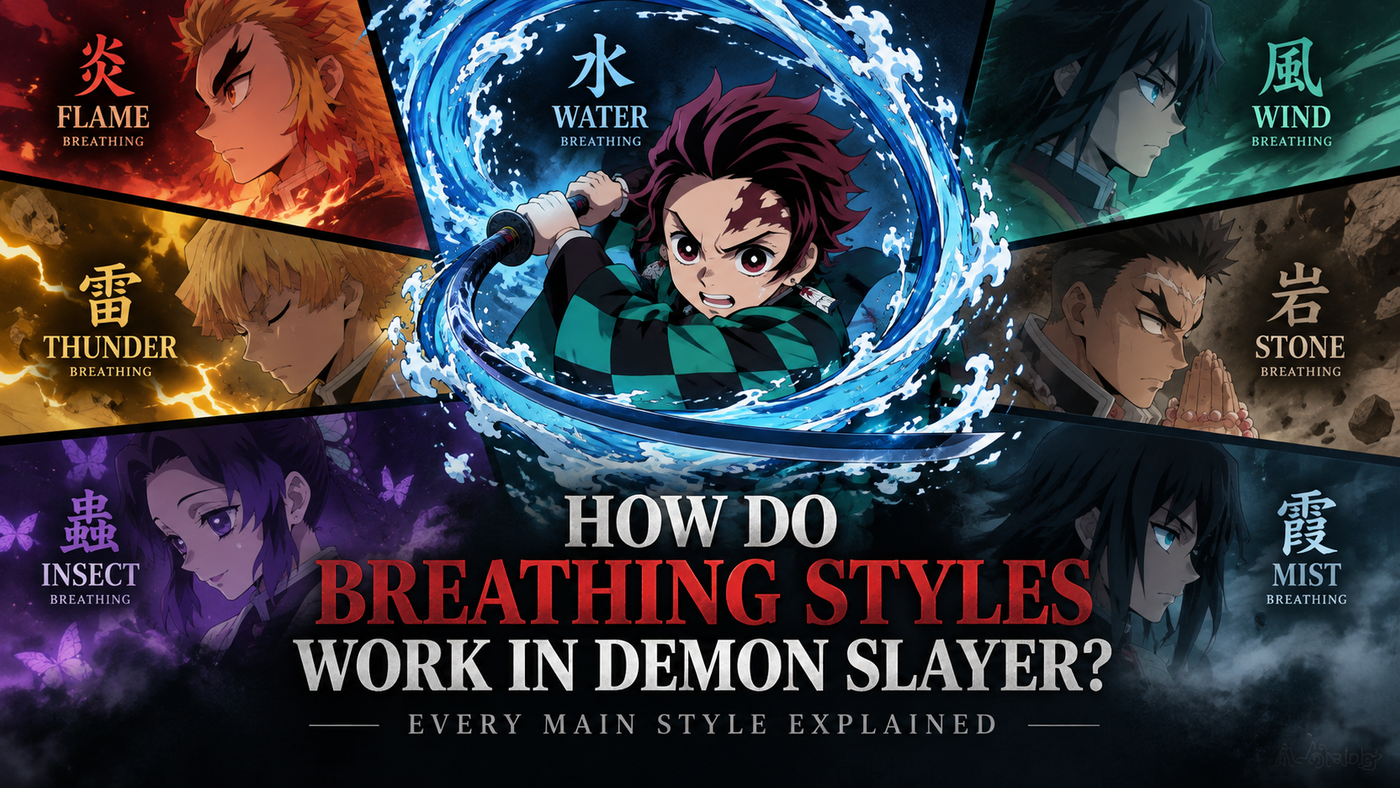
How Do Breathing Styles Work in Demon Slayer? Every Main Style Explained
Rushabh Bhosale
Updated
Breathing Styles are the foundation of Demon Slayer’s combat system, but they are easy to misunderstand because the anime makes every sword strike look almost supernatural. Water curls around Tanjiro’s blade, Zenitsu attacks through flashes of lightning, and Rengoku’s swordsmanship appears to erupt in flame. Yet Demon Slayers are not conventional elemental mages.
At their core, Breathing Styles combine Total Concentration Breathing with specialized swordsmanship. Controlled breathing lets a trained swordsman push physical performance far beyond an ordinary human, while each style organizes that power around a distinct pattern of movement, timing and attack. The result is a system where technique matters as much as raw strength.
How do Breathing Styles work in Demon Slayer?
A Demon Slayer first learns to control breathing deeply enough to improve oxygen intake and circulation. Total Concentration Breathing is used to sharpen the body’s performance, increasing the strength, speed, stamina, reactions and focus needed to fight demons whose natural physical abilities exceed those of normal humans.
That does not make every swordsman equally powerful. Breathing is a method, not a fixed stat boost. Training, physique, experience, sword skill and compatibility with a style all matter. This is why two people using related techniques can fight in completely different ways.
The named Forms are repeatable combat techniques built around those principles. A Water Breathing form emphasizes fluid transitions and adaptable movement. Thunder Breathing turns explosive acceleration into decisive attacks. Stone Breathing is suited to immense physical power. The visual identity reflects the swordsmanship rather than replacing it.
Are the elemental effects actually real?
The safest way to understand the effects is that Breathing Styles do not literally generate ordinary elements. Tanjiro cannot create drinking water with Water Breathing, and Flame Breathing is not a substitute for a fire. The effects express how the sword technique looks and feels rather than functioning as elemental sorcery.
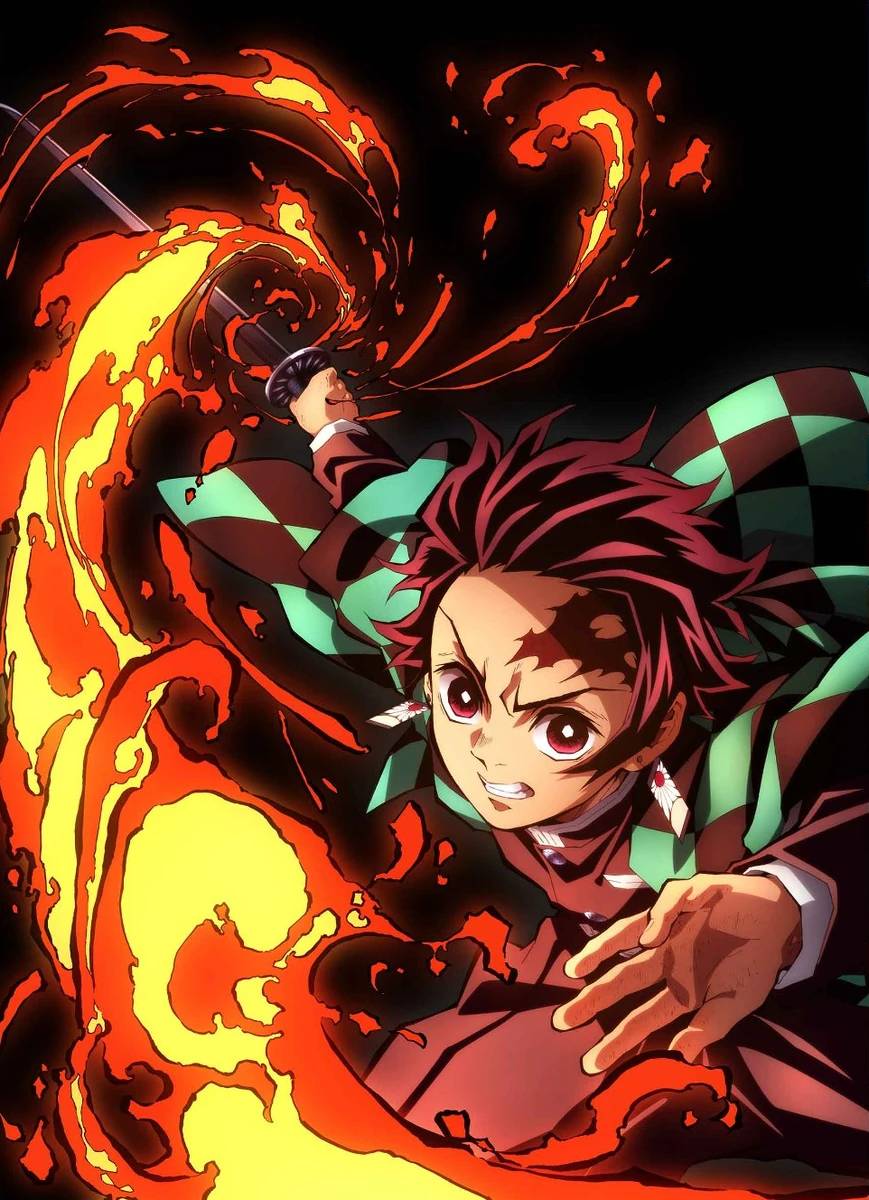
That distinction explains why the anime can depict enormous waves, flames or lightning without turning Demon Slayers into spellcasters. The series deliberately exaggerates the sensation and identity of the swordsmanship. What matters physically is the user’s movement, Nichirin weapon and the superhuman performance enabled by breathing.
Sun Breathing is where the system begins
Sun Breathing is the original Breathing Style associated with Yoriichi Tsugikuni. The major foundational styles developed because other swordsmen could not simply reproduce Yoriichi’s method at his level. Instead, they adapted the underlying idea to bodies and fighting styles that suited them better.
This is one of the most important ideas in Demon Slayer’s power system: adaptation is not failure. A style becomes effective when it fits the person using it. Later generations continue that process, producing branches and even highly personal techniques.
The five major styles derived from Sun Breathing
Water Breathing
Water Breathing is one of the most adaptable styles and is the first system Tanjiro formally learns. Its movements emphasize fluidity and the ability to transition between attacks. Giyu Tomioka demonstrates how far the style can be refined, including a form he developed himself.
Flame Breathing
Flame Breathing favors forceful, committed sword attacks and is most closely associated in the anime with Kyojuro Rengoku. Its direct style suits a fighter willing to meet danger head-on rather than relying on deception.
Thunder Breathing
Thunder Breathing emphasizes explosive speed. Zenitsu Agatsuma is unusual because his greatest strength comes from obsessively refining the First Form rather than mastering the entire style. His fighting style is a good example of Demon Slayer rewarding specialization instead of treating a larger move list as automatically superior.
Wind Breathing
Wind Breathing uses aggressive, sweeping attacks that fit Sanemi Shinazugawa’s relentless combat style. The techniques feel violent and difficult to contain, matching a swordsman who constantly presses opponents instead of giving them room to recover.
Stone Breathing
Stone Breathing is associated with Gyomei Himejima and is built around extraordinary physical capability. Gyomei’s unusual weapon set also shows that a Breathing Style is broader than a collection of standard katana swings. Weapon choice and personal attributes can reshape how the underlying principles are expressed.
Why are there so many other Breathing Styles?
The family tree keeps branching because Demon Slayers modify existing systems to fit their own bodies and talents. Flower and Serpent Breathing develop from Water, while Insect Breathing adapts further around Shinobu Kocho’s speed, precision and poison-based fighting method. Love Breathing grows from Flame Breathing but is tailored to Mitsuri Kanroji’s unusual flexibility and physical constitution.
Inosuke takes the idea even further with the self-developed Beast Breathing. His techniques depend heavily on instinct, flexibility and heightened senses. Demon Slayer therefore treats Breathing as a living martial tradition: strong fighters inherit ideas, modify them and sometimes create something new.
Total Concentration Constant is a major training milestone
Using Total Concentration during an attack is only part of the challenge. Tanjiro’s training later focuses on maintaining the breathing method continuously, including during ordinary activity and sleep. That turns a temporary combat technique into a new physical baseline.
This helps explain the enormous gap between inexperienced Corps members and elite swordsmen. The strongest Slayers are not simply activating a special move when a demon appears. Their bodies have been conditioned around the breathing discipline itself.
Breathing Styles are only one layer of a Demon Slayer’s strength
Breathing does not explain every late-series power increase. The Demon Slayer Mark is a separate phenomenon that can dramatically enhance an already skilled fighter, while other advanced states push perception and weapon performance further.
That distinction matters when comparing characters. Knowing a particular Breathing Style does not automatically place someone above a user of another style. The swordsman’s mastery, physical traits, experience and access to advanced abilities can matter more than the style’s name.
Is Sun Breathing automatically the strongest?
Sun Breathing has the greatest historical importance and originates with Yoriichi, the benchmark against which Demon Slayer’s swordsmen are measured. But the series does not reduce every fight to a simple style ranking. A technique that perfectly fits its user can be more useful than attempting to imitate a system the fighter cannot properly perform.
Tanjiro’s own progression makes that clear. His journey is not about collecting styles like upgrades. It is about understanding his body, inherited knowledge and the differences between techniques well enough to fight more efficiently.
Why Demon Slayer’s Breathing system works so well
Breathing Styles give Demon Slayer spectacular visual combat without removing the vulnerability of its human fighters. Demons possess regeneration and supernatural Blood Demon Arts. Slayers answer with discipline, specialized weapons, physical conditioning and techniques refined across generations.
That is the key to understanding Demon Slayer Breathing Styles. They are not simply water magic, fire magic or lightning magic with swords. They are individualized martial systems built on Total Concentration Breathing, and their branching history reflects one of the series’ central ideas: humans survive impossible battles by adapting what they inherit to the strengths they actually have.
Tags
Sources
Frequently Asked Questions
What is the strongest Breathing Style in Demon Slayer?
Sun Breathing is the original Breathing Style and the foundation from which the major styles developed. It is uniquely important to the series because of Yoriichi Tsugikuni and Tanjiro's Hinokami Kagura.
Are the water, fire and lightning in Breathing Styles real?
Breathing Styles do not function like elemental magic that creates usable water, fire or lightning. The effects communicate the character and movement of the sword technique, while the physical damage comes from the swordsman and Nichirin blade.
Is Hinokami Kagura the same as Sun Breathing?
The story eventually connects the Kamado family's Hinokami Kagura directly to the preservation of Sun Breathing.
Next up
Chainsaw Man’s Four Horsemen Explained: Who Are They?
Who are the Four Horsemen in Chainsaw Man? Control, War, Famine and Death explained, including Makima, Nayuta, Yoru, Fami, their powers and Pochita connection.