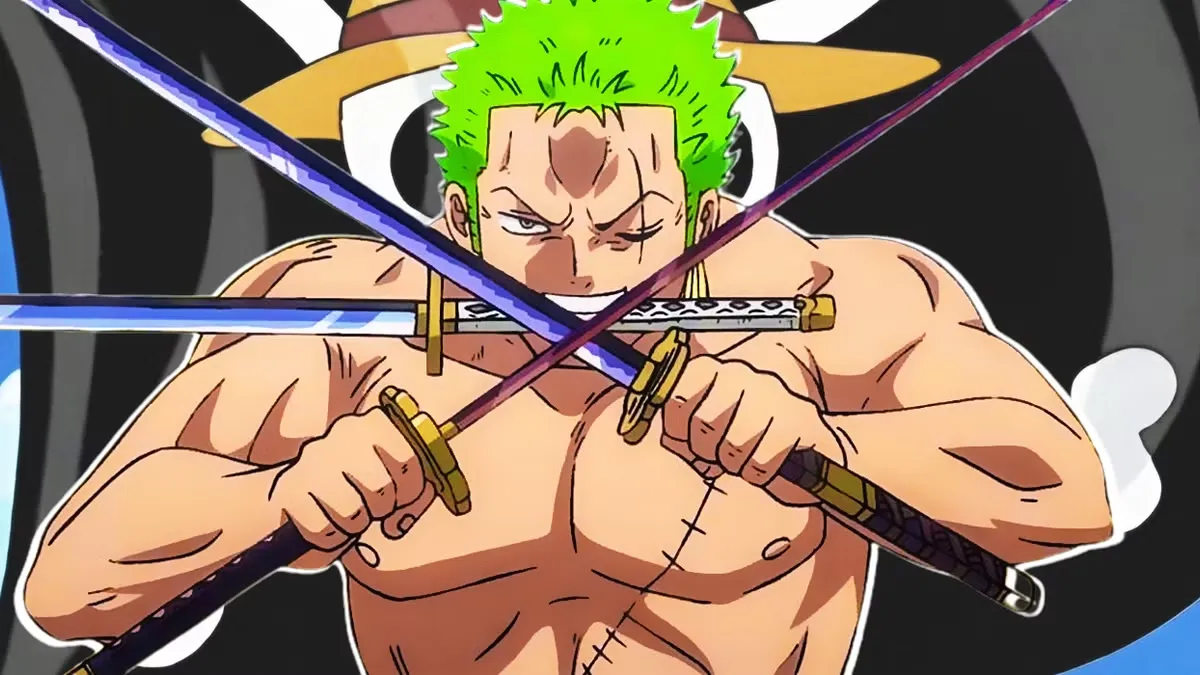

Zoro uses three swords in One Piece because his signature fighting style, Santoryu, is tied to his ambition to become the world's greatest swordsman and the promise he made to his childhood rival Kuina. After her death, he inherited her sword, Wado Ichimonji. His unusual style uses a sword in each hand and another in his mouth. It is both a recognizable fictional fighting technique and a reminder of the dream he carries.
This explanation contains spoilers for Zoro's childhood and the early East Blue saga, with a brief reference to his later swords.
How Kuina shaped Zoro's three-sword style
Before joining Luffy, Zoro trained at a dojo in Shimotsuki Village. He was determined to improve, but Kuina repeatedly defeated him. Their rivalry mattered because she was not merely another obstacle on his way to becoming stronger. She wanted the same title that he did, and she understood the ambition behind his training.
Kuina worried that expectations about women would prevent her from reaching the top. Zoro rejected the idea that their rivalry should be decided by anything other than their abilities. They agreed that one of them would eventually become the greatest swordsman. When Kuina died unexpectedly, their competition ended without either having achieved that goal.
Zoro received her sword from her father and continued pursuing their shared ambition. The manga establishes this history in chapter 5, while the anime revisits it in episode 19. Crunchyroll's licensed episode listing explicitly connects the history of his three-sword style to their vow.
What is the sword Zoro holds in his mouth?
The sword most closely associated with that position is Wado Ichimonji, the blade that belonged to Kuina. Its white appearance also makes it easy to recognize among Zoro's changing collection of swords. The official One Piece website identifies Wado Ichimonji as the mouth-held sword in its description of a licensed three-sword set featuring Enma and Sandai Kitetsu.
The emotional significance of Wado Ichimonji is more important than its appearance. Other swords can be replaced as Zoro encounters new challenges, but this one connects his present adventures to his childhood. It makes his promise visible even during scenes in which nobody mentions Kuina.
Does using three swords automatically make Zoro stronger?
No. One Piece does not establish a universal rule that a swordsman becomes stronger simply by carrying more blades. Zoro's ability comes from his own training and the fictional techniques he has developed. His signature style is an expression of that ability rather than a shortcut to it.
His confrontation with Dracule Mihawk during the Baratie arc illustrates the distinction particularly well. Mihawk demonstrates that a vastly more experienced swordsman can overcome Zoro regardless of the number of weapons he carries. The encounter forces Zoro to confront the enormous gap between his ambition and his current skill.
Zoro also uses techniques involving fewer than three swords. Santoryu is his trademark, not a restriction that prevents him from fighting in other ways. The number of blades alone is therefore a poor measure of his strength in any particular encounter.
Why the third sword matters to the story
There is a compelling symbolic reading of Zoro's style: two swords represent his own training, while the additional blade represents the dream he inherited from Kuina. That interpretation fits his backstory, but it should not be confused with a formal supernatural rule. The manga does not require readers to believe that Kuina's spirit literally powers every attack.
The distinction is important because Zoro's promise is about responsibility rather than magical assistance. His rival never gets the chance to discover how far she could have gone. Every milestone he reaches consequently has a second meaning beyond personal achievement.
One Piece uses similar emotional connections elsewhere in the crew. Luffy's childhood, for example, explains why his ambition is inseparable from the people who inspired him. These early memories give the Straw Hats reasons to continue when their goals seem impossibly distant.
Where to watch Zoro's backstory
If you want to revisit the origin without searching through hundreds of episodes, start with episode 19 of the original One Piece anime. Manga readers can find the early account in chapter 5 of the first volume. The Baratie confrontation with Mihawk is a useful follow-up because it shows how seriously Zoro takes his promise when faced with a superior opponent.
Ultimately, the three-sword style works because it combines a distinctive character design with a personal history. Zoro does not need to explain his childhood every time he appears. The sword he carries from Kuina already tells part of that story.