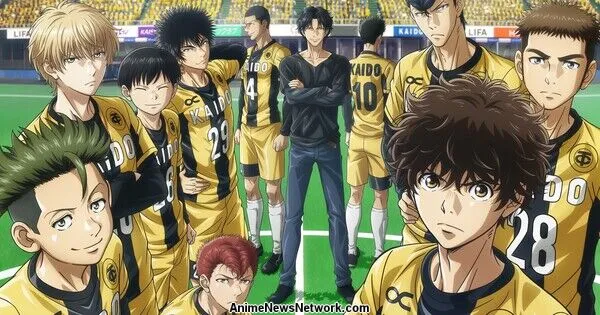

With Aoashi Season 2 back on television since October 4, 2026, the old Blue Lock vs Aoashi argument has fresh relevance: which soccer anime actually understands the sport better? On realistic coaching, positioning and the work of a youth academy, Aoashi wins. On the psychology of a striker, instant tension and turning each possession into a contest of nerve, Blue Lock is more gripping. Neither verdict makes the other show a failure. They are built to make viewers watch different parts of the same pitch.
The timing matters. Crunchyroll's March announcement confirmed that Aoashi's new season follows Ashito in Esperion's A-team, and the official broadcast page lists its October 2026 return. Blue Lock's next anime installment is instead the announced NEO EGOIST LEAGUE season, with no release date provided in its June 8 update. This is a comparison of their storytelling, not a claim that both are airing new episodes this week.
The comparison only works if we define the rules
We are judging five things: the credibility of the training environment, the use of actual team tactics, how each protagonist improves, the tension of its matches, and the value to someone who wants to understand soccer. That is different from asking which manga sells more copies or which character would score in an imaginary crossover. Popularity cannot decide whether a defensive rotation makes sense; realism cannot decide which cliffhanger is more exciting.
There is also a spoiler boundary. The comparison draws mainly on the anime premises and broadly established character development, not on the final outcomes of manga arcs. It does not assume Ashito and Isagi play identical positions or face comparable opponents.
Aoashi wins the coaching and tactical realism contest
Aoashi begins with Ashito Aoi, a talented but impulsive player from Ehime, entering Tokyo City Esperion's youth development structure under coach Tatsuya Fukuda. His early instinct is to run at goal and solve the situation himself. The series keeps showing why that is not enough when teammates have different jobs, opponents close passing lanes and the coach demands decisions made before the ball arrives.
That structure gives the show a credible way to teach. A promising teenager can still struggle with his first touch, scanning, defensive responsibilities and the speed of a better squad. Training is not simply a montage that unlocks a new move. Mistakes can cost a player trust, playing time or his place in a system. Aoashi's second season raising the level to Esperion's A-team makes those questions even sharper without requiring the story to turn into a superhero contest.
For readers who care about actual skill development, our realistic sports anime ranking also places Ao Ashi among the clearest examples of learning through positioning and collective decisions. That does not make every fictional sequence a coaching manual, but it explains why the series rewards viewers who pay attention to players away from the ball.
Blue Lock wins at turning a striker's decision into drama
Blue Lock asks a deliberately more extreme question: what if Japan tried to manufacture one world-class goal scorer by making hundreds of promising forwards compete against one another? Kodansha's official description presents the project as a search for an ace striker among 300 young players. The selection format is fiction designed to pressure its cast, not a realistic national-team recruitment program.
Yoichi Isagi's defining problem is not that he cannot cooperate. It is that he hesitates when a decisive chance asks him to take responsibility. The story turns awareness, timing, finishing and self-belief into dramatic battles. Its exaggerated language about ego gives ordinary soccer decisions a psychological scale that feels closer to a competitive thriller than a documentary about a club academy.
The best defense of Blue Lock is that its exaggeration still starts from recognisable questions: when should a forward shoot instead of pass, how do you attack space before it opens, and what makes a player willing to fail in pursuit of a goal? Our guide to Ego's philosophy looks at that idea in detail. The series makes a point about responsibility and ambition; it does not establish that selfishness is the best strategy for every position in real soccer.
Isagi's vision and Ashito's vision are not the same lesson
Both protagonists learn to read the field, which is why the comparison gets interesting. Ashito's developing awareness is tied to the movement of a whole team and the demands of playing a role within it. Isagi's reading of space is framed around predicting opponents, finding a route to goal and constructing a decisive scoring opportunity. Their talents can look similar in a short clip, but their stories use those talents for different purposes.
In Aoashi, understanding where a teammate will be is valuable even if Ashito never takes the final shot. In Blue Lock, reading the same movement matters because it may create the one chance Isagi needs to finish. This is an interpretation of the stories' priorities, not a claim that Isagi never assists or that Ashito lacks attacking ambition.
Blue Lock fans can explore the specific fictional technique in our breakdown of Isagi's metavision. A real player can scan and anticipate, but a manga's near-perfect tactical predictions should not be confused with a reproducible training method.
Which one makes a better match to watch?
For immediate suspense, Blue Lock has the advantage. It treats a duel, a change of possession or a missed opportunity as a potential elimination event. Its rivalries have clear personalities, and the camera can make a single shot feel like the end of the world. The trade-off is that the tournament machinery and heightened monologues can overwhelm the rhythms of an ordinary match.
Aoashi often builds its tension more slowly. A substitution, a teammate's refusal to trust Ashito or an opponent exploiting a weak side can matter as much as the scoreboard. Its payoff comes from recognising an earlier lesson inside a later game. If you enjoy seeing why a passing triangle works, the quieter passages are not filler; they are the setup for the football.
That difference was already visible when Crunchyroll compared the shows in 2022. What has changed in 2026 is the viewing context: Aoashi is actively continuing its academy story while Blue Lock is preparing its next major anime arc. The central creative distinction remains intact.
The fan argument is real, but it is not a popularity referendum
A June 2026 discussion on r/BlueLock pushed back against treating Aoashi's realism as automatic proof of superiority, arguing that readers can value different kinds of sports storytelling. Another strand of the discussion values Aoashi's tactical detail more highly. These are attributable fan opinions, not a scientific poll or evidence that the entire fandom agrees.
A useful way to settle the debate is to stop demanding the same result from both shows. If someone wants to understand fullbacks, team shape and the friction of developing young talent, recommend Aoashi. If someone wants a high-pressure rivalry series about becoming a decisive scorer, recommend Blue Lock. A viewer who likes both is not contradicting themselves.
Verdict: Aoashi is better football instruction; Blue Lock is better striker theater
Our verdict is Aoashi for realism, coaching and the team game, Blue Lock for urgency, rivalries and psychological stakes. The overall winner depends on why you pressed play. The fairest recommendation is to try Aoashi if you want to learn to watch the spaces between players, and Blue Lock if you want to feel the pressure inside one player's final decision.
For anyone returning to these franchises in late 2026, start with Aoashi's first season before its ongoing second season. For Blue Lock, the next announced anime chapter is NEO EGOIST LEAGUE; our Season 3 status guide tracks what has actually been confirmed. Neither series needs to beat the other to justify a place on a soccer fan's watchlist.
Frequently asked questions
Frequently asked questions
Is Aoashi more realistic than Blue Lock?
Yes, in its depiction of youth-academy training, team roles and tactical positioning. Blue Lock intentionally uses a fictional elimination-style striker program to heighten psychological drama.
Are Blue Lock and Aoashi both airing new seasons in November 2026?
No. Aoashi Season 2 began on October 4, 2026. Blue Lock Season 3, subtitled NEO EGOIST LEAGUE, was announced, but the June 2026 official update did not give a release date.
Sources & references6 sources
- Crunchyroll, Aoashi Season 2 October 4 premiere and A-team story
- Aoashi Season 2 official broadcast and streaming page
- Crunchyroll, Blue Lock Season 3 NEO EGOIST LEAGUE announcement, June 8 2026
- Kodansha USA, Blue Lock manga official synopsis
- Crunchyroll, BLUELOCK and Aoashi comparison, December 3 2022
- Reddit r/BlueLock, June 28 2026 debate on different appeal of the two series