
Alchemy in Fullmetal Alchemist is the ability to transform existing matter by understanding its composition, breaking it down and rebuilding it in a different form. Its central rule, Equivalent Exchange, means that an alchemist cannot simply obtain something from nothing. This is why Edward Elric can reshape a stone floor into a weapon but cannot bring his mother back to life by assembling the chemical ingredients of a human body.
The system is more than a convenient set of combat powers. In Hiromu Arakawa's story, its limitations drive the brothers' journey, expose the cost of the Philosopher's Stone and eventually challenge Edward's belief that every sacrifice must earn an equal reward. This guide explains the practical rules first, then the major exceptions and what they mean. Later sections contain clearly marked Brotherhood and manga ending spoilers.
What is Equivalent Exchange in Fullmetal Alchemist?
Equivalent Exchange is the basic principle that creating or obtaining something through alchemy requires material of corresponding value. An alchemist can reorganize what is already present, but cannot use a small pile of dirt to manufacture a huge mass of gold. The official Fullmetal Alchemist: Brotherhood introduction describes alchemy as understanding, decomposing and reconstructing matter under this rule.
Think of a sculptor reshaping a block of stone. The finished statue may look completely different from the starting block, but the sculptor did not create its material out of thin air. Alchemy compresses and expands that idea into something fantastical: the alchemist can transform structures rapidly, provided the necessary material and knowledge are available.
Equivalent Exchange is not a universal guarantee that effort will produce happiness or that suffering will always be compensated. Edward initially treats the principle as a way to understand the world, but the story repeatedly shows people losing things that cannot be measured or restored with a simple calculation. That tension is part of the series' central argument.
How does an alchemical transmutation work?
Most alchemy follows three conceptual stages. First comes comprehension: the alchemist needs to understand the material's structure and the result they intend. Next is deconstruction, when the existing substance is broken down. Finally comes reconstruction, when its components are rearranged into the desired form. These stages explain why knowledge is as important as raw power.
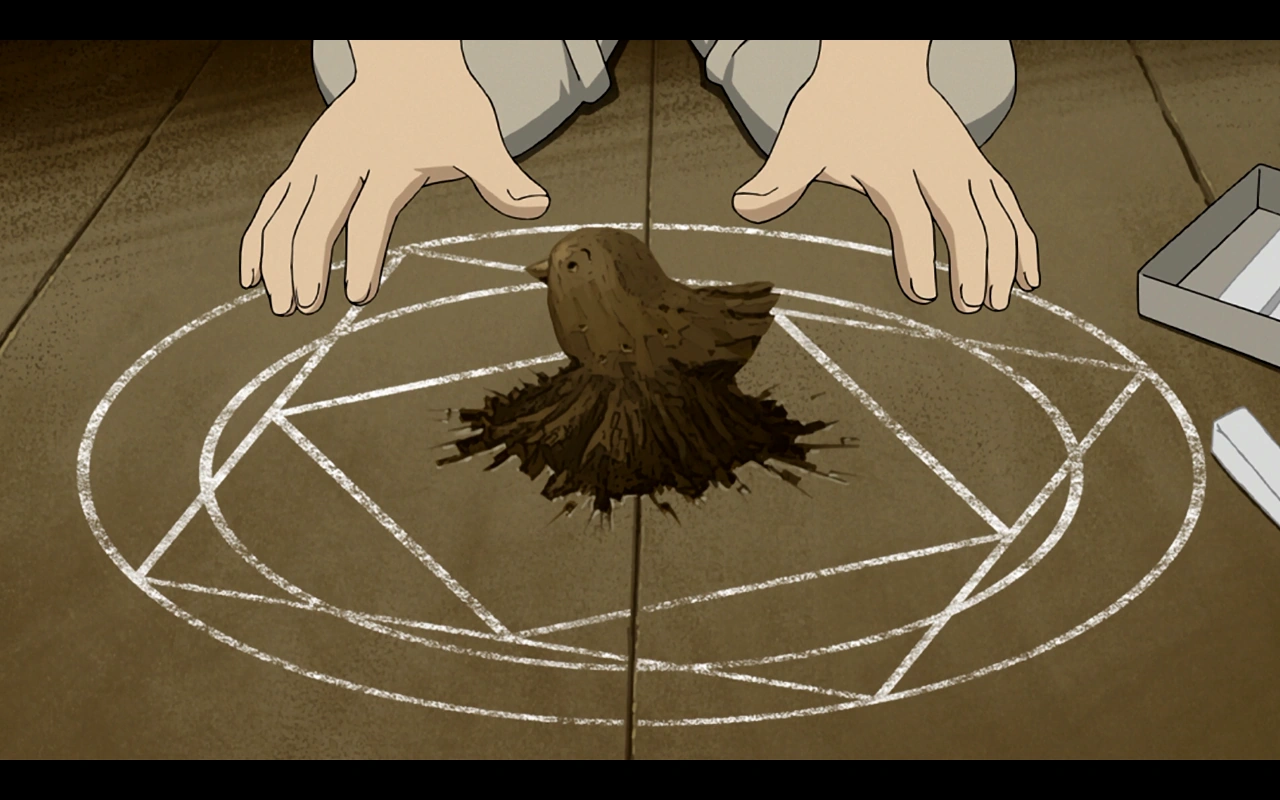
For example, Edward frequently changes the shape of stone or metal during a fight. He is not creating a new element; he is using nearby material to form a blade, wall or obstacle. Different alchemists specialize in different applications because expertise and the properties of the available matter constrain what they can do.
That emphasis on rules distinguishes alchemy from many anime power systems. Frieren's magic relies on mana and visualization, while Nen in Hunter x Hunter involves aura and individual techniques. Fullmetal Alchemist instead frames its supernatural feats around material transformation and the ethics of what is consumed to achieve a result.
Why do alchemists need transmutation circles?
A transmutation circle, or array, provides the pattern that directs an alchemical reaction. Its markings represent a specific operation and channel the process. Some alchemists draw circles before performing a technique; others carry prearranged arrays on equipment, clothing or gloves so they can activate a familiar form of alchemy quickly.
Roy Mustang's flame alchemy illustrates the value of specialization. He does not need to improvise an entirely new array every time he attacks because his equipment supports a technique he has studied and refined. The circle does not make him all-powerful: the conditions and materials involved still matter.
Why can Edward use alchemy without drawing a circle?
Edward can perform transmutations by clapping his hands because he has seen the Gate of Truth. Rather than needing a separate drawn circle, he uses his own body to complete the necessary circuit. The ability is extraordinary, but it is not evidence that he has escaped Equivalent Exchange or can ignore material limits.
The explanation is inseparable from the brothers' original mistake. Their attempt at human transmutation brought Edward into contact with Truth and exposed him to alchemical knowledge at a terrible price. His ability to work without a conventional circle is therefore not an effortless superpower: it is connected to the traumatic event that set the entire plot in motion.
Why is human transmutation forbidden?
The most consequential taboo is trying to resurrect a dead person. After their mother dies, Edward and Alphonse assemble what they believe are the components of a human body and attempt to bring her back. The transmutation fails. Edward loses his left leg, Alphonse loses his entire body, and Edward sacrifices his right arm to bind Alphonse's soul to a suit of armor.
The failure reveals a limit that cannot be solved by gathering enough ordinary ingredients. A living person is not merely a list of elements, and the brothers cannot reproduce their mother's life by rebuilding physical matter. The official Brotherhood introduction identifies human transmutation as alchemy's taboo and the cause of the brothers' losses.
This is not a case of a strict teacher withholding a useful spell. The taboo is fundamental to the story's treatment of grief. The brothers want to reverse death, but their attempted shortcut only creates more suffering. Their later choices become meaningful precisely because they must learn to live with consequences rather than treat every problem as a transaction.
What are Truth and the Gate of Truth?
Truth is the mysterious presence encountered by alchemists who cross the boundary of forbidden human transmutation. The Gate is associated with profound alchemical knowledge and a toll extracted from those who reach it. Edward, Alphonse and Izumi Curtis each discover that receiving knowledge does not mean they control the terms of the exchange.
Does the Philosopher's Stone break Equivalent Exchange?
A Philosopher's Stone appears to let its user bypass normal restrictions, producing transmutations on a scale that would otherwise be impossible. That promise drives the Elric brothers' search. Yet Brotherhood episode 7, Hidden Truths, explicitly centers on their discovery of the horrifying ingredient required to make a Stone.
The crucial distinction is between avoiding a cost and hiding who pays it. The Stone is powered by human souls, which means the apparent shortcut depends on the lives sacrificed to create it. A character using a Stone can act as though the usual price has disappeared, but the story reveals that the burden has been shifted onto other people.
This twist turns Equivalent Exchange into a moral problem as well as a technical rule. A powerful tool may let someone accomplish a seemingly impossible task, but the reader must still ask where its resources came from and whether the people who paid had any choice. Fans who enjoy the consequences of devil contracts in Chainsaw Man will recognize a different version of that concern.
What is the difference between alchemy and alkahestry?
Amestrian alchemy and Xingese alkahestry are related but distinct traditions. Alkahestry is especially associated with medical techniques and the study of the Dragon's Pulse, a flow of energy understood differently from the system taught in Amestris. Characters such as May Chang show that an alchemist's assumptions about the world can depend on where they learned their craft.
This difference becomes important to the plot rather than remaining decorative world-building. Knowledge from outside Amestris helps characters question what they have been taught about the energy behind their own alchemy. For a first-time viewer, the safest takeaway is that there is more than one way to understand and apply the underlying phenomenon.
Does Equivalent Exchange still matter at the end? Major spoilers
Major Fullmetal Alchemist: Brotherhood and manga ending spoilers follow. Edward ultimately offers up his own Gate of Truth, surrendering his ability to perform alchemy, to bring Alphonse back. The ending is not a trick in which he suddenly discovers an unlimited source of power. He chooses his brother over the talent and identity that have defined much of his life.
That decision also reframes the series' opening lesson. Edward once thought that the world could be mastered through enough knowledge and the correct exchange. By the conclusion, he recognizes the value of relationships, help from others and an ordinary human life. The last episodes, The Other Side of the Gateway and Journey's End, bring this idea to its resolution.
The ending does not mean the mechanics of alchemy were fake all along. Rather, the story distinguishes a rule for changing matter from a complete philosophy for how people should live. A person can follow a technical rule perfectly and still make a disastrous moral choice.
Is alchemy the same in the 2003 anime and Brotherhood?
Not entirely. Fullmetal Alchemist (2003) begins with the same brothers and a similar premise but develops an anime-original storyline, including different explanations and outcomes. Fullmetal Alchemist: Brotherhood follows the completed manga's main narrative more closely. Details about the Gate, the Stone and the ultimate resolution should not be freely mixed between the two versions.
This guide uses the manga and Brotherhood as its primary continuity. If you are watching the 2003 adaptation, treat later plot revelations here as potentially different from that show's own answers. The basic idea of Equivalent Exchange is shared, but the conclusions are not interchangeable.
Why Fullmetal Alchemist's power system works so well
Alchemy remains memorable because the rules produce story consequences instead of merely limiting fight choreography. The same framework explains why Edward can improvise in battle, why Roy Mustang's specialized technique is formidable, why the brothers' childhood mistake cannot simply be undone and why the Philosopher's Stone is morally horrifying.
It also makes an unusually strong point about power: understanding a process is not the same as having the right to perform it. Knowledge can heal, build or destroy, depending on who uses it and who bears the cost. For comparisons with other anime systems, see our guides to cursed energy in Jujutsu Kaisen and Breathing Styles in Demon Slayer.
Frequently asked questions
What is the main rule of alchemy in Fullmetal Alchemist?
Equivalent Exchange. An alchemist transforms existing matter rather than creating a desired object from nothing, and the materials and process impose limits.
Can Edward Elric create anything?
No. Edward needs suitable material and understanding. Clapping his hands replaces a drawn circle; it does not remove alchemy's other restrictions.
Why can't alchemy bring dead people back?
The brothers' failed attempt shows that assembling the ingredients of a human body cannot recreate a dead person's life. Human transmutation is a central taboo.
Does a Philosopher's Stone have unlimited power?
No. Its extraordinary power is connected to human souls sacrificed in its creation, making it a horrifying shortcut rather than a free source of energy.
Does Edward lose his alchemy at the end of Brotherhood?
Yes. He relinquishes his Gate of Truth in the final exchange that restores Alphonse.
Frequently asked questions
Frequently asked questions
What is the main rule of alchemy in Fullmetal Alchemist?
Equivalent Exchange: transmutation requires existing matter of appropriate value.
Can Edward Elric create anything?
No. He needs suitable materials and understanding; clapping removes the need to draw a circle, not the other rules.
Why can't alchemy bring dead people back?
Human transmutation cannot recreate a dead person's life from chemical ingredients and is the series' central taboo.
Does a Philosopher's Stone have unlimited power?
No. Its apparent shortcut relies on human souls sacrificed to make the Stone.
Does Edward lose his alchemy at the end of Brotherhood?
Yes. He gives up his Gate of Truth to restore Alphonse.
Sources & references6 sources
- Fullmetal Alchemist: Brotherhood Official USA Introduction
- VIZ Official Fullmetal Alchemist Manga Catalog
- Crunchyroll: Brotherhood Episode 12 One Is All, All Is One
- Brotherhood Official USA Episode 7 Hidden Truths
- Crunchyroll: Brotherhood Episode 63 The Other Side of the Gateway
- VIZ Fullmetal Alchemist Volume 27