
Full manga spoilers for Boruto: Naruto Next Generations and Boruto: Two Blue Vortex follow, including Kurama's fate and Himawari's story. Anime-only viewers should be aware that the final sections discuss events beyond the original Boruto television series.
Naruto lost Kurama because Baryon Mode consumed the Nine-Tailed Fox's life force during the battle with Isshiki Otsutsuki. Naruto believed the transformation might kill them both, but Kurama had withheld a crucial detail: Kurama alone would pay the fatal price. Naruto survived, while the partner who had shared his body since infancy disappeared. That is the confirmed explanation, not a theory about someone extracting the Nine-Tails.
The story has an important second chapter. Kurama later reappears inside Naruto's daughter Himawari in Boruto: Two Blue Vortex. That revival does not undo what Naruto experienced, and it does not mean he secretly kept his former Nine-Tails power. Here is how the sacrifice, transformation and return fit together.
Why did Naruto use Baryon Mode against Isshiki?
Isshiki was too dangerous for Naruto and Sasuke to overcome through their familiar tactics. The Otsutsuki's physical ability, shrinking techniques and pressure left them struggling to protect both the village and their family. The official synopsis for Boruto episode 217, Decision describes Kurama presenting Baryon Mode as a last resort that could end Naruto's life.
That context matters. Naruto did not suddenly unlock a consequence-free upgrade that he could activate whenever an enemy became difficult. Kurama offered an emergency answer to a specific opponent whose remaining lifespan was already limited. The fight was as much about reducing Isshiki's time as about landing stronger attacks.
The manga's Boruto Volume 14, which covers Chapters 52 through 55, frames the transformation as a desperate trump card with a potentially lethal cost. This is why treating Baryon Mode as simply Naruto's next permanent form misses the entire point of the confrontation.
How does Baryon Mode actually work?
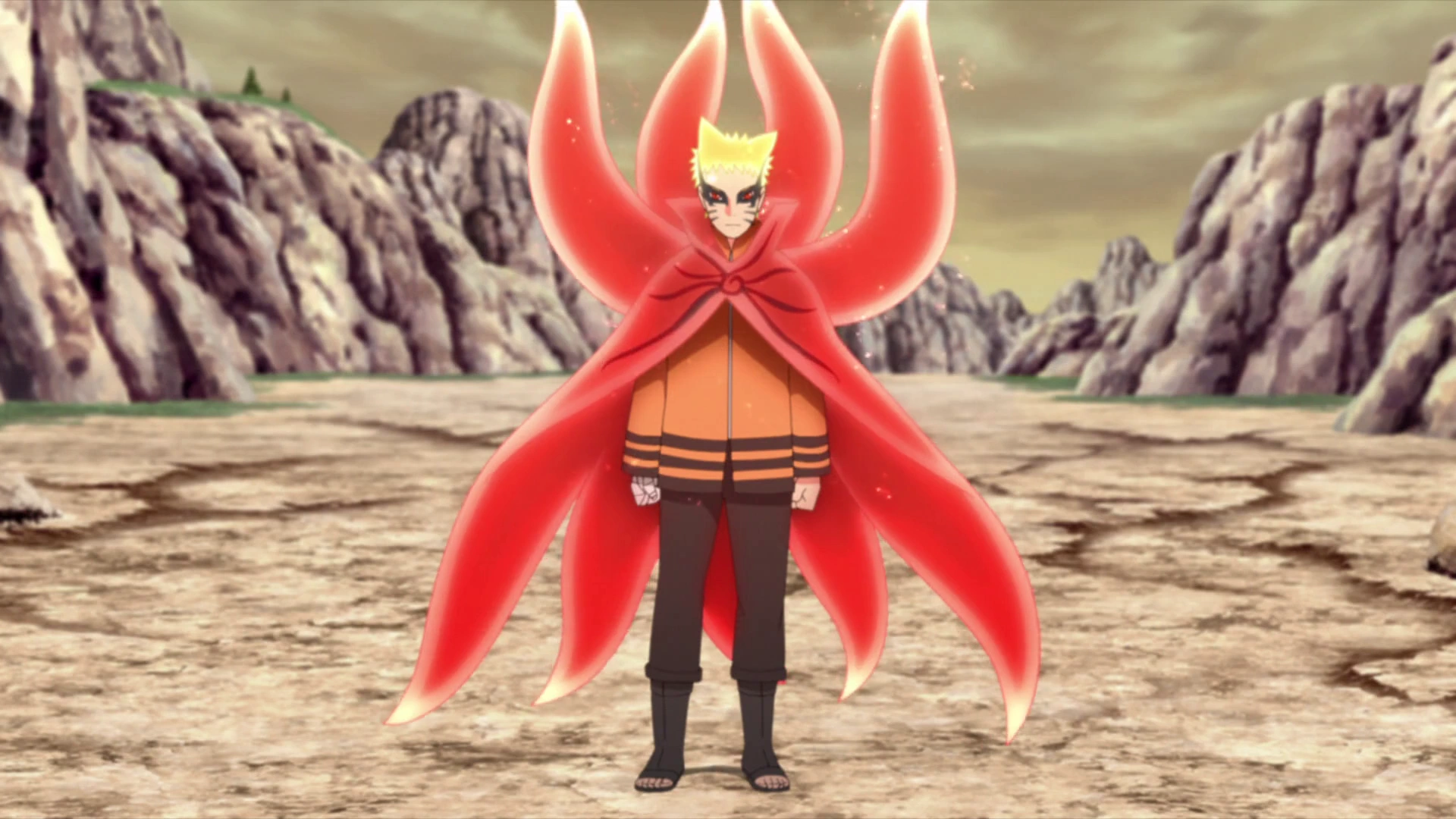
Most of Naruto's previous Nine-Tails transformations involve drawing on, sharing or shaping Kurama's chakra. Baryon Mode changes the underlying process. The two sources of chakra are fused to create a new, unusually powerful energy. The official Naruto Baryon Mode database compares the principle to nuclear fusion, but the comparison is a storytelling analogy, not a scientific claim that real nuclear reactions occur inside Naruto.
This fusion comes at a price: it burns through life force. It also affects an opponent who makes physical contact with the transformed fighter. Against Isshiki, even short exchanges become consequential because each successful contact reduces the enemy's remaining lifespan. The strategic goal is therefore different from overwhelming someone with a single enormous blast.
Kurama advises Naruto to avoid wasting movement and focus on efficient contact. This helps explain the close-range fighting style associated with the form. Its extraordinary power is real, but so is the cost. The longer the mode remains active, the closer the user moves toward the end of their life.
Why did Kurama die but Naruto survive?
Kurama let Naruto believe they would both die if they used the technique. Afterward, the truth emerges: Kurama was the actual user bearing the life-consuming burden. The official character database confirms that Kurama helped Naruto activate Baryon Mode at the cost of his own life. It also explicitly identifies Kurama, not Naruto, as the one who died.
That reveal makes the scene more painful than an ordinary power-up with a drawback. Naruto agrees to the risk because he is prepared to protect others, but he is not fully informed about the sacrifice his friend has already chosen. Kurama knows Naruto might refuse if he understood that the cost would fall on Kurama alone.
The result should not be confused with the older idea that a jinchuriki inevitably dies when a Tailed Beast is extracted. Kurama is not forcibly pulled out by an enemy during this sequence. His life is expended through the mechanism of Baryon Mode, while Naruto remains alive. Those are distinct events with different causes.
Did Naruto permanently lose the Nine-Tails' chakra?
Naruto loses his partnership with Kurama and the enormous reserve of power that partnership provided. The loss is significant because Kurama's chakra had supported many of Naruto's most recognizable abilities, including his advanced Nine-Tails transformations. It is inaccurate to assume he can freely use those forms after Kurama's death.
However, losing Kurama does not erase Naruto's entire career as a shinobi. His experience, training, tactical judgment and techniques developed outside the partnership do not simply vanish. Describing him as suddenly powerless exaggerates the consequence, while claiming nothing changed understates how much the Nine-Tails mattered.
The distinction is especially clear when looking back at the Pain invasion arc. Naruto's identity as a fighter and protector was never reducible to the fox alone. He developed Sage Mode and learned to confront people through understanding as well as strength. Baryon Mode removes an extraordinary resource, not everything Naruto learned.
Why was Kurama's sacrifice such an important character moment?
Kurama begins Naruto's story as a feared presence trapped inside a child. Their relationship is defined by mistrust, exploitation and anger before it becomes genuine cooperation. The official Naruto Shippuden episode titled Kurama highlights the gradual change in the Nine-Tails' attitude toward Naruto.
That history makes the final choice meaningful. Kurama is no longer acting as an unwilling reservoir of chakra. He decides to protect Naruto and the people Naruto loves, even though doing so will end his own existence at that moment. The sacrifice belongs to a character who has learned trust, not to an interchangeable source of combat energy.
The relationship also carries the weight of Naruto's childhood. The Nine-Tails was sealed within him after the attack that reshaped his family and village. Readers exploring Obito's role in Naruto's history can see how the tragedy surrounding the beast connects to the larger shinobi conflict. Kurama's final act turns that long history of fear into a moment of freely chosen loyalty.
Did Baryon Mode kill Isshiki?
Baryon Mode was crucial to defeating Isshiki, but the precise outcome deserves careful wording. Naruto's attacks rapidly drained Isshiki's already limited lifespan, giving the heroes an opportunity they could not have created through normal combat. The confrontation still involved other characters and choices; it was not a straightforward case of Naruto punching Isshiki once and instantly destroying him.
The official database calls Baryon Mode one of the deciding factors in the battle. That phrasing is more accurate than presenting the form as an unlimited technique capable of automatically killing any opponent. Its value depended on the opponent's circumstances, the contact-based lifespan drain and the urgent need to end the fight quickly.
Is Kurama really dead, or does he return?
Kurama really dies during the Isshiki battle. Later, however, Boruto: Two Blue Vortex reveals that he has been reborn inside Himawari Uzumaki. The official Kurama database states both facts plainly: he passed away after Baryon Mode and later returned within Himawari. Treating either event as fake ignores the story's explicit explanation.
The same source explains that Tailed Beasts can eventually revive after death. Ordinarily, that process could take centuries or even millennia, but Kurama's rebirth happened remarkably quickly. The official description says the precise cause is still unknown. Claims that a particular genetic trait or secret ritual definitively explains the timing should therefore be presented as speculation, not established canon.
The official synopsis for Boruto: Two Blue Vortex Volume 3 also identifies Himawari's surprising power during the attack on Konoha. Her connection with Kurama is a major development in her own story, not merely a device to restore Naruto's former combat status.
Does Kurama's return mean Naruto gets Baryon Mode back?
No confirmed event establishes that Naruto has regained Kurama or can activate Baryon Mode again. Kurama's return inside Himawari changes the future of the Nine-Tails, but it does not automatically recreate the original Naruto-Kurama partnership. Those are separate questions, and a reunion or transfer should not be asserted without an explicit development in the manga.
It is also misleading to assume that Himawari can repeat Naruto's Baryon Mode under identical conditions. The form was a specific, life-consuming technique whose earlier use killed Kurama. Her relationship with the reborn beast has its own possibilities, but a familiar power name is not proof that the same sacrifice can be safely repeated.
Why this loss changes Naruto's story
The ending of Kurama's partnership marks a generational shift. Naruto spent much of his life turning a source of hatred into an ally, and his greatest triumph was not simply mastering a stronger transformation. He built trust where there had been fear. Kurama's decision to save him shows that transformation has become mutual.
The wider Naruto story has repeatedly asked what people inherit from conflict. The fallout from Itachi and the Uchiha tragedy offers another example of how choices made for protection can leave deep scars. Kurama's sacrifice is different in motive and context, but it likewise forces the next generation to live with consequences that power alone cannot erase.
The clearest answer is therefore both mechanical and emotional. Naruto lost Kurama because Baryon Mode burned Kurama's life away to stop Isshiki. Naruto survived, lost access to their shared power, and had to face life without his oldest companion. Kurama's later revival in Himawari adds hope without cancelling that loss.
Frequently asked questions
What episode does Naruto lose Kurama?
Kurama's farewell occurs in Boruto: Naruto Next Generations episode 218, following the Baryon Mode battle shown in episode 217.
What manga chapter does Kurama die in?
Boruto: Naruto Next Generations Chapter 55 depicts the aftermath and Kurama's farewell.
Does Naruto die after using Baryon Mode?
No. Kurama bears the fatal cost of the transformation, and Naruto survives.
Is Kurama alive in Boruto: Two Blue Vortex?
Yes. The official Naruto database confirms that Kurama is reborn within Himawari, although the exact reason for the unusually rapid revival is not established.
Can Naruto still use Nine-Tails Chakra Mode?
Not as before. The original Kurama partnership ended, and no confirmed restoration of Naruto's former Nine-Tails transformations follows merely from Kurama's revival in Himawari.
Frequently asked questions
Frequently asked questions
What episode does Naruto lose Kurama?
Kurama's farewell occurs in Boruto: Naruto Next Generations episode 218, following the Baryon Mode battle shown in episode 217.
What manga chapter does Kurama die in?
Boruto: Naruto Next Generations Chapter 55 depicts the aftermath and Kurama's farewell.
Does Naruto die after using Baryon Mode?
No. Kurama bears the fatal cost of the transformation, and Naruto survives.
Is Kurama alive in Boruto: Two Blue Vortex?
Yes. The official Naruto database confirms that Kurama is reborn within Himawari, although the exact reason for the unusually rapid revival is not established.
Can Naruto still use Nine-Tails Chakra Mode?
Not as before. The original Kurama partnership ended, and no confirmed restoration of Naruto's former Nine-Tails transformations follows merely from Kurama's revival in Himawari.
Sources & references8 sources
- Official Naruto database: Baryon Mode
- Official Naruto database: Kurama (Nine Tails)
- Official Naruto database: Isshiki Otsutsuki
- Official Boruto anime: Episode 217, Decision
- Official Naruto Shippuden anime: Kurama episode
- Official Naruto manga: Boruto Volume 14
- Official Naruto manga: Two Blue Vortex Volume 3
- VIZ: Boruto Chapter 55