
Major spoilers for all 13 episodes of the 2021 Odd Taxi television anime follow.
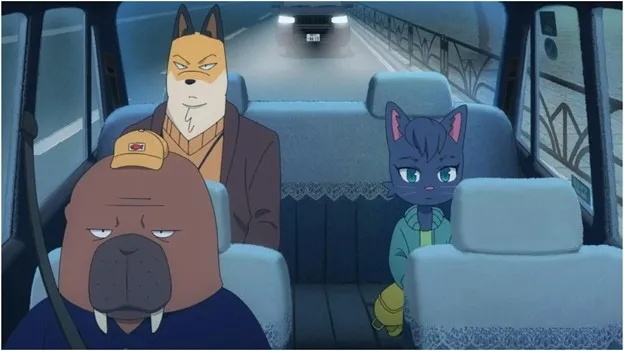
Odokawa sees people as animals because of a perceptual disorder that developed after a traumatic childhood car accident. Odd Taxi presents this as a form of visual agnosia. The passengers are actually human, and the animal designs communicate his unusual experience of the world to the audience. Episode 13 reveals this directly when he begins seeing human faces again.
Are the characters in Odd Taxi actually animals?
No. The series takes place in a human society, not a world populated by talking animals. The jobs, relationships and criminal investigation are real within the story. What changes is the visual representation of the people involved. The mystery therefore does not require a supernatural transformation or an alternate universe to explain its ending.
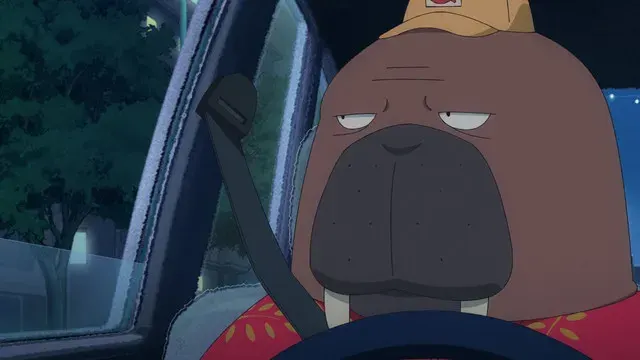
This distinction matters because the anime spends most of its runtime encouraging viewers to accept its character designs as an ordinary artistic convention. A walrus driving a taxi seems no stranger than a talking animal in another animated series. The audience has little reason to demand an explanation until the dialogue starts to contradict the images.
What happened to Odokawa as a child?
In the finale, his doctor Goriki examines material from Odokawa's childhood. It establishes that he felt uncomfortable around people and was drawn to animals instead. After surviving a devastating family car accident, his perception changed. The animal appearances became the familiar way he recognized the people around him.
The licensed episode listing for Where To? identifies Goriki's investigation of Odokawa's past as a central part of the finale. Crunchyroll's September 14, 2022 feature on the show's perspective explicitly identifies visual agnosia as the explanation for the animal imagery. The episode's account connects the condition to his childhood experience, rather than presenting it as an ability he deliberately acquired.
There is an important distinction between the fictional device and a medical diagnosis. Visual agnosia broadly concerns difficulties recognizing visual information. Odd Taxi uses a highly stylized manifestation of that concept. Its particular animal imagery and the way it resolves should not be treated as a typical clinical presentation or a prediction of how real patients recover.
The clues that make more sense on a rewatch
One of the most useful clues is the difference between Odokawa's confidence and other people's reactions. When he identifies someone by an animal characteristic, his description sounds natural to the viewer but can sound peculiar to the person hearing it. The same conversation has two different meanings depending on which visual reality you assume.
Crunchyroll's feature highlights the photograph that Goriki uses to test Odokawa's recognition of a person seen from behind. It also points to his description of Shirakawa as an alpaca. These moments are especially effective because they involve ordinary conversation rather than a dramatic announcement that the world is not what it seems.
The existence of ordinary pets is another clue. A viewer might initially accept the distinction between a household animal and an animal-shaped person as part of the fictional world's rules. After the reveal, that distinction needs no elaborate explanation: the pets are animals, while the people have been presented through an unusual visual framework.
Why does Odokawa see humans again at the end?
The final episode brings Odokawa into another life-threatening incident involving water. Shirakawa rescues him, and after he regains consciousness he recognizes her and Goriki as human beings. The sequence echoes his childhood experience while reversing its visual outcome. The anime establishes the change in his perception, but it does not offer a detailed neurological explanation of how that change occurred.
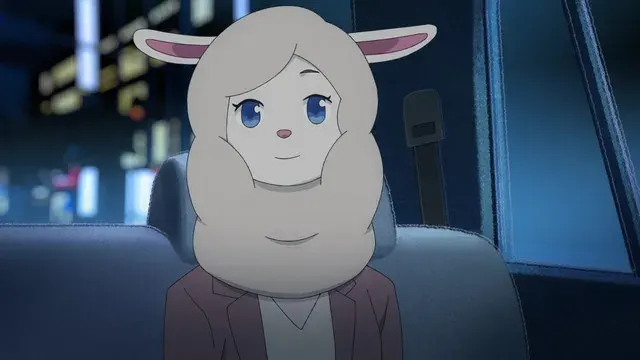
The emotional contrast is just as significant as the physical resemblance between the two incidents. The child who found human company frightening becomes an adult whose survival depends on another person's willingness to help him. Reading the rescue as a sign of renewed trust is a thematic interpretation, not a separate medical explanation.
Does the reveal mean the mystery is solved?
Not entirely. The change in perception resolves the question of the animal designs, but it does not erase the events of the crime story. In particular, the final passenger is Sakura Wadagaki, whose involvement in the murder is revealed to the audience. Odokawa's new way of seeing people creates an unsettling gap between what the audience knows and what he can immediately recognize. The television finale leaves the consequences of that encounter unresolved.
The ending also resolves the strange question of the occupant of Odokawa's closet: the animal there is an ordinary cat. It is a small but effective reversal of the assumption that every animal-shaped figure must be a person. The show has trained viewers to make exactly the wrong distinction.
Why the animal designs are more than a twist
The visual conceit makes the audience share an assumption without requiring Odokawa to narrate every scene. It also encourages viewers to remember a large cast through distinctive silhouettes. Once those silhouettes disappear, recognition becomes a problem for the audience as well as for the protagonist. That is why the ending changes the experience of earlier episodes rather than simply adding a surprising fact.
For other stories that use the viewer's assumptions in different ways, explore our guide to anime with unreliable perspectives. For character-focused stories about perception and isolation, our psychological drama anime recommendations offer a different route into the genre.
On a second viewing, pay attention to what the characters actually say rather than just what their designs suggest. The most rewarding part of Odd Taxi is that the conversations still work after the reveal, but the reasons for their awkwardness become clearer. The story never needed its passengers to be literal animals; it needed the audience to believe that they were.