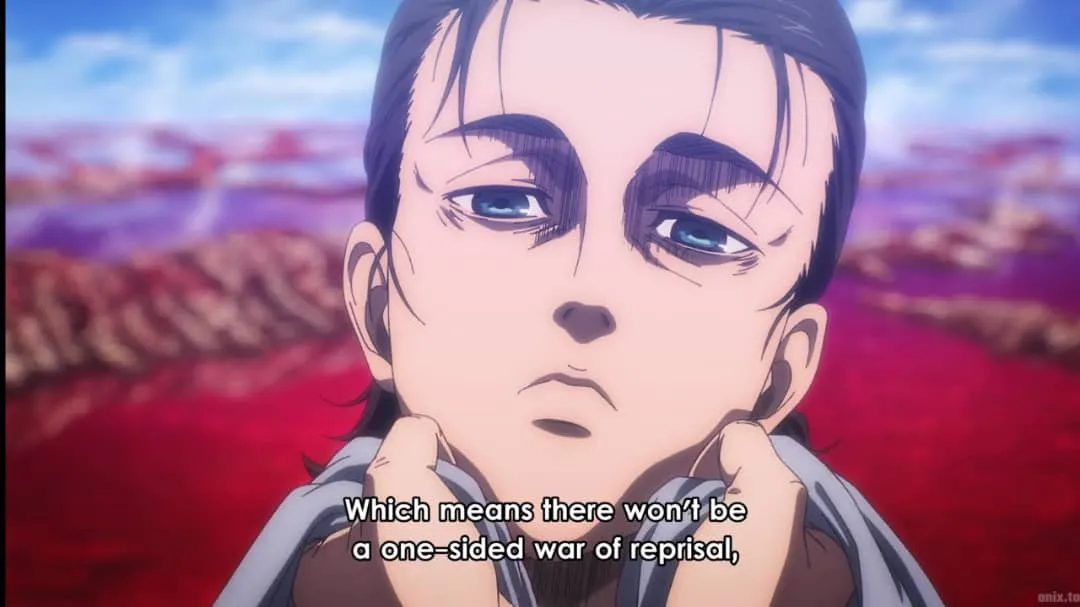

Eren started the Rumbling because he saw no other path to protect Paradis Island from the world's hatred. After witnessing future memories showing the island's inevitable destruction, and after the world refused all diplomatic solutions, Eren activated the Wall Titans to eliminate 80% of humanity. His plan had multiple layers: leveling the playing field between Paradis and the world, making his friends into heroes by stopping him, and fulfilling what he believed was an inevitable future. But beneath the strategic reasoning, Eren admitted he would have done it regardless—driven by a twisted desire for freedom and disappointment that humanity existed beyond the walls.
The question "why did Eren start the Rumbling" has multiple answers, and all of them are true simultaneously.
That's what makes Attack on Titan's ending so devastating. Eren's motivations weren't singular or clean. They were layered, contradictory, and ultimately more human than viewers wanted to accept.
He did it to save his friends. He did it because he saw the future and believed it inevitable. He did it because the world left him no choice.
And he did it because, deep down, he wanted to.
The Immediate Reason: The World Refused Peace
On the surface level, Eren started the Rumbling because every attempt at diplomacy failed catastrophically.
Like many anime characters shaped by systemic hatred rather than personal malice, Eren’s turn mirrors the same logic seen in why Sasuke betrayed Konoha, where the system itself leaves no room for reconciliation.
When Paradis discovered the truth about the outside world, they tried peaceful solutions. They sent envoys. They attempted to establish trade relationships. They sought allies who might speak on their behalf.
The world responded with rejection, disgust, and open declarations of war.
Willy Tybur's speech in Liberio crystallized this reality. Speaking before an international audience, Tybur acknowledged that Paradis hadn't attacked anyone in a century. He admitted King Fritz's peace was genuine.
Then he declared war anyway. Because fear and hatred of Eldians transcended logic or self-preservation.
For Eren, watching this speech confirmed what he'd already suspected: the world would never accept Paradis' existence. No amount of good behavior would erase two thousand years of Eldian Empire atrocities from collective memory.
Diplomatic solutions weren't just difficult—they were impossible.
How the World's Hatred Became Insurmountable
The hatred Paradis faced wasn't rational political opposition. It was existential disgust rooted in generational trauma.
The Eldian Empire had oppressed humanity for millennia using Titan powers. Marley and other nations remembered their ancestors being eaten, enslaved, and dominated. That historical wound festered across centuries, creating hatred that no contemporary Eldian could reasonably address.
Where Eren tries to overwrite time itself, other stories choose acceptance instead, a contrast that becomes clearer when compared to why Frieren feels different from other fantasy anime.
Paradis' inhabitants had lived peacefully inside the walls for a hundred years, harming no one. This fact didn't matter. They were still "devils" because they could potentially become Titans.
The world demanded Paradis' destruction not for anything its current people had done, but for what their distant ancestors did and what they might theoretically do in the future.
This created an impossible situation. How do you make peace with people who hate you for crimes committed centuries before you were born? How do you negotiate when the other side's starting position is your complete extermination?
Eren concluded you can't. So he decided to exterminate them first.
The Deeper Reason: He Saw the Future and Believed It
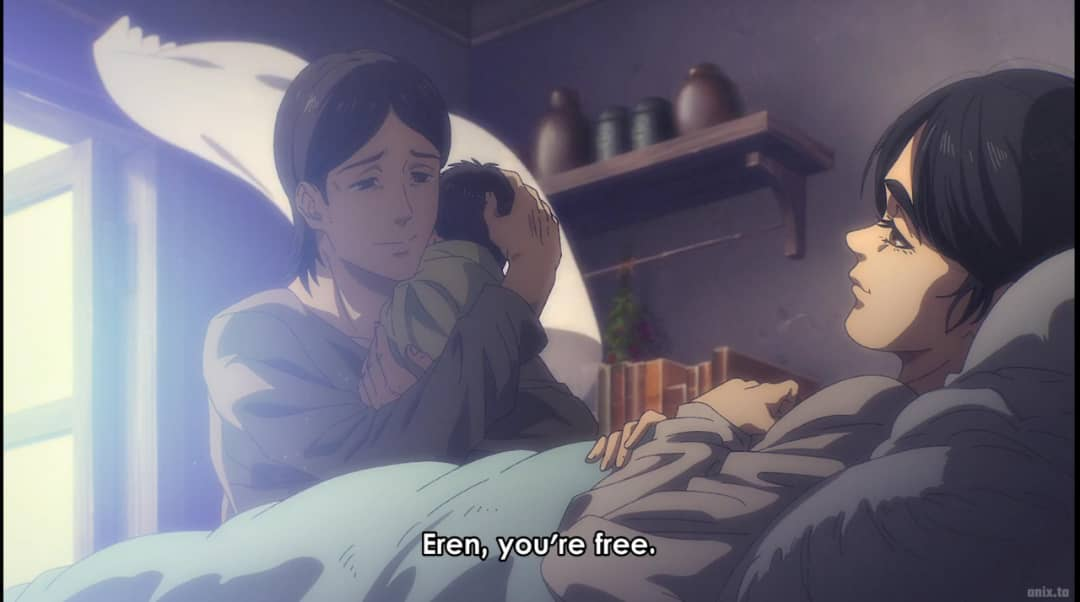
Understanding why Eren started the Rumbling requires understanding how the Attack Titan's power affected him psychologically.
At its core, the Rumbling exposes the emptiness behind unchecked power fantasies, a flaw that becomes obvious in stories like why Solo Leveling feels overhyped after the first arc.
When Eren kissed Historia's hand, he experienced his father Grisha's memories—including memories of future events Grisha himself had seen through Eren's later influence. This created a closed time loop where Eren saw fragments of his own future, including the Rumbling.
This vision fundamentally changed him.
Eren didn't just see a possible future. He saw what felt like an inevitable one, and that vision shaped every decision afterward. The question of whether he chose the Rumbling or was driven to it by predetermined fate became philosophically tangled beyond resolution.
The Attack Titan's Curse of Consciousness
The Attack Titan possesses a unique ability among the Nine Titans: its inheritors can see memories from future successors.
This sounds like an advantage. In practice, it's psychological torture.
Imagine knowing what you'll do in the future but not understanding why you'll do it. Imagine seeing yourself commit atrocities and being unable to determine if you're choosing that path or simply fulfilling a vision you've already seen.
Eren experienced this paradox. He saw the Rumbling in his future memories, then had to live through the years leading up to it, knowing what was coming but unable to tell if his choices were his own or simply him acting out a predetermined script.
This created a form of fatalism that made the Rumbling feel inevitable even when alternatives theoretically existed. If he'd already seen himself doing it, could he actually choose not to?
The anime never definitively answers whether Eren had genuine free will or was bound by destiny. That ambiguity is intentional and central to understanding his state of mind when he activated the Founding Titan.
How Eren Started the Rumbling Without Royal Blood
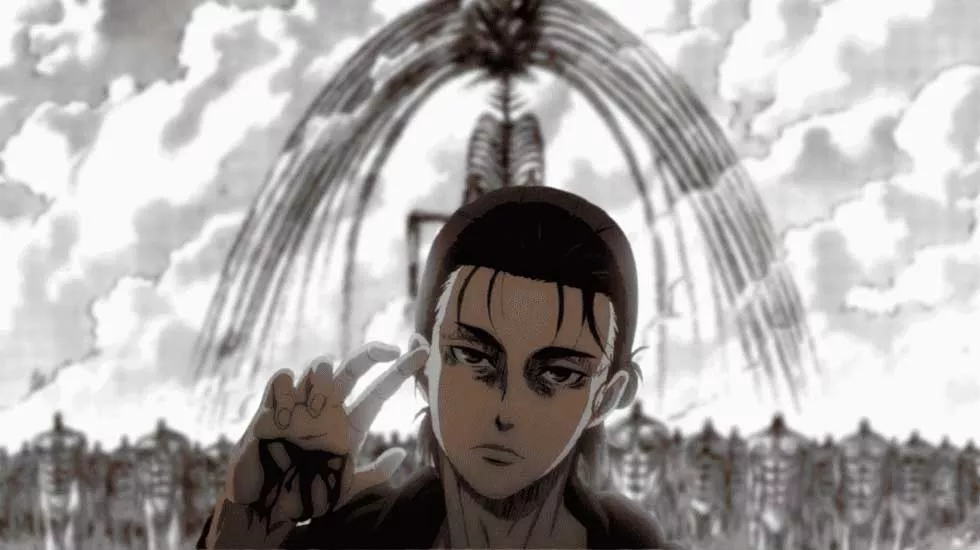
One of the most common questions is how Eren activated the Founding Titan's full power despite not having royal blood.
The Founding Titan normally requires royal lineage to access its complete abilities. King Fritz implemented the Renouncing War Vow, which prevented royal blooded Founding Titan holders from using its power aggressively.
This created a catch-22: non-royals couldn't use the Founder's full power, and royals were prevented by the vow from using it for anything except pacifism.
Eren found the loophole: physical contact with someone of royal blood.
The Zeke Connection
When Eren made contact with Zeke, who possessed royal blood through their father Grisha's first wife Dina Fritz, he gained temporary access to the Founding Titan's full capabilities.
But because Eren himself wasn't royal, he wasn't bound by the Renouncing War Vow. This allowed him to command the Wall Titans freely while Zeke provided the royal blood necessary to unlock that command.
Zeke initially believed he controlled this arrangement, thinking Eren was pretending to go along with his euthanasia plan while secretly working toward it. The reality was exactly reversed—Eren manipulated Zeke into providing the royal blood key Eren needed to activate the Rumbling.
The moment Eren made contact with Zeke in Paths, he accessed Ymir Fritz directly and convinced her to follow his will instead of remaining bound to royal commands. This severed the royal family's control over the Founding Titan permanently and gave Eren complete authority over the Wall Titans.
Did Eren Do the Rumbling for His Friends?
Yes and no. This is where Eren's motivations become most complicated.
In the final episode, Eren explicitly tells Armin his plan was to make his friends into heroes by having them stop him, thus protecting them from the world's retaliation. By positioning himself as humanity's enemy and his friends as its saviors, he intended to secure their safety and status.
This sounds noble until you examine it closely.
Eren's plan required killing 80% of humanity. He forced his friends to fight him, causing psychological trauma they'd carry forever. He didn't consult them or give them choice in becoming "heroes."
More damningly, he admitted that even if this outcome wasn't guaranteed, he would have done the Rumbling anyway.
The Selfish Core Beneath the Noble Justification
Eren's confession to Armin revealed the uncomfortable truth: protecting his friends was real motivation, but not the only one or even the primary one.
He wanted to wipe the slate clean and create a flattened world. When he learned humanity existed beyond the walls, he felt crushing disappointment that the "freedom" he'd imagined—an empty world to explore—didn't exist.
The Rumbling became a twisted attempt to create that imagined freedom by erasing the humanity that spoiled it.
Much like the deliberate confusion in Sonny Boy, the series never clarifies whether Eren could have chosen differently or whether believing in inevitability is what made it real.
This desire existed alongside his tactical concerns about protecting Paradis and his friends. All these motivations were simultaneously true, creating a psychological mess where noble intentions and genocidal impulses coexisted without resolution.
Eren saved his friends, but he also traumatized them forever. He protected Paradis, but made its people complicit in mass murder. He sought freedom, but achieved it through the ultimate denial of freedom to billions of others.
Why Eren Did the Rumbling Even Though He Knew He'd Die
Eren knew from his future memories that he would die. Mikasa would kill him, ending the Rumbling before total human extinction.
So why proceed with a plan he knew wouldn't fully succeed?
Because partial success still achieved multiple goals. Destroying 80% of humanity meant the remaining 20% roughly equaled Paradis' population, leveling the playing field between the island and the world.
It meant his friends became heroes who saved that remaining humanity, securing their status and safety.
It meant Eldians could no longer become Titans, as Ymir Fritz's release from Paths ended the Titan curse entirely.
And it meant Eren experienced the "freedom" he craved—the ability to impose his will on the world without constraint, even if briefly.
The Self-Fulfilling Prophecy
The tragic irony is that Eren's future memories may have created a self-fulfilling prophecy rather than revealing inevitable fate.
If Eren hadn't seen the Rumbling in his future memories, would he have found different solutions? Would diplomatic efforts have gotten more genuine attempts if he hadn't already "known" they'd fail?
The Attack Titan's power to see the future potentially cursed its inheritors to cause that future by believing it inevitable.
Eren became trapped in a loop where he acted out the future he'd seen because he'd seen it, unable to determine if alternate choices were ever actually possible.
This doesn't excuse the Rumbling. But it contextualizes Eren's psychological state—a young man who saw himself commit genocide in visions and then spent years unable to escape that destiny, whether it was truly fixed or simply became fixed through his belief in it.
The Uncomfortable Truth About Eren's Choice
Here's what makes the Rumbling so difficult to process: Eren wasn't entirely forced into it, but he also wasn't entirely free when choosing it.
The world's genuine refusal to make peace created real constraints. The Attack Titan's future memories created psychological constraints. Ymir Fritz's will and the Founding Titan's power created metaphysical constraints.
But within all those constraints, Eren still wanted the Rumbling on some level. He admitted this to Armin. Even without these external pressures, part of him desired to wipe away the world that disappointed him.
That's the core discomfort. We want villains to be forced into villainy by circumstances or be purely evil. Eren was neither.
He was a traumatized kid given godlike power, shown a horrifying future, surrounded by impossible choices, and ultimately revealed to have destructive impulses that made the worst choice feel satisfying even as it disgusted him.
Why the Rumbling Feels So Devastating
Attack on Titan refuses to let viewers off easy with simple answers.
Eren wasn't mind-controlled. He made choices. But those choices occurred in a context so constrained and psychologically damaged that calling them fully "free" feels inaccurate.
He saved his friends. But he did so through methods they never consented to and trauma they'll never escape.
He protected Paradis temporarily. But the cycle of violence continues, as shown in the post-credits scene where war eventually returns.
He sought freedom. But achieved it by denying freedom to everyone else, making his philosophy collapse into hypocrisy.
The Rumbling works as tragedy because it demonstrates how someone can simultaneously be victim and perpetrator, savior and destroyer, acting from genuine care while causing unforgivable harm.
That complexity is why "why did Eren start the Rumbling" has no single clean answer. Because Eren himself had no single clean motivation.
He was messy, contradictory, traumatized, and ultimately human in the worst possible ways—given power exceeding his wisdom and forced to make choices exceeding his moral capacity.
The Rumbling happened because the world was cruel, because fate seemed inevitable, because diplomacy failed, because Eren saw the future, because he wanted to protect his friends, and because he wanted it.
All of these are true. And that's what makes it so hard to accept.
Frequently asked questions
Frequently asked questions
Why did Eren start the Rumbling in Attack on Titan?
Eren started the Rumbling because he believed the world would never accept Paradis Island and would eventually destroy it. After seeing future memories and witnessing the failure of diplomacy, he chose mass destruction as the only way to protect his friends and homeland, while also fulfilling his own distorted desire for freedom.
Did Eren really do the Rumbling for his friends?
Partially. Eren wanted to protect his friends and turn them into heroes by having them stop him. However, he admitted that even without that outcome, he still wanted the Rumbling on some level. His motivations were both selfless and selfish.
Why did Eren stop at 80% of humanity?
Eren knew from his future memories that he would be stopped before wiping out all humanity. Killing 80% was enough to weaken the world, protect Paradis temporarily, and allow his friends to end the conflict by killing him.
Did Eren know Mikasa would kill him?
Yes. Eren saw fragments of his future, including his own death. He knew Mikasa would ultimately stop him, and he accepted that outcome as part of his plan.
Did the Rumbling end the Titan curse?
Yes. When Mikasa killed Eren and Ymir Fritz was freed from Paths, the power of the Titans disappeared permanently, ending the Titan curse for all Eldians.