
Nature in anime is not always a beautiful backdrop. Sometimes a forest is a contested home, a mountain trail is an invitation to slow down, or a strange organism forces people to reconsider what they call dangerous. The best stories make the landscape consequential: people must adapt to it, learn from it, damage it, or discover that they never understood it in the first place. This guide brings together eight anime films and series that use the natural world in notably different ways, from ecological conflict to the simple pleasure of spending time outdoors. It is designed for viewers seeking an environmental theme as well as those who simply want an atmospheric watch.
The list deliberately separates stories about environmental responsibility from stories about appreciating scenery. A quiet camping comedy is not an environmental manifesto, and a supernatural forest is not a scientific account of biodiversity. Both can still help a viewer notice how a place changes human behavior. For a quick choice, watch Princess Mononoke for moral conflict, Nausicaä for an imagined ecosystem, Mushishi for patient observation, Laid-Back Camp for relaxation, Silver Spoon for agriculture, Natsume's Book of Friends for belonging, Pom Poko for habitat loss, or Children of the Sea for an ambitious and ambiguous ocean experience.
How these nature anime were selected
Four editorial criteria guide this ranking: how essential the environment is to the plot; whether the story grants nonhuman life or landscapes significance beyond decoration; how clearly it explores the consequences of human decisions; and how successfully its tone serves its intended audience. These are interpretive judgments, not numerical sustainability scores. We do not treat supernatural creatures as real biological evidence, and we distinguish a film's moral argument from factual claims about climate, forestry or agriculture. The entries avoid major ending spoilers, although the themes of some films necessarily involve conflict, destruction and death.
8. Children of the Sea: an ocean mystery that resists easy answers
Children of the Sea follows Ruka, whose encounters with two mysterious boys draw her into an extraordinary marine story. The film's most immediately persuasive achievement is visual: underwater life is not merely a location for action but a dense, moving world with its own rhythms. Schools of fish, shifting light and enormous expanses of water give the characters a sense of scale they cannot control. This is a very different experience from a conventional adventure in which the ocean exists only to hide a monster or a treasure.
The narrative grows increasingly abstract, using cosmic imagery and symbolic connections between life, water and existence. That ambition can be thrilling, but it also makes the film difficult to recommend to someone who wants clearly explained rules or a tidy resolution. Its environmental value lies less in presenting a practical conservation argument than in making human certainty feel small. Choose it for sensory immersion, philosophical questions and remarkable marine imagery. It ranks eighth because the opacity of its later storytelling may leave some viewers emotionally distant despite the beauty of its world.
7. Laid-Back Camp: the pleasure of being outdoors without conquering it
Laid-Back Camp follows girls who enjoy camping, planning trips and learning how to spend time comfortably outside. Its landscapes are inviting rather than threatening, and much of the pleasure comes from the practical details of preparing a meal, choosing equipment, traveling to a site and watching the weather. The series is not built around a crisis in which a forest must be saved. Instead, it asks a smaller question: what does it feel like to give a place your attention for a few hours rather than rushing through it?

That everyday perspective is valuable because it avoids treating nature as something that matters only when disaster strikes. Different characters enjoy solitude and companionship in different proportions, and their choices make the experience approachable. The show is not a substitute for up-to-date camping safety advice, route information or local regulations. Its leisurely pace and low stakes will not satisfy someone seeking ecological debate, but they make it the most comforting entry here. Choose it when you want to feel curious about a quiet weekend outdoors rather than anxious about the fate of the planet.
6. Natsume's Book of Friends: living alongside what others cannot see
Takashi Natsume sees yokai, supernatural beings that most people around him cannot perceive. His encounters often unfold in fields, woods, old houses and villages where human and nonhuman histories overlap. The series is not a literal ecological study, but its strongest stories depend on the idea that a place may matter to someone whose experience we do not share. Natsume's task is frequently to listen before deciding whether a spirit is a threat, a nuisance or a lonely presence with an unfinished attachment.
The series excels at patient observation. A small encounter can reveal years of misunderstanding, and the protagonist's growing ability to set boundaries prevents compassion from becoming an obligation to solve everything. Nature here is inseparable from memory and folklore, rather than a collection of scientific facts. Compared with the more explicitly environmental films above it, the connection is indirect; that is why it ranks sixth. But for viewers who appreciate forests, seasonal atmosphere and gentle stories about coexistence, it offers a meaningful alternative to action-heavy fantasy. Readers seeking similar emotional connections can explore AnimeSparks' found-family anime guide.
5. Silver Spoon: the environment is also someone's workplace
Yuugo Hachiken enters an agricultural school with little experience of farm life. His classmates' familiarity with livestock, food production and physical labor quickly challenges his assumptions. Silver Spoon is especially useful in a nature-themed ranking because it refuses to imagine the countryside as a place untouched by human needs. Fields, animals, machines and schedules are connected to livelihoods. People care about living creatures while also making difficult decisions about production, costs and the future of their farms.
This makes the series less immediately scenic than Laid-Back Camp, but more direct about the practical relationships between people and land. It can be funny and warm while confronting uncomfortable questions about where food comes from. The anime is a dramatized school story, not a comprehensive guide to animal welfare or modern agricultural practices. Its characters are also still learning, so their perspectives should not be mistaken for universally applicable answers. For a related but more kitchen-centered angle, AnimeSparks' cooking anime ranking examines how food changes storytelling after ingredients leave the farm.
4. Pom Poko: development seen from the animals' side
Pom Poko imagines tanuki struggling as suburban development transforms their habitat. Its fantastical premise gives the animals personalities, social divisions and magical abilities, but the central conflict is recognizably about land use. The forest is not an empty resource waiting for people to arrive. It is already home to a community with relationships and traditions, even if the film expresses that idea through folklore and comedy. The tanuki's attempts to resist development range from playful schemes to desperate action.
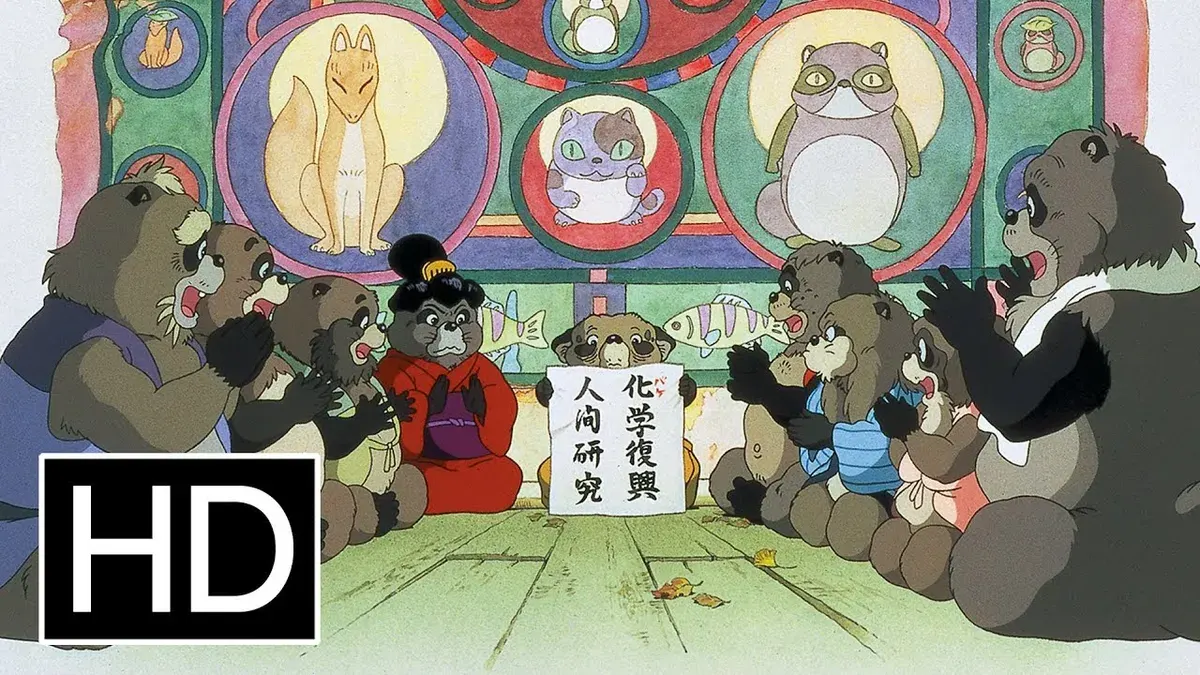
The film's shifting tone is one of its strengths and potential barriers. Broad humor sits beside sadness, and the animals are not depicted as perfectly united or strategically wise. Their disagreements prevent the story from becoming a simple sermon in which every nonhuman character represents pure innocence. Some of the cultural humor and folkloric imagery may be unfamiliar to international viewers, while the consequences of habitat loss remain understandable. Choose Pom Poko when you want an environmental story that is both mischievous and mournful. Its particular perspective makes it more direct about human expansion than many beautifully animated forest fantasies.
3. Mushishi: observe first, explain carefully
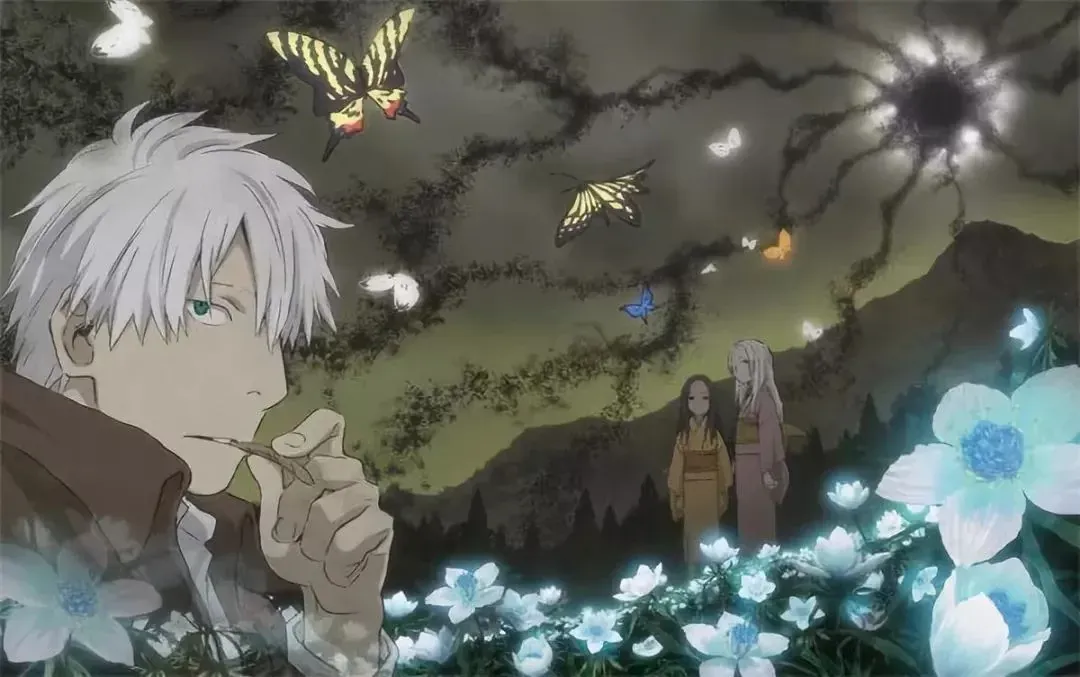
Mushishi follows Ginko, a traveling specialist who encounters mushi, mysterious lifeforms that exist outside ordinary human understanding. Each episode examines how contact with them affects a person, household or landscape. The show's distinctive move is to avoid making every strange organism an enemy. A mushi may cause suffering without having malicious intentions. Ginko's role is to investigate conditions and possible remedies rather than deliver a speech about defeating evil. That investigative rhythm gives the natural world a sense of independence.
The setting is quiet and frequently melancholy, with forests, mountains and water shaping the mood of each encounter. The fictional mushi are not actual microbes or ecological categories, and the series should never be presented as scientific education. Nevertheless, its storytelling resembles an ethic of careful observation: understand a system before attempting to change it, and accept that intervention can have costs. Viewers who need a continuing central mystery may find the episodic structure too slow. Those willing to sit with ambiguity will find one of anime's most distinctive ways of portraying coexistence. Its restraint earns a higher place than louder stories that use nature only as a visual spectacle.
2. Nausicaä of the Valley of the Wind: curiosity in a poisoned world
In Nausicaä of the Valley of the Wind, surviving human communities fear a toxic forest and the enormous insects associated with it. Nausicaä approaches the same environment with curiosity, studying its organisms rather than assuming that destruction is the only possible response. Her position matters because the film connects environmental misunderstanding to political fear. Rival powers make decisions under pressure, and the apparent danger of the landscape becomes a justification for actions that may deepen the crisis.
The film's post-apocalyptic ecology is imaginary, and its mechanisms should not be treated as a model of real pollution cleanup. Its deeper argument is about the danger of making irreversible decisions before understanding the relationships among living things. Nausicaä is not simply powerful because she can fight or fly; her willingness to pay attention changes what options are visible to others. The 1984 film also differs from the longer manga, so conclusions about one version should not automatically be applied to the other. It ranks second for turning ecological curiosity into an urgent adventure without reducing every human opponent to a caricature. Studio Ghibli's official film listing confirms its original production and release.
1. Princess Mononoke: environmental conflict without an easy villain
Princess Mononoke brings Ashitaka into a struggle between an expanding ironworking settlement and the beings of an ancient forest. The conflict is powerful because both sides have reasons that matter. Lady Eboshi's community offers work and protection to people marginalized elsewhere, yet its activities harm the surrounding environment. San's loyalty to the forest is deeply felt, but her anger cannot simply reconcile the needs of those living in Iron Town. Ashitaka tries to understand the people and beings involved without pretending their interests are already compatible.

That refusal to simplify the conflict makes the film unusually durable. It does not argue that every technology is evil or that all human activity must stop. Instead, it shows how benefits enjoyed by one group can impose costs on another, and how righteous certainty can fuel escalating violence. The gods and curses are mythic devices, not literal explanations of environmental damage. The drama works because the ecological stakes and social stakes are inseparable: protecting the forest while ignoring vulnerable workers would be an incomplete moral answer, just as helping workers while destroying the forest would be.
Its violent imagery and intense confrontations make it less suitable for viewers seeking the comfort of Laid-Back Camp or the quiet observation of Mushishi. But for anyone interested in how anime can dramatize competing environmental and human responsibilities, it is the clearest starting point. The official Studio Ghibli film page identifies the 1997 production. The film earns first place not because it provides a tidy solution, but because its conflicts remain worth discussing after the story ends.
Which nature anime should you watch first?
Choose by the question you want the story to ask. If you want to think about development, industry and responsibility, start with Princess Mononoke or Pom Poko. If you enjoy speculative ecosystems and a protagonist who investigates before attacking, choose Nausicaä or Mushishi. If your goal is to unwind, Laid-Back Camp is the gentlest option. Silver Spoon is best when you want the practical world of food and farming, while Natsume's Book of Friends explores what it means to share a place with unfamiliar lives. Children of the Sea is the boldest visual and symbolic experiment, but also the least straightforward narrative.
These works are not interchangeable documentaries. Their environmental ideas emerge from fantasy, folklore, comedy, school life and drama. A useful way to compare them is to ask whether the landscape could be removed without changing the characters' decisions. In the strongest entries, the answer is clearly no. For more personalized options, try the AnimeSparks recommendation finder, which can filter suggestions by mood and genre rather than treating every nature-themed story as the same experience.
Frequently asked questions
What is the best anime about environmental issues?
Princess Mononoke is the strongest choice here for an explicit conflict over land, industry and the needs of different communities. Nausicaä offers a more speculative approach built around understanding an unfamiliar ecosystem. Neither film should be used as a factual substitute for environmental science.
Which nature anime is relaxing?
Laid-Back Camp is the easiest recommendation for a peaceful outdoor atmosphere. Natsume's Book of Friends and Mushishi are slower and contemplative, but both can become sad or unsettling. Choose according to whether you want comfort or quiet mystery.
Are Studio Ghibli nature movies all about the same message?
No. Princess Mononoke focuses on competing human and ecological interests, Nausicaä explores fear and the consequences of misunderstanding an ecosystem, and Pom Poko uses folklore and comedy to portray habitat loss. Their different storytelling methods are a reason to watch more than one rather than treating them as substitutes.