
The Philosopher's Stone is the object that starts Edward and Alphonse Elric's search in Fullmetal Alchemist. It seems to promise an escape from the limits of alchemy, including the terrible consequences of the brothers' attempt to bring their mother back. The truth is much darker: a Stone is powered by human souls, and its apparent miracles come at a cost that somebody else has already paid.
This explanation follows Hiromu Arakawa's manga and Fullmetal Alchemist: Brotherhood, not the separate 2003 anime continuity. It covers the Stone's creation, its limitations, the tragedy of Xerxes, and Father's plan for Amestris. Major plot and ending spoilers follow.
What is a Philosopher's Stone in Fullmetal Alchemist?
A Philosopher's Stone is a concentrated alchemical energy source made from human lives. Rather than being an ordinary mineral with limitless magic, it holds a finite reserve of souls that an alchemist can draw upon to perform extraordinary transmutations. Stones can appear as red crystals or as material incorporated into a person's body, and not every Stone has the same capacity.
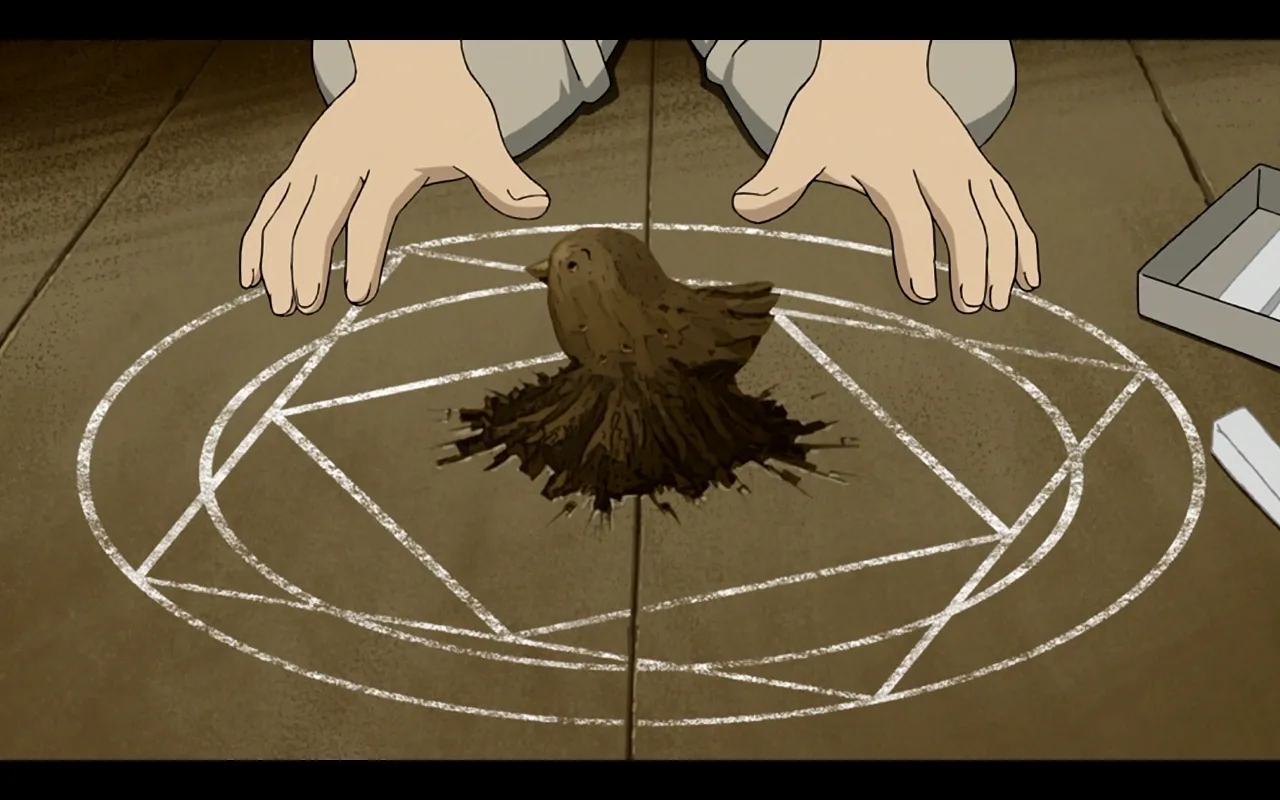
Alchemy usually requires the practitioner to understand the materials being transformed and work within the principle of Equivalent Exchange. A Stone can supply the energy needed for feats that appear to ignore that rule. But the apparent exception hides a terrible exchange: the lives used to create it. For the underlying mechanics, see our Fullmetal Alchemist alchemy and Equivalent Exchange.
How is a Philosopher's Stone made?
The essential ingredient is human souls. An alchemical process sacrifices people and binds their souls into a usable reserve of power. The series introduces this discovery when the brothers investigate Dr. Marcoh's research and the Fifth Laboratory. The initial promise of a harmless scientific breakthrough gives way to the realization that making a Stone is a mass atrocity, not a clever recipe.
That revelation matters because it changes the Elrics' mission. They cannot simply obtain a Stone, restore their bodies and call the problem solved. Using one means benefiting from people who were murdered or exploited to make it. The Brotherhood episode 'Hidden Truths' and the Fifth Laboratory episode provide official episode-level context for this early turning point.
Does a Philosopher's Stone break Equivalent Exchange?
Not in the straightforward sense that it produces something from nothing. A Stone lets an alchemist spend an extraordinary stored resource instead of paying the usual immediate cost through ordinary materials and energy. Its users may perform feats far beyond what their own bodies or surroundings could sustain, but the reserve is neither free nor inexhaustible.
This distinction is the story's central argument about shortcuts. If an alchemist can save one person only by consuming the lives of others, the apparent triumph raises an ethical question rather than disproving the rules of the world. The Stone makes a hidden cost easier to ignore; it does not erase that cost.
Can a Philosopher's Stone run out of power?
Yes. Its stock of souls can be depleted. The Homunculi often heal injuries by drawing on the energy inside their Stones, but repeated damage can exhaust that resource. They are exceptionally difficult to kill, not invulnerable or universally immortal. This is why battles against them can become contests of endurance rather than one decisive strike.
The same limitation applies to more conventional alchemical uses. A small Stone and an immense Stone are not interchangeable, and the story does not give viewers a reliable numerical conversion between souls and individual transmutations. Claims that one soul always equals a fixed number of attacks are not established rules. Our separate guide to all seven Homunculi and their powers explains their different forms of regeneration.
Why are Philosopher's Stones red?
The series consistently associates the artificial Stones with a red substance, a visual shorthand for the promise of forbidden power. But the color is not the real explanation of their abilities. The defining property is the trapped souls, not a special chemical element that any alchemist could safely mine or synthesize. Looking for a natural red rock misses the point of the story's reveal.
What happened in Xerxes, and how is Hohenheim involved?
The fall of the ancient kingdom of Xerxes exposes the Stone's creation on a national scale. A being later known as Father, originally the Dwarf in the Flask, manipulates the kingdom's ruler with a promise of immortality. The massive transmutation instead sacrifices the population, while Father and the enslaved man later named Van Hohenheim survive with enormous stores of souls.
Hohenheim did not knowingly agree to the massacre. His subsequent existence is shaped by the voices and lives inside him, and his long effort to understand and cooperate with those souls stands in sharp contrast to Father's treatment of them as fuel. The official Brotherhood episode about the Dwarf in the Flask introduces this history, while VIZ's manga catalogue identifies the original work.
This is also why calling Hohenheim simply 'immortal' is misleading. His extraordinary lifespan is bound to a Stone-like condition, and the story treats that existence as a burden rather than an uncomplicated reward. His role is not merely to possess great power, but to decide what responsibility comes with it.
What is Father's nationwide transmutation plan?
Father tries to repeat the logic of Xerxes on an even larger scale. The country's wars, violence and strategically placed bloodshed are connected to a transmutation circle spanning Amestris. The point is not that every battle is a random tragedy: the political machinery of the state helps prepare an enormous alchemical sacrifice.
Edward begins uncovering the geography of this conspiracy during the Briggs storyline. The Brotherhood episode 'The Shape of This Country' establishes the scope of the danger. By the final confrontation, the question is whether Father can turn an entire population into a resource for his own ambition.
How do the Homunculi use Philosopher's Stones?
Most of Father's Homunculi carry Stones within themselves. Those souls power regeneration and sustain abilities that would be impossible for ordinary humans. Lust can heal catastrophic damage, for example, while other Homunculi survive attacks that would kill a normal person. Their different strengths should not be confused with infinite reserves.
The Homunculi also show that a Stone's power does not automatically create wisdom or emotional maturity. Father's creations have distinct personalities and conflicting desires. Greed's story in particular asks whether someone designed as a vessel for appetite can still choose meaningful bonds over possession. The Stone gives them endurance; it does not settle what they will do with it.
Can humans use a Stone without becoming Homunculi?
Yes. A Stone can be carried or used by an alchemist without turning that person into one of Father's seven creations. Dr. Marcoh knows how Stones are produced, and later characters use Stones in urgent situations. Alphonse briefly uses one in the battle against Pride and Kimblee, a development reflected in VIZ's Volume 23 synopsis.
Using a Stone and being created as a Homunculus are different circumstances. The former involves drawing on an existing reserve; the latter involves a being whose nature and abilities are fundamentally tied to that reserve. The moral weight of the sacrificed souls, however, remains present in both cases.
Why do Edward and Alphonse refuse to rely on a Stone?
The brothers are not naïve about the dangers they face. Their refusal grows from understanding what a Stone contains. If their original mistake was trying to reverse death through forbidden alchemy, curing its consequences by consuming the victims of another atrocity would repeat the same moral blindness in a new form.
Their choice also creates tension rather than an easy moral victory. Other people have immediate needs, and some characters make difficult decisions about Stones already in existence. The series does not pretend every situation is simple. It keeps returning to the distinction between a life-saving result and the methods used to obtain it.
Is a Philosopher's Stone the same as a red stone in the 2003 anime?
No single explanation should merge the two anime continuities. Brotherhood follows the manga's account of souls, Xerxes and Father's conspiracy. The 2003 Fullmetal Alchemist adaptation branches into an original story with different lore, motivations and endgame revelations. Readers looking up a scene from the older series should check which continuity the explanation describes.
What happens to the Philosopher's Stones at the end of Brotherhood?
The finale confronts Father with the limits of stolen power and the resistance of the people he treats as expendable. Hohenheim's preparations, the allies' sacrifices and the Elrics' decisions undermine Father's plan. The official final manga volume frames the conclusion around what the brothers must give up rather than the discovery of a perfect unlimited energy source.
Edward's final solution is especially important: he does not win by finding a larger Stone. He gives up his own ability to perform alchemy to restore Alphonse. The ending answers the brothers' original problem with a personal sacrifice and a rejection of the belief that every loss can be fixed through greater power.
What does the Philosopher's Stone symbolize?
It symbolizes the seductive idea that a complicated human problem can be solved by a technological shortcut without confronting the people who bear its cost. In Fullmetal Alchemist, that shortcut is literally built from human lives. The military's secrecy and Father's plans turn the Stone into a story about exploitation on a national scale.
There is a useful contrast with other anime power systems. In devil contracts in Chainsaw Man, a bargain often states its price openly; in Binding Vows in Jujutsu Kaisen, restrictions are central to how advantages are obtained. Fullmetal Alchemist's Stone is more disturbing because its price is concealed from the person enjoying the benefit.
That is why the Stone remains compelling even after its mystery is solved. The question stops being 'How powerful is it?' and becomes 'Who paid for this power, and can its user live with that answer?' For Edward and Alphonse, that question ultimately matters more than any transmutation.
Frequently asked questions
Frequently asked questions
What is a Philosopher's Stone made of in Fullmetal Alchemist?
It is created by sacrificing human lives and binding their souls into an alchemical energy reserve.
Is the Philosopher's Stone unlimited?
No. Its stored souls can be consumed, and its power can run out.
Why won't Edward use a Philosopher's Stone?
He refuses to restore his body by exploiting people whose lives were taken to create the Stone.
Is Hohenheim a Philosopher's Stone?
In Brotherhood, Hohenheim's body contains an enormous number of souls from the tragedy of Xerxes, giving him Stone-like abilities and a long lifespan.
Can a Philosopher's Stone bring the dead back?
It can power extraordinary transmutations, but the series does not establish that it can truly restore a dead person's original life and soul.
Are Philosopher's Stones different in the 2003 anime?
Yes. The 2003 anime diverges from the manga and Brotherhood, so its lore and ending should be explained separately.
Sources & references8 sources
- VIZ Fullmetal Alchemist series overview
- VIZ Fullmetal Alchemist Volume 3
- Crunchyroll Brotherhood Episode 7: Hidden Truths
- Crunchyroll Brotherhood Episode 8: The Fifth Laboratory
- Crunchyroll Brotherhood Episode 35: The Shape of This Country
- Crunchyroll Brotherhood Episode 40: Homunculus (The Dwarf in the Flask)
- VIZ Fullmetal Alchemist Volume 23
- VIZ Fullmetal Alchemist Volume 27