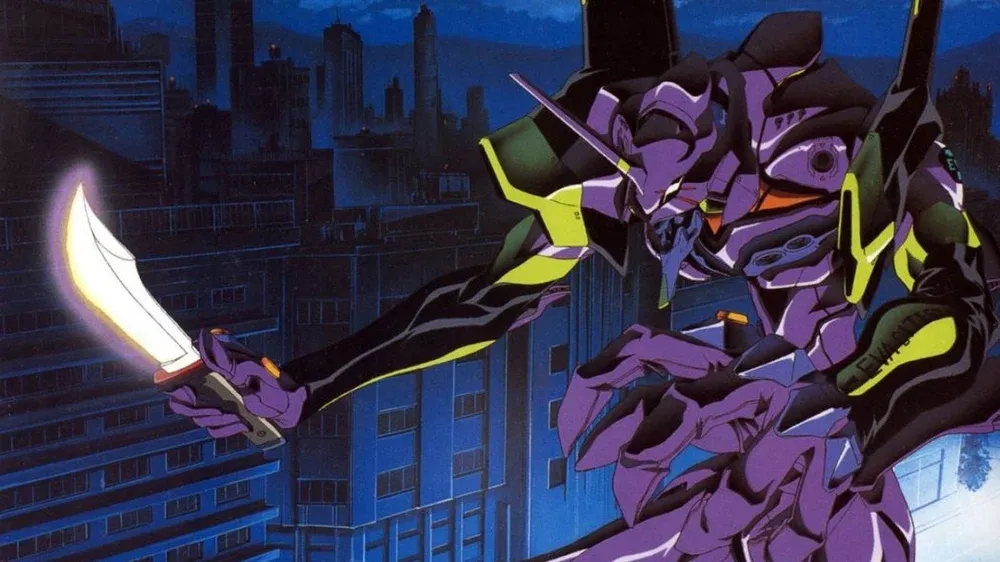

Neon Genesis Evangelion (1995) disguises a deeply personal story about depression, loneliness, and identity crisis as a mecha anime. Creator Hideaki Anno channeled four years of clinical depression into the series, making protagonist Shinji Ikari's struggle to pilot the Eva a metaphor for living with mental illness. The giant robots aren't just war machines—they're literal prisons that trap pilots inside their own trauma. The series introduced the "Hedgehog's Dilemma" and "AT Fields" as frameworks for understanding why human connection feels impossible when you're depressed. Unlike typical mecha anime celebrating heroism, Evangelion asks: what if piloting the robot that saves humanity destroys the pilot's sense of self?
What Makes Evangelion Different From Other Mecha Anime
Neon Genesis Evangelion premiered in October 1995 as what appeared to be another giant robot anime. Humanity fights mysterious beings called Angels using biomechanical weapons called Evangelions, piloted by teenagers.
Then episode 4 aired.
The episode, titled "Hedgehog's Dilemma," featured almost no robot combat. Instead, it followed 14-year-old Shinji Ikari as he ran away from home, rode trains aimlessly, and sat alone in a movie theater—overwhelmed by anger he couldn't articulate. He listens to the same songs on repeat, going nowhere fast, pondering his place in life.
This wasn't how mecha anime worked. Where were the explosions? The strategic battles? The heroic speeches about protecting Earth?
What followed over 26 episodes wasn't a celebration of piloting giant robots. It was a psychological autopsy of what it costs to be the person everyone depends on when you can barely function yourself.
Hideaki Anno's Depression Became Shinji's Depression
The series exists because its creator spent four years unable to leave his house.

Hideaki Anno suffered four years of clinical depression. In his own words: "I tried to include everything of myself in Neon Genesis Evangelion—myself, a broken man who could do nothing for four years. A man who ran away for four years, one who was simply not dead. Then one thought, 'You can't run away,' came to me, and I restarted this production."
Finding Words for What He Couldn't Name
Anno didn't initially understand he had depression. Mental health wasn't openly discussed in 1990s Japan—it was seen as weakness.
Halfway through production, creatively blocked while writing character Rei Ayanami, Anno asked a friend for reading suggestions about mental illness. The book he picked up startled him—it described his own problems. Anno had been struggling with depression for years without having the language for it.
This discovery transformed the series. What started as a standard mecha show became intensely autobiographical. Anno poured his self-loathing, isolation, and inability to connect directly into Shinji.
The result is a protagonist who feels nothing like typical anime heroes. Shinji doesn't want to save the world. He doesn't believe he can. He pilots the Eva because refusing feels worse than the terror of getting inside.
The Eva as Prison: When Your Body Becomes a Cage
In most mecha anime, piloting a giant robot represents power and agency. In Evangelion, it's the opposite.
The Evangelion units are biomechanical—part machine, part living organism. Pilots don't control them so much as synchronize their nervous systems with them, experiencing the Eva's pain as their own.
Trapped Inside the Thing That's Supposed to Save You
Shinji is a helpless boy trapped inside a killing machine. This captures depression's specific horror—you're trapped inside a body that's supposed to keep you alive but instead makes living feel impossible.
The Eva becomes a visual metaphor for dissociation: being present but disconnected, going through motions while feeling absent from your own life.
In episode 18, Unit-01 goes berserk and eats an Angel while Shinji screams inside the entry plug, unable to stop his own body from committing violence. He's a passenger in something that wears his shape but doesn't respond to his will.
Similar to Welcome to the NHK's portrayal of social anxiety as paralysis, Evangelion shows how mental illness doesn't just affect your thoughts—it hijacks your entire physical existence.
The Hedgehog's Dilemma: Why Connection Feels Impossible
Episode 4 introduces a concept that becomes the series' emotional foundation: the Hedgehog's Dilemma.
Dr. Ritsuko Akagi explains it: "Hedgehogs have a hard time sharing warmth with other hedgehogs. The closer they get, the more they hurt each other with their quills. People are also like that. Some part of Shinji is afraid to take that risk because he's afraid of being hurt."
The Depression Paradox
This perfectly describes depression's cruel logic: you desperately need connection but believe you'll contaminate anyone who gets close. Every attempt at intimacy feels like a threat—to yourself and others.
Shinji pushes away every person who tries to care about him, not because he doesn't want their warmth but because he's convinced proximity to him will hurt them. His quills aren't defensive mechanisms he consciously deploys. They're intrinsic to his sense of self.
AT Fields: The Literal Barriers Around Our Identities
The series' most brilliant metaphorical device is the AT Field—Absolute Terror Field.
In-universe, AT Fields are force fields that protect both Angels and Evangelions during combat. But the name reveals their real function.
The term A.T. Field stands for 'Absolute Terror Field.' What does it mean for an entire person to be held together by terror?
What Holds You Together Also Keeps You Alone
The AT Field represents psychological boundaries—the walls we build around our identities to protect ourselves from being known, judged, or abandoned. They symbolize barriers that separate one individual from another, keeping their thoughts private.
When you're depressed, these boundaries become prison walls. Your AT Field protects you from vulnerability but also ensures you remain isolated. You can't let anyone in without risking annihilation of the fragile self you've constructed.
This connects to how Mushishi shows that some problems aren't meant to be fixed—sometimes the thing keeping you alive is also the thing keeping you alone.
Every Character Suffers Different Symptoms of the Same Disease
Shinji isn't the only one trapped by depression and trauma. Every major character demonstrates a different manifestation of mental illness:
Rei Ayanami: Dissociation and Questioning Existence
Rei exhibits symptoms of dissociation and depersonalization. She doesn't value her own life because she doesn't believe she has a real self to value. Her question "Am I real?" isn't philosophical—it's the desperate plea of someone who can't feel their own existence.
Asuka Langley Soryu: Compensatory Ego and Fear of Worthlessness
Asuka is Shinji's opposite—aggressively confident, competitive, desperate to prove her value through performance. But her bravado is armor protecting the same wound Shinji bears openly: the belief that she's fundamentally unlovable.
When her sync rate drops and she can no longer pilot effectively, her entire identity collapses. She attempts suicide. The thing she used to prove her worth becomes impossible, leaving nothing underneath.
This mirrors the crushing pressure in Hajime no Ippo when your entire identity becomes what you achieve.
Misato Katsuragi: Functional Depression and Avoidance
Misato functions in society. She has a job, maintains relationships, appears normal. But she drinks heavily, avoids emotional intimacy, and uses sexual attention as validation rather than connection. Her functionality doesn't mean she's healed. It means she's better at hiding.
The Human Instrumentality Project: When Isolation Becomes Unbearable
The series' final act introduces the Human Instrumentality Project—a plan to merge all human consciousness into a single unified being to banish loneliness forever.
The Fantasy of No Longer Being Separate
SEELE created the Project to unite humanity into one consciousness. Wars and conflict would be erased, but at the cost of individuality.
For someone suffering profound loneliness and self-loathing, the promise of dissolving your separate self into an ocean of shared consciousness where you can never be rejected or abandoned sounds like relief.
Instrumentality isn't presented as villainy. It's presented as euthanasia for identity—a permanent solution to the pain of being a separate, vulnerable self.
Episodes 25 & 26: The Therapy Session Ending
The original series' final two episodes abandoned external plot entirely. Instead, they take place almost entirely inside Shinji's mind as he undergoes something resembling group therapy during Instrumentality.
Deconstructing Identity Under Depression
The episodes ask Shinji to examine his core beliefs: "I'm worthless," "Nobody wants me here," "I only exist to be used by others."
The episodes systematically challenge these beliefs, showing that Shinji's depression distorts reality. No one ever told Shinji he's not lovable, no one told him that he is a failure. His father didn't summon him to hurt him—Gendo is simply incapable of expressing care.
The "Congratulations" Scene
The series ends with Shinji accepting that he wants to exist as himself, flaws and all. Everyone applauds. "Congratulations!"
For viewers expecting narrative closure, this felt like a betrayal. For viewers recognizing depression, it felt painfully honest. Recovery isn't defeating your demons. It's deciding to live despite them.
The End of Evangelion: The Relapse
Fans reacted poorly to the original ending. Some sent death threats.
Anno's response was The End of Evangelion (1997)—a film showing what "actually" happened during those final episodes. It's cynical and deeply depressing, showing the darkest possible version of events.
The Darkest Possible Version
The film is brutal. Shinji sexually assaults comatose Asuka. The military massacres Nerv personnel. Giant Rei's decapitated head floats through space bleeding across the stars.
Shinji still rejects Instrumentality. He still chooses individual existence over eternal unity.
But the film's final image is Shinji strangling Asuka on a beach littered with corpses before she reaches up to caress his face. He collapses. She says: "Disgusting."
Recovery Isn't Linear
Shinji still comes to the same conclusion—that he wants to live and be with others, in spite of the suffering it may cause. But it's clear he still has a long way to go in fixing his broken mental state.
The End of Evangelion acknowledges that having a breakthrough doesn't fix everything. Shinji's decision to live doesn't erase his capacity for harm, his self-loathing, or his broken relationships. It just means he's choosing to exist in that brokenness rather than escape it.
This brutal honesty is why the film endures—similar to how Chainsaw Man feels empty and wrong on purpose.
Why Evangelion's Approach to Mental Health Matters
Mental health is brought up frequently these days, but in 1997, it was a taboo subject. This is part of why Neon Genesis Evangelion is so vital in the conversation about mental health.
Before Evangelion, anime heroes struggled with tactical problems—defeating enemies, protecting friends, saving worlds. Internal struggles were obstacles to overcome on the way to victory.
Evangelion made internal struggle the entire point.
The Series Doesn't Offer Solutions
What makes Evangelion valuable isn't that it teaches you how to fix depression. It's that it shows depression accurately—the self-loathing that feels like truth, the isolation that seems like protection, the fantasy of disappearing completely.
For many viewers, especially those who watched it as teenagers, Evangelion was the first time they saw their internal experience reflected in fiction. One viewer wrote after watching Shinji's silent train ride in episode 4: "A TV show helped me understand something about my own mental health for the first time."
Recognition Isn't Recovery, But It's a Start
The series doesn't promise healing. Shinji ends both the TV series and End of Evangelion still damaged, still struggling, still capable of hurting himself and others. But he's chosen to keep existing.
That's not inspirational in the traditional sense. It's just honest. And for people living with depression, that honesty can be more valuable than false hope—recognition that the struggle doesn't end, you just find ways to live alongside it.
This connects to why Reigen Arataka works as one of anime's best-written adults—flawed people trying to function despite not having everything figured out.
The Giant Robots Were Never the Point
Neon Genesis Evangelion uses its mecha framework as elaborate metaphor. The Angels represent existential threats. The Evas represent bodies you're forced to inhabit. The AT Fields represent the terror that holds your identity intact.
But strip away the sci-fi imagery and you have a story about a depressed teenager who can't connect with others, doesn't value his own life, and has to choose whether existence is worth its pain.
The genius is hiding that story inside a genre typically defined by power fantasies and heroic triumph. Anno weaponized audience expectations. You came for giant robots saving humanity. You got a dissection of what it costs to save yourself when you don't believe you're worth saving.
Nearly three decades later, Evangelion remains essential viewing not despite its refusal to provide answers, but because of it. It trusts viewers to sit with discomfort, to recognize themselves in Shinji's struggle, and to understand that choosing to exist—however imperfectly—is its own kind of heroism.
No giant robot required.
Where to Watch: Neon Genesis Evangelion and The End of Evangelion are streaming on Netflix with English subtitles and dub.