
Can anime teach you real science? Yes, if you know which lessons to keep and which dramatic shortcuts to question. Dr. STONE can spark an interest in chemistry, Cells at Work! makes immune cells memorable, and Planetes gives orbital debris the seriousness it deserves. None of them replaces a textbook or a lab. That distinction is the point of this ranking.
We picked ten shows for the specific scientific ideas they make easier to understand, not for how often a character says the word science. Each entry separates a useful real-world takeaway from a fictional device, an oversimplification, or a historical caveat. The order reflects our editorial judgment of learning value, clarity and entertainment, not a measured scientific-accuracy score.
Quick guide: which science anime should you watch?
Chemistry and engineering: Dr. STONE. Human biology: Cells at Work! Space debris and orbital risk: Planetes. Rocks and mineral identification: Ruri Rocks. Agriculture and food systems: Silver Spoon. Fermentation: Moyashimon. Astronaut training: Space Brothers. Astronomy and observation: Asteroid in Love. Animal adaptations: Heaven's Design Team. History and philosophy of scientific discovery: Orb: On the Movements of the Earth.
A useful way to judge these shows is to ask three questions: Does the central scientific principle exist outside the story? Does the anime show the real constraints on using it? And could a viewer verify the lesson from an independent scientific source? A series can be excellent at the first question while taking considerable liberties with the other two.
1. Dr. STONE: best for the excitement of chemistry and engineering
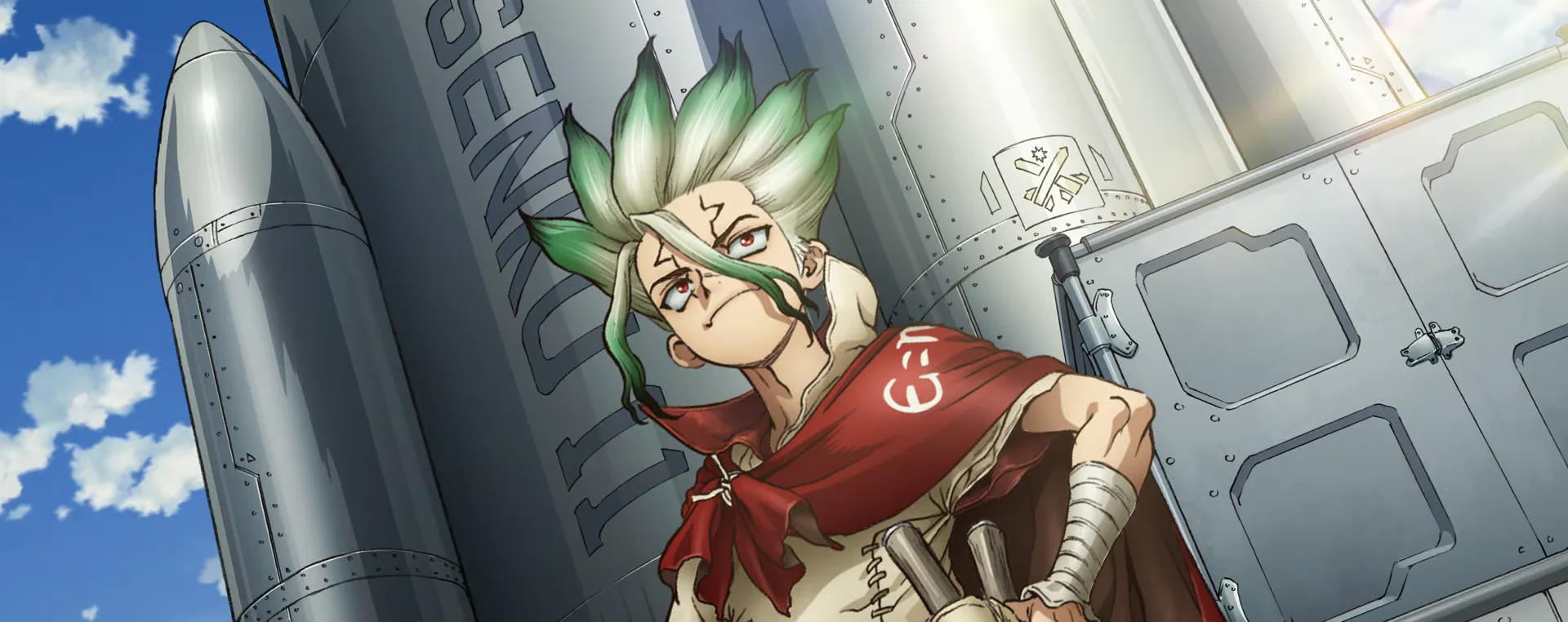
Senku wakes in a world where modern civilization has collapsed and attempts to rebuild technology by working through materials, tools and scientific knowledge. The series makes a persuasive point: a finished invention rests on a long chain of discoveries and skilled labor. Glassmaking, electricity and chemical processes become problems with prerequisites rather than magic items unlocked by a hero.
What you can learn: scientific progress is cumulative, measurement matters, and making a useful product requires more than knowing its chemical formula. What to question: Senku's speed, access to suitable materials, purity control and the ease with which dangerous processes are sometimes compressed into an adventure montage. Real chemistry demands protective equipment, training, controlled conditions and repeated testing. Do not copy the show's experiments at home.
If you need a starting point across its multiple seasons and specials, use the AnimeSparks watch-order guide rather than assuming every extra installment is optional. This is the best pick for someone who wants to feel curious enough to read an actual science book afterward.
2. Cells at Work!: best for remembering what immune cells do
Inside an anthropomorphized human body, a red blood cell transports oxygen while white blood cells respond to threats. Turning cellular roles into a workplace makes basic anatomy less abstract. The series gives viewers a memorable entry point into circulation, infection and the division of labor between different cell types.
What you can learn: red blood cells transport oxygen, immune defenses have specialized jobs, and the body responds to injury through coordinated processes. What to question: cells are not conscious people, bacteria do not stage literal sword fights, and an immune response is far more complex than one heroic cell defeating an enemy. Treat the show as a visual mnemonic, not medical guidance or a complete explanation of immunity.
3. Planetes: best for understanding why space junk matters
Set in 2075, Planetes follows a crew paid to retrieve debris in orbit. Its premise sounds mundane until you consider the speeds involved. NASA explains that even small fragments can damage spacecraft because orbital objects travel at enormous velocities. That real hazard gives the series a stronger scientific foundation than many futuristic space adventures.
What you can learn: orbital debris is a genuine operational risk, preventing collisions requires tracking and engineering, and space work involves unglamorous maintenance as well as exploration. What to question: the economics and technology of routine human-operated debris collection in 2075 are speculative. The show is not a forecast of how future cleanup programs will actually work.
Planetes also has a literary connection worth following: its manga was created by Makoto Yukimura, who later wrote Vinland Saga. If the humane, work-focused storytelling appeals to you, our Vinland Saga recommendations explore related character-driven series. The link is about storytelling, not a claim that Viking history teaches orbital mechanics.
4. Ruri Rocks: best for learning how to look at minerals
Ruri begins by wanting shiny stones. Meeting graduate student Nagi turns that fascination into field observation, collecting and mineralogy. Unlike a fantasy treasure hunt, the pleasure comes from asking where a specimen formed, what its appearance reveals and which properties could help identify it.
What you can learn: mineral identification is not simply naming a pretty color. Geologists use properties such as hardness, luster and other observable traits, alongside geological context. The US Geological Survey's Mohs scale is a practical reference for relative scratch hardness. What to question: color alone rarely proves an identification, and real collecting requires permission, attention to protected sites and basic field safety. The series may inspire a hobby, but it is not a permit to remove specimens wherever you find them.
5. Silver Spoon: best for understanding the work behind food
Yuugo Hachiken enters an agricultural school expecting relief from academic pressure and instead confronts demanding practical work. Animals, crops, schedules and the economics of producing food become part of everyday life. The science here is not a dazzling machine: it is applied biology, animal husbandry and a constant negotiation between ideals and resources.
What you can learn: agriculture involves biological systems, labor, costs and ethical decisions, and food does not arrive at a store without people making difficult choices. What to question: one fictional school cannot represent every farming system, animal-welfare standard or regional practice. For actual agricultural guidance, consult local extension services and professional sources rather than treating a dramatic scene as universal policy.
This is also one of the best choices if you prefer grounded human stories to experiments. Our underrated anime recommendations are a useful next stop for other quieter, character-led series.
6. Moyashimon: best for fermentation and the invisible microbial world
Tadayasu Sawaki can see microorganisms without a microscope, an obviously fictional ability that turns microbes into recognizable characters. At an agricultural university, that device becomes a way to discuss food production, fermentation and the organisms that participate in it. A Crunchyroll episode synopsis explicitly features a sake-brewing demonstration and the role of microbes.
What you can learn: microorganisms are not all harmful; some play essential roles in producing familiar foods and beverages. Fermentation depends on biological activity and carefully managed conditions. What to question: microorganisms are not visible to the naked eye in the way Sawaki sees them, and not every microbe is safe or useful. Do not treat the show's depiction as instructions for culturing unknown organisms or producing food without sanitation controls.
7. Space Brothers: best for the human side of astronaut training
At 32, Mutta decides to pursue the astronaut dream that his younger brother has already approached. Instead of reducing spaceflight to a launch countdown, Space Brothers spends time on selection, teamwork, preparation and the strain of ambitious professional goals. It is especially effective at showing that an astronaut must cooperate under pressure.
What you can learn: space careers demand training, communication, problem-solving and resilience. NASA describes astronaut candidates practicing emergency procedures, underwater spacewalk simulations, robotics, survival and geology. What to question: the show's selection process belongs to its fictionalized Japanese program and era; it is not an up-to-date application handbook for NASA, JAXA or any other agency. Requirements and training pathways change.
8. Asteroid in Love: best for learning how astronomy is practiced
Mira's childhood promise to discover an asteroid draws her into a school club that combines astronomy and geology. The series is gentle, but its focus on observing, recording and comparing data captures something essential about science: the exciting result is often built on repetitive, careful work.
What you can learn: amateur observation can lead to meaningful questions, and identifying a moving object takes evidence rather than a single pretty telescope image. NASA's citizen-science programs show how volunteers can contribute to research by examining astronomical images. What to question: finding and officially naming an asteroid follows formal verification and naming procedures; a fictional discovery should not be read as a guaranteed path from a club project to a named celestial body.
9. Heaven's Design Team: best for asking why animals are built the way they are
In this workplace comedy, a divine design department tries to fulfill increasingly absurd requests for new animals. The creative setup is fantasy, but the resulting questions are biological: why might a certain body plan be impractical, what trade-offs come with size, and how do real animals solve survival problems? The franchise even collaborated with a natural-science museum in Tokyo.
What you can learn: an animal's anatomy involves physical constraints and trade-offs, and surprising real adaptations are often more interesting than invented creatures. What to question: evolution is not a client briefing followed by a design committee's approval. Natural selection, inheritance and environmental pressures do not operate like product development. Enjoy the joke, then check a zoology reference before accepting any single explanation of an adaptation.
10. Orb: On the Movements of the Earth: best for the courage and limits of scientific inquiry
Orb follows characters investigating ideas about the motion of Earth and the Sun under threat in a fictionalized fifteenth-century setting. Its most valuable lesson is about evidence, uncertainty and the personal cost of challenging accepted beliefs. It is a gripping drama about what knowledge can mean to people, not a course in celestial mechanics.
What you can learn: scientific claims should be evaluated against observations, and the history of ideas involves arguments, institutions and human consequences. What to question: the series uses invented characters and a dramatized historical setting. Do not use its depiction of religious institutions, persecution or the discovery of heliocentrism as a literal timeline of European scientific history. Its emotional truth and historical accuracy are separate questions.
Which science anime is the most accurate?
There is no responsible single-number accuracy ranking here. A biology allegory, a historical drama and a future-space workplace series make different kinds of claims. Cells at Work! simplifies real biological roles; Planetes starts from a real orbital hazard but invents future working conditions; Dr. STONE uses genuine scientific ideas while dramatically accelerating production. Calling any one of them 100% accurate would mislead readers.
If your goal is a testable fact, start with Ruri Rocks for mineral properties, Cells at Work! for the broad jobs of cells, or Planetes for the real dangers of debris. Then cross-check the idea using USGS, a reputable biology textbook or NASA. If your goal is curiosity about how scientific thinking works, Dr. STONE and Orb may leave a stronger impression, even though their storytelling takes larger liberties.
Three science-fiction anime we deliberately did not rank as science lessons
Steins;Gate is a brilliant time-travel thriller, but its fictional message-to-the-past mechanism is not established physics. Read our Steins;Gate science-fiction review for why the story works without confusing its rules with experimental proof. Fullmetal Alchemist uses the language of matter and exchange, but its alchemy is supernatural; our Fullmetal Alchemist alchemy guide explains the fictional system on its own terms. Neither should be sold as a real chemistry tutorial.
That exclusion matters because a science-themed anime and an anime that teaches a verifiable scientific idea are not automatically the same thing. This list rewards a clear route from a scene to a real-world question, while acknowledging where the route ends.
How to use these anime without learning the wrong lesson
Pick one concept from an episode, write down the claim in plain language, and look for an independent explanation. For example: Can tiny debris really threaten a spacecraft? NASA says yes, because speed matters. Can you identify a mineral from its color alone? Not reliably; compare additional properties. Are microbes always villains? No; some are essential to fermentation. This simple habit turns entertainment into a reason to investigate rather than a substitute for investigation.
Our recommendations are not laboratory procedures, medical advice, or a substitute for safety training. The point is to enjoy a story, notice a question worth asking and follow the evidence outside the screen.
Frequently asked questions
Frequently asked questions
Can anime actually teach science?
Anime can introduce real concepts and make them memorable, but dramatization and missing details mean every claim should be checked against a scientific reference.
Is Dr. STONE scientifically accurate?
Many inventions draw on real principles, but the story compresses time, resources, expertise and safety requirements. It is not a step-by-step experimental manual.
Is Cells at Work! accurate for biology?
It offers a useful simplified picture of cell roles and immune responses, but its characters and battles are metaphors, not literal cellular behavior.
Which anime is best for learning about space?
Planetes is best for orbital debris risk, Space Brothers for astronaut preparation, and Asteroid in Love for observation and amateur astronomy.
What science anime is good for beginners?
Start with Cells at Work! for biology, Ruri Rocks for geology, or Dr. STONE for a broad introduction to scientific curiosity.
Is Orb based on true history?
It explores real questions about astronomy and scientific ideas through a fictionalized historical drama. Its characters and persecution narrative should not be treated as a documentary record.
Sources & references16 sources
- Crunchyroll, Dr. STONE series synopsis
- Crunchyroll, Cells at Work! series
- Crunchyroll, Planetes series
- NASA, What Is Orbital Debris?
- Crunchyroll, Ruri Rocks series
- USGS, Mohs Hardness Scale
- Crunchyroll, Silver Spoon series
- Crunchyroll, Moyashimon episode on fermentation
- Crunchyroll, Space Brothers series
- NASA, Astronaut Candidates Get to Work
- Crunchyroll, Asteroid in Love series
- NASA, citizen-science asteroid discovery
- Crunchyroll, Heaven's Design Team synopsis
- Crunchyroll, Heaven's Design Team science museum collaboration
- Netflix, Orb: On the Movements of the Earth
- Crunchyroll, Planetes catalog announcement and creator credit