
Some anime are entertaining. A few are genuinely great. And then there's Steins;Gate — a show that sits in a category almost entirely by itself. It holds a 100% critic score on Rotten Tomatoes, a near-perfect score on MyAnimeList, and 15 years after it first aired, people are still calling it the gold standard for time travel storytelling in any medium — anime or otherwise.
If you've been putting it off wondering if the hype is real, this is the piece that'll finally push you to watch it. And if you've already seen it, you already know exactly why it deserves this.
What Is Steins;Gate?
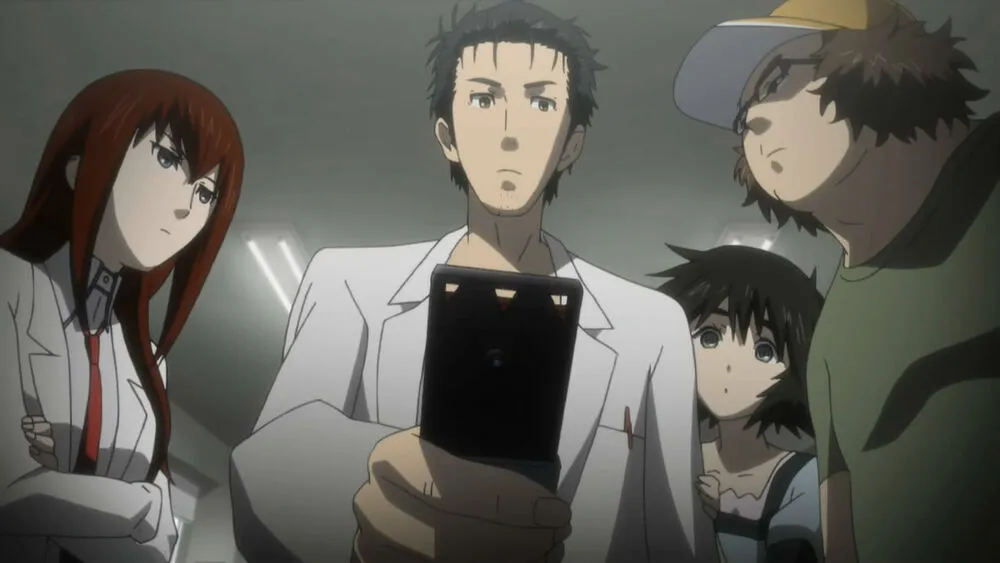
Steins;Gate is a 24-episode sci-fi anime produced by White Fox, adapted from a 2009 visual novel by 5pb. and Nitroplus. It originally aired in 2011 and follows Rintaro Okabe — a self-proclaimed "mad scientist" who runs the Future Gadget Laboratory out of cramped Akihabara apartment with his two friends: hacker Itaru "Daru" Hashida and cheerful childhood friend Mayuri Shiina.
Through a chaotic series of events, Okabe discovers that a modified microwave connected to a phone can send text messages back in time — what they call "D-mails." What starts as playful experimentation quickly spirals into something genuinely terrifying, as every change to the past ripples into the present in ways nobody anticipated. The anime is available on Crunchyroll, Amazon Prime Video, and Apple TV.
The Slow Burn That Actually Pays Off
Let's be upfront about something: the first 11 episodes are slow. They're dense with jargon, otaku humor, and slice-of-life banter that can feel disconnected from what you expected. A lot of people drop it here, and that's a genuine shame — because everything in those episodes is load-bearing.
Every joke, every character quirk, every seemingly throwaway detail is being quietly placed. By the time episode 12 hits and the story shifts gears completely, you realize the show was building a foundation the whole time. Once it clicks, it becomes almost impossible to stop watching. The payoff isn't just satisfying — it's one of the most emotionally devastating experiences anime has to offer.
This kind of patient, slow-burn storytelling is rare. It's the same quality that makes shows like Monster anime so psychologically unforgettable — they trust the audience to wait before showing their hand.
The Time Travel Mechanics Are Actually Airtight

Most time travel stories fail because their internal logic falls apart under scrutiny. Steins;Gate doesn't have that problem. It builds its mechanics from real theoretical physics — specifically the Butterfly Effect, the Many-Worlds Interpretation, and Kerr Black Hole theory — and then applies them consistently from episode one to the final scene. Not once does it cheat.
The key concept is the "divergence meter" — a value representing how far a given timeline has diverged from a baseline. History in this world has gravity; certain events will happen regardless of small interventions, because causality bends back toward fixed points. This is what makes Okabe's attempts to save people so gut-wrenching. He can't just fix things. Every action he takes has a specific, calculated consequence.
The show also draws from the real story of John Titor — an internet personality who appeared in online forums in 2000, claiming to be a time traveler from 2036. His predictions were just plausible enough to become a cult phenomenon, and Steins;Gate weaves him directly into its narrative in a way that makes the sci-fi feel grounded rather than fantastical.
Compare this to something like Tokyo Revengers — which uses time travel more as an emotional device than a logical one — and the difference in ambition becomes clear. That's not a knock on Tokyo Revengers. It's just a different kind of story. Steins;Gate wants you to think, not just feel.
Okabe Is One of the Best Protagonists in Anime
Rintaro Okabe starts out looking like a comedy character. He's theatrical, eccentric, talks to himself in a fake villain voice, and claims to be battling shadowy organizations. It's played for laughs.
Then the story puts him through something brutal, and that theatrical mask becomes the most heartbreaking part of the show. You watch a man who built his entire identity around being in control slowly realize he cannot control the one thing that matters most. His transformation across 24 episodes is one of the best character arcs in anime — not just sci-fi anime, but anime, full stop.
Mamoru Miyano's voice performance is equally legendary. The way it shifts from comedic grandstanding to quiet, broken desperation is genuinely stunning. The English dub is also frequently cited as one of the best in the medium.
The Supporting Cast Actually Earns Its Place
Every character in Steins;Gate has a purpose, and that's not something you can say about most anime. Kurisu Makise — the sharp, quietly vulnerable neuroscientist who becomes the show's emotional center — has a dynamic with Okabe built through genuine wit and conflict rather than forced chemistry.
Mayuri is warm and easily underestimated, until the story shows you exactly what she means to Okabe. Daru provides comic relief but gets moments of real depth. Secondary characters like Suzuha, Moeka, and Luka all play roles that feel essential to the time travel puzzle, not decorative.
This is an ensemble that earns your attachment slowly, which is exactly why the second half hits as hard as it does. You've spent 11 episodes with these people. By the time things go wrong, you're already fully invested.
Zero Filler. Zero Wasted Episodes.
Steins;Gate has no filler. Every episode exists for a reason. Even the slow early episodes that feel like slice-of-life are quietly setting up emotional beats that the second half pays off with devastating precision — which is also why it holds up so well on rewatch. You see the architecture clearly the second time.
This puts it in rare company alongside Fullmetal Alchemist: Brotherhood and Attack on Titan as anime that simply don't waste your time. It's exactly the kind of series we talk about when discussing what separates the best anime from everything else — the ones willing to build before they blow your mind.
If you dropped it after three episodes because it felt too slow, the honest advice is: get to episode 12 and then decide.
The Soundtrack Deserves Its Own Mention
The OST by Takeshi Abo is exceptional in a quiet way. Tracks like "Gate of Steiner" carry an almost unbearable weight by the end — not because they're grand or sweeping, but because of what they've come to mean in context. The music doesn't manipulate you. It amplifies what's already there.
For an anime about time, the way the score creates dread, loss, and fragile hope is almost poetic. It's the kind of soundtrack that stays with you long after the show ends — similar to how certain anime only hit harder as you get olderand your ears become more attuned to what they're really saying.
Why It Still Matters 15 Years Later
Steins;Gate aired in 2011 and is still influencing sci-fi anime in 2026. Its world line theory, divergence mechanics, and approach to emotional storytelling through time travel have become a template that dozens of shows have tried to follow. None have quite matched it.
Its fingerprints appear in Vivy: Fluorite Eye's Song, Link Click, and Summer Time Rendering — all of which owe something to the emotional blueprint it laid down. The sequel, Steins;Gate 0, expands the universe by exploring alternate timelines where Okabe made a different choice, and it manages to deepen the original without undermining it.
What makes it endure is that Steins;Gate uses sci-fi as the actual substance of its emotional storytelling, not just a backdrop. The time travel mechanics don't exist to make the plot cool — they generate the moral and emotional dilemmas the characters face. The mechanics and the meaning are completely inseparable.
The Verdict
Steins;Gate is not just one of the best sci-fi anime ever made. It's one of the best uses of sci-fi storytelling in any medium. The slow start is real, but so is the payoff. If you haven't watched it yet, the only mistake is waiting any longer.
El. Psy. Kongroo.
Frequently asked questions
Frequently asked questions
Is Steins;Gate worth watching?
Yes, without question. Despite a slow first 11 episodes, the payoff is one of the most emotionally satisfying in anime history. It holds a 100% critic score on Rotten Tomatoes.
Do I need to watch it in order?
Yes. Watch the 24-episode main series first. Steins;Gate 0 is a companion piece exploring an alternate timeline — it's best appreciated after finishing the original.
Is it based on real science?
Partially. It draws from the Butterfly Effect, world line theory, and Kerr Black Hole physics, and incorporates the real internet story of John Titor. The science is fictionalized but more grounded than most sci-fi anime.
Where can I watch Steins;Gate?
Crunchyroll, Amazon Prime Video, Apple TV, and The Roku Channel.