
Haibane Renmei is worth watching if you want a quiet, emotionally demanding anime that trusts atmosphere, character behavior, and unanswered questions more than exposition. Its 13 episodes follow Rakka, a girl who awakens from a cocoon in the walled town of Glie with grey wings, a halo, and no memory of the life she lived before. What begins as a gentle fantasy gradually becomes a profound story about guilt, isolation, forgiveness, and the fear that some people cannot be saved.
The series is not flawless. Its early pace can feel almost weightless, some of its symbolism is intentionally unresolved, and viewers expecting conventional fantasy world-building may leave frustrated. Yet those same qualities are central to its power. Haibane Renmei does not treat mystery as a puzzle to be solved. It uses mystery to recreate the emotional experience of living with pain you cannot fully explain.
Quick verdict
| Category | Assessment | |---|---| | Story | A restrained coming-of-age drama shaped by mystery and spiritual symbolism | | Characters | Rakka and Reki form the emotional core; the supporting cast adds warmth and stability | | Animation | Modest production values, but excellent visual direction and a memorable muted palette | | Music | Gentle, melancholic and essential to the series’ atmosphere | | Pacing | Deliberately slow, especially in the first half | | Best for | Viewers who enjoy introspective fantasy, emotional ambiguity and character-driven drama | | Final score | 9/10 |
The best way to approach Haibane Renmei is not as a lore mystery about what Glie “really” is. It is a drama about people who have arrived somewhere between their past and their future, and who must decide whether they are willing to move forward.
What is Haibane Renmei about?
Rakka is born from a large cocoon inside Old Home, a worn but welcoming building occupied by other Haibane. Like them, she receives a halo and grows ash-colored wings. She is given a name based on the dream she experienced inside the cocoon, but she remembers nothing about her previous identity.
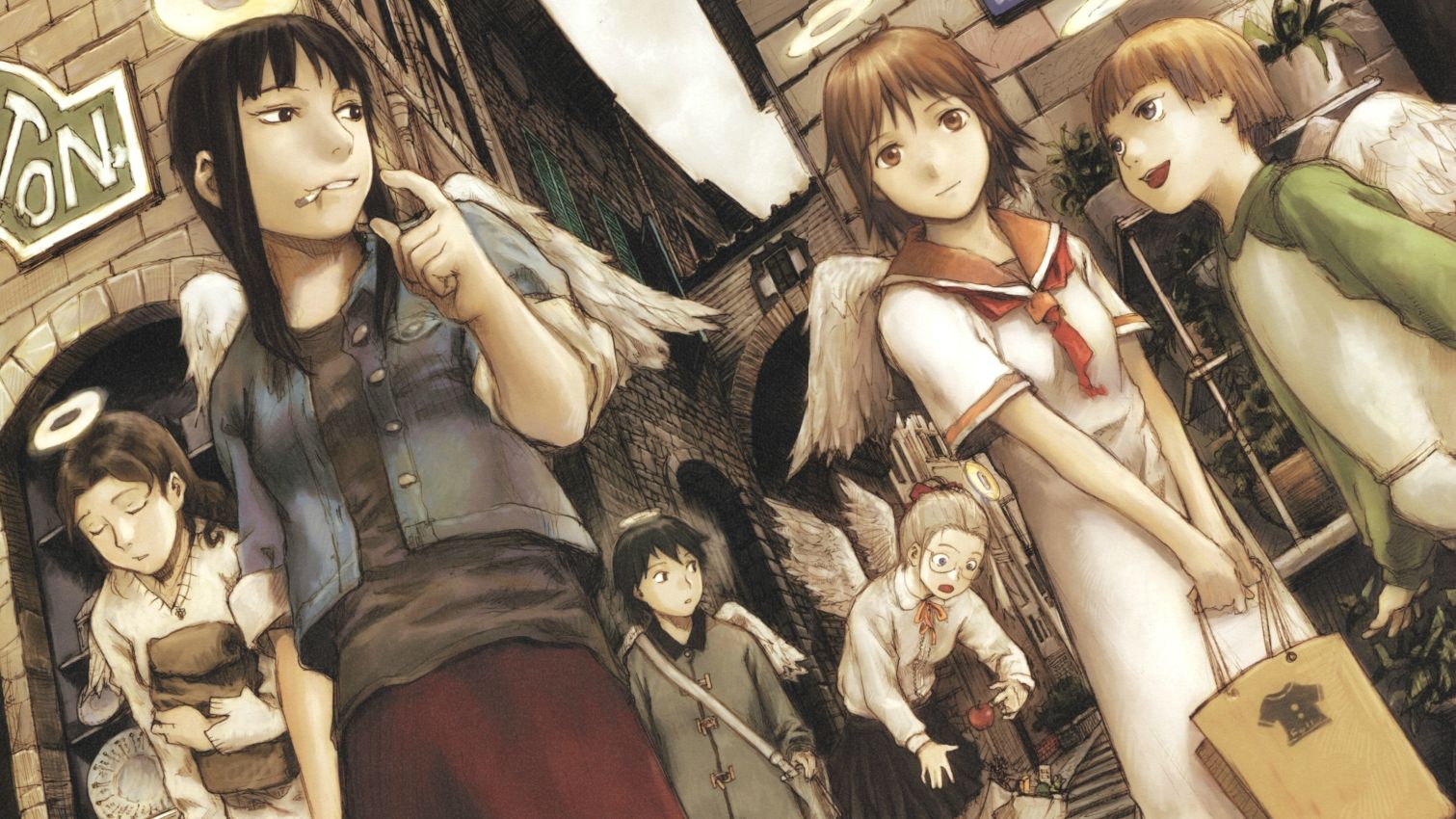
The Haibane live under unusual rules. They cannot leave the walls surrounding Glie. They use second-hand possessions rather than buying new things. They work among the human townspeople, but remain separate from them. The mysterious Toga communicate with the Haibane Renmei, an organization that oversees their lives and customs, yet clear answers about the world remain scarce.
At first, the series concentrates on ordinary routines: finding Rakka a job, exploring the town, cleaning Old Home, sharing meals, and learning how the Haibane live. This domestic calm is not filler. It establishes Glie as a place where wounded people can experience safety before the story asks whether safety alone is enough to heal them.
A fantasy world built from emotional logic
Many fantasy anime introduce a strange world and then steadily explain its history, power system, and governing rules. Haibane Renmei does something more difficult. It presents rules without guaranteeing explanations.
The walls matter, but the series does not provide a conventional history of who built them. The halos and wings matter, but they are not treated as combat abilities or proof of a simple religious allegory. Dreams matter, but they do not function as straightforward records of the past. Glie feels carefully designed even when its origins remain unknowable.
This ambiguity works because the world follows emotional rather than mechanical logic. The characters may not understand why they are in Glie, just as people experiencing depression or grief may not understand why certain memories, fears, or beliefs have such power over them. The world is meaningful without becoming fully legible.
That places Haibane Renmei close to contemplative fantasy such as *Frieren: Beyond Journey’s End*, where small moments carry emotional weight because the story is willing to slow down. The difference is that Frieren looks backward across centuries, while Haibane Renmei traps its characters inside a present they cannot escape until they confront what they carry within themselves.
Rakka is not passive—she is emotionally lost
Rakka can initially appear less dramatic than many anime protagonists. She is polite, uncertain, observant, and often guided by the more experienced Haibane around her. She does not arrive in Glie with a grand ambition. Her first concern is simply understanding where she belongs.
That uncertainty is the point. Rakka’s identity is unstable because she has no past to organize her sense of self. She learns who she is through work, friendship, responsibility, and the way others respond to her. Her development is less about becoming stronger than becoming willing to participate in life.
The series understands that loneliness does not always look like open rejection. Rakka is surrounded by kind people, yet she can still feel fundamentally separate from them. She receives support, but support cannot immediately erase the belief that something is wrong with her.
This is where the series shares emotional territory with *March Comes in Like a Lion*. Both anime show that care matters most when it is patient and ordinary. A meal, a room, a task, or a person who keeps returning can become a form of rescue. Neither series pretends that kindness instantly cures depression, but both argue that healing often begins through repeated proof that a person is allowed to remain.
Reki is the real heart of Haibane Renmei
Rakka may be the audience’s point of entry, but Reki becomes the series’ deepest character. She is dependable, practical, and protective. She helps new Haibane through the frightening process of awakening, manages daily life at Old Home, and often appears more emotionally mature than everyone around her.
That competence hides a painful contradiction. Reki wants to be needed because being needed allows her to avoid asking whether she is loved. She can care for others without believing that she deserves the same care in return.
Her generosity is genuine, but it is also defensive. Helping people gives her a role. A role creates distance from her own vulnerability. She can become the person who saves others while secretly believing that she herself is beyond saving.
This makes Reki more than a tragic mentor figure. She represents the way guilt can become an identity. When someone believes their pain proves they are bad, forgiveness can feel threatening because it challenges the entire story they have built about themselves.
The series’ most important insight is that being offered help and accepting help are different acts. A person trapped in shame may interpret love as pity, kindness as obligation, and forgiveness as something meant for better people. Reki’s struggle is not simply to receive rescue. It is to believe that rescue can be sincere.
The “circle of sin” is psychological, not a rulebook
Spoiler warning: The following sections discuss major developments and the ending.
The series introduces the idea of being “sin-bound,” but it wisely avoids reducing sin to a list of moral violations. The condition is closer to a self-reinforcing state of guilt. A person feels guilty, believes that guilt makes them unworthy, rejects the relationships that might challenge that belief, and then treats their isolation as proof that they were unworthy all along.
That is the circle.
The solution is not punishment. Nor is it simple self-forgiveness, because a person trapped inside their own judgment may not possess the emotional tools to release themselves. The series instead suggests that another person must reach into the circle—but the person inside must still choose to respond.
This is why Haibane Renmei is ultimately a story about grace. Grace is not presented as innocence or the erasure of consequences. It is the possibility that someone can be seen completely and still be offered a future.
Rakka’s relationship with Reki becomes powerful because Rakka does not save her through superior wisdom. She saves her by refusing the version of Reki’s story in which every act of kindness was false and every relationship was doomed. Rakka recognizes that Reki’s care mattered, even if Reki’s motives were complicated. Human motives are almost always complicated. That does not make love unreal.
Why the symbolism remains effective
The wings, halos, walls, cocoons, dreams, birds, wells, and Day of Flight invite interpretation. It is easy to read Glie as purgatory, the Haibane as souls between lives, and the Day of Flight as spiritual release. Those readings are reasonable, but the anime never locks itself into a single theological system.
That restraint protects the story from becoming a code-breaking exercise. The symbols matter because of what they reveal emotionally.
- Cocoons suggest rebirth, but also isolation before connection.
- Wings imply freedom, yet the Haibane cannot fly.
- Halos make them appear angelic, although they are confused and imperfect.
- The walls provide security while also limiting growth.
- The Day of Flight represents departure, but departure can feel like abandonment to those left behind.
The symbolism repeatedly joins two opposing meanings. Safety can become confinement. Care can contain selfishness. Departure can be both loss and liberation. This tension makes Glie feel less like a literal afterlife and more like a psychological space in which damaged people are given time to become capable of leaving.
Viewers who appreciate the identity questions and visual abstraction of *Kaiba* may find a similar willingness here to let science-fiction or fantasy imagery carry emotional ideas. Kaiba asks whether identity survives the loss or exchange of memory. Haibane Renmei asks whether a person can build a future without recovering a complete past.
The slow first half is both a strength and a weakness
The early episodes are deliberately gentle. Rakka explores Glie, tries different jobs, becomes accustomed to Old Home, and learns the rhythms of Haibane life. For viewers who need immediate conflict, this section can feel uneventful.
The pacing works better in retrospect. The anime needs Old Home to feel safe before that safety can be threatened by loss. It needs the supporting characters to feel like a household rather than a collection of plot devices. It needs daily life to become valuable enough that leaving it carries emotional weight.
Even so, the series occasionally asks for more patience than necessary. Some early scenes repeat Rakka’s uncertainty without adding much to it, and the limited animation can make quiet passages feel flatter than intended. A modern production might communicate the same stillness with more expressive background animation and subtler character acting.
Yet speeding the series up would create a different problem. The final episodes work because the viewer has spent time inhabiting Glie. The story’s emotional climax depends on routine becoming attachment.
Art direction matters more than animation quality
Haibane Renmei is not a showcase of fluid animation. Its production limitations are visible in inconsistent drawings, restrained movement, and sequences that rely heavily on still compositions. Judged purely by technical polish, it has aged more than many prestige anime from the same period.
Its art direction, however, remains distinctive. Glie is built from faded greens, browns, greys, and warm interior light. The color palette makes the town feel old, calm, and slightly removed from reality. Old Home is worn but comforting; the abandoned factory is harsher and more alienated; the walls are beautiful from a distance and oppressive when approached.
The character designs also avoid exaggerated glamour. The Haibane look ordinary enough that their wings and halos become stranger. Their supernatural features do not turn them into heroic beings. They remain awkward young people doing chores, searching for work, arguing, grieving, and trying to understand themselves.
This visual modesty supports the story. A more spectacular version of Haibane Renmei might weaken its intimacy.
Kow Otani’s music gives Glie its soul
The soundtrack is one of the anime’s greatest strengths. Kow Otani’s score blends delicate strings, piano, woodwinds, percussion, and folk-like textures into music that feels both comforting and distant.
The opening theme, “Free Bird,” immediately establishes that contradiction. It suggests movement and openness, yet the imagery and setting are defined by boundaries. The ending theme, “Blue Flow,” carries a soft melancholy that rarely pushes the audience toward a single emotion. It leaves space for sadness, relief, and uncertainty to coexist.
The score does not merely decorate scenes. It helps Glie feel like a remembered place—somewhere the viewer may never have visited but somehow recognizes. Long after specific plot details fade, the emotional texture of the music remains.
The supporting cast creates a believable community
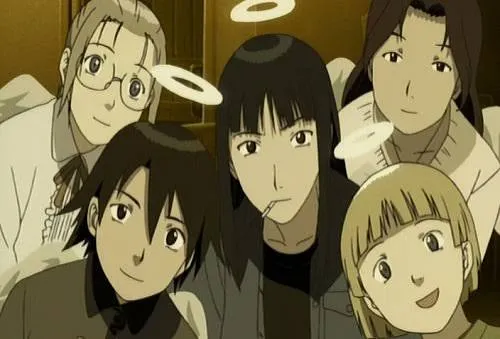
Kuu, Nemu, Kana, and Hikari do not receive the same psychological depth as Rakka and Reki, but each represents a different way of inhabiting Glie.
Kuu is restless and eager to prove maturity. Nemu carries the heaviness of someone who has remained too long. Kana finds energy in practical work and mechanical curiosity. Hikari is gentle but capable of small acts of mischief. Together, they prevent Old Home from becoming a purely symbolic location.
Their ordinary personalities matter because the story is not claiming that every Haibane experiences pain identically. Some are closer to departure. Some are comfortable. Some are still searching for a role. The community gives each person room to move at a different pace.
This is also why Haibane Renmei deserves a place among AnimeSparks’ underrated anime worth discovering. It offers something increasingly rare: a fantasy world where community is not background decoration but the mechanism through which the story understands recovery.
What Haibane Renmei says about forgiveness
Many stories frame forgiveness as a moral reward. A character confesses, apologizes, suffers, and is then forgiven because they have earned it. Haibane Renmei is more unsettling.
It asks what happens when someone cannot accept forgiveness even after it is offered.
Reki’s pain comes partly from the belief that her inner motives invalidate her outward kindness. Because she needed others, she assumes her care for them was selfish. Because she feared abandonment, she assumes every bond she formed was manipulative. The anime rejects this demand for emotional purity.
People often help others partly because they also need connection. That does not make the help meaningless. Love can contain fear. Generosity can coexist with dependency. A good action does not become false merely because the person performing it is wounded.
Rakka’s final act of faith is therefore not a declaration that Reki has never done anything wrong. It is a refusal to let Reki reduce her entire life to her worst interpretation of herself.
That is the series’ most lasting message: moving forward does not require proving that you were always innocent. It requires accepting that you are more than the guilt through which you have learned to see yourself.
Is Haibane Renmei depressing?
The anime deals directly with grief, self-hatred, abandonment, and suicidal imagery, so it can be emotionally difficult. Its tone is melancholic, and several episodes create a powerful sense of loneliness.
But the series is not nihilistic. Its sadness exists inside a larger belief that connection matters. People may fail to recognize love, resist help, or hurt one another while trying to survive, yet the possibility of reaching someone remains real.
In that sense, Haibane Renmei is hopeful without becoming reassuring in a simplistic way. It does not promise that everyone heals quickly. It argues that pain does not have to be the final authority over a person’s life.
Who should watch Haibane Renmei?
You should watch Haibane Renmei if you enjoy:
- introspective character dramas;
- fantasy that leaves some mysteries unresolved;
- stories about grief, guilt and recovery;
- slow, atmospheric pacing;
- symbolic imagery that supports multiple interpretations;
- anime such as Serial Experiments Lain, Kino’s Journey, Kaiba, Mushishi, Frieren, or March Comes in Like a Lion.
You may struggle with it if you need clear lore explanations, frequent plot twists, action, or fast pacing. The series expects the viewer to sit with silence and uncertainty rather than treating them as problems that must immediately be solved.
Final verdict
Haibane Renmei remains one of anime’s finest hidden gems because it understands that guilt is not defeated by logic alone. People can know they are loved and still feel unworthy of love. They can be surrounded by community and remain convinced they are alone. They can want rescue while rejecting every hand extended toward them.
The series turns those contradictions into a restrained fantasy about learning to accept a future. Its animation may be modest and its first half may test impatient viewers, but its atmosphere, music, symbolism, and central relationship have lost little of their force.
More than two decades after its original broadcast, Haibane Renmei still feels unusual—not because its world is impossible to explain, but because it refuses to explain away the emotional complexity of being forgiven.
AnimeSparks rating: 9/10
Frequently asked questions
Frequently asked questions
Is Haibane Renmei worth watching?
Yes. Haibane Renmei is worth watching for viewers who enjoy slow, atmospheric anime centered on character psychology, grief, guilt and forgiveness. It is less suitable for anyone seeking action or complete explanations for every mystery.
How many episodes does Haibane Renmei have?
Haibane Renmei has 13 television episodes. Its compact length allows the story to move from gentle slice-of-life material into a focused emotional conclusion.
Is Haibane Renmei sad?
Haibane Renmei is melancholic and deals with grief, isolation, self-hatred and suicidal imagery. However, its overall message is hopeful: connection and forgiveness can help people move beyond identities built around guilt.
Does Haibane Renmei explain what Glie is?
No definitive explanation is given. Glie can be interpreted as an afterlife, purgatory or psychological space, but the anime deliberately keeps its cosmology ambiguous and prioritizes emotional meaning over fixed lore.
Does Haibane Renmei have a complete ending?
Yes. Although the wider world remains mysterious, the central emotional conflict involving Rakka and Reki reaches a clear and satisfying conclusion.