
Yubaba steals Chihiro's name in Spirited Away to bind her to the bathhouse and make it harder for her to return to the human world. By replacing her original name with Sen, the witch threatens to separate Chihiro from her memories and identity. Haku understands the danger because he has already lost his own name under Yubaba's rule.
Spoiler warning: This explanation discusses Haku's identity and the ending of the 2001 film.
Why does Yubaba need Chihiro to sign a contract?
Chihiro enters the bathhouse because she needs a way to survive in the spirit world and rescue her parents. Haku advises her to obtain employment. After encountering Kamaji and receiving help from Lin, she reaches Yubaba's office and insists on being given a job. The witch eventually agrees, but the employment contract comes with a supernatural price.
The important distinction is that employment protects Chihiro from immediate danger without making her free. Yubaba controls the terms of her stay. The contract gives the witch an opportunity to impose a new identity on the girl, turning a request for protection into a means of keeping her dependent.
Why is Chihiro renamed Sen?
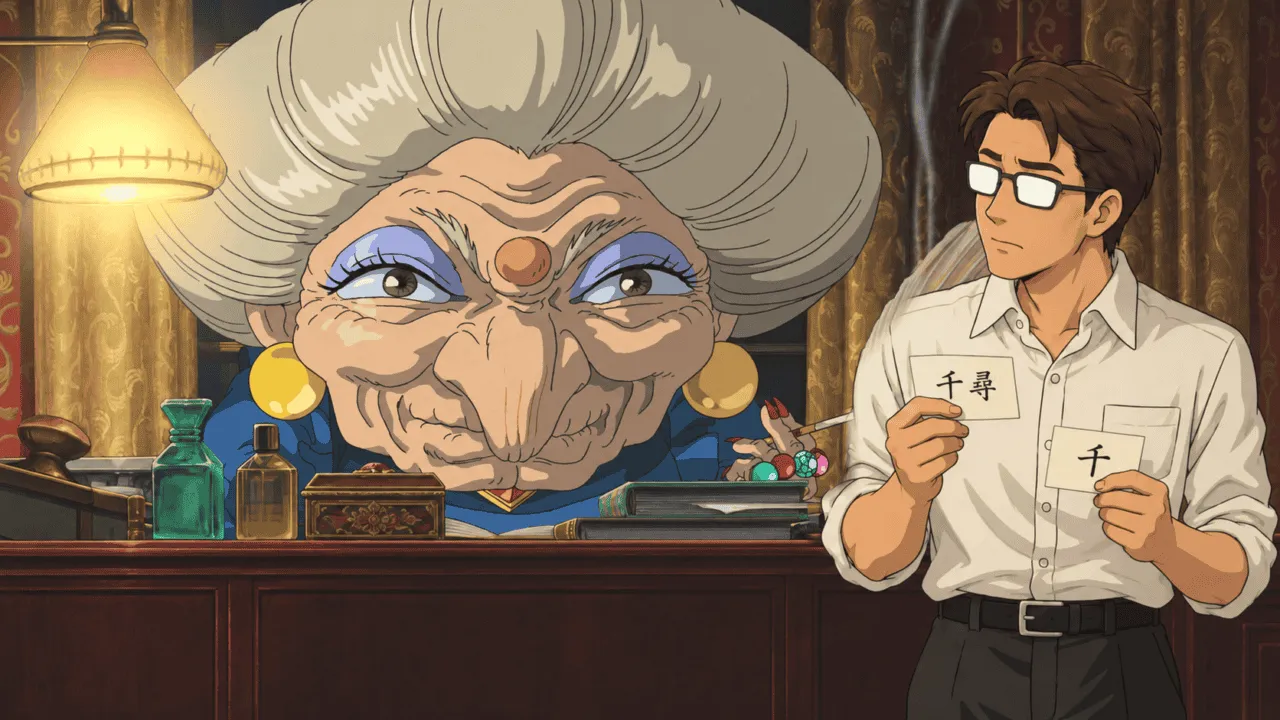
The transformation makes particular sense when you look at the Japanese writing. Chihiro's full name is Ogino Chihiro (荻野千尋). Yubaba magically removes three characters from the written name, leaving 千. This character can be pronounced chi in Chihiro and sen in another context. It means one thousand.
Sen is therefore not a completely unrelated nickname. It is a surviving fragment of the name Chihiro already possesses. The animation makes the theft visible: the written characters are treated as physical things that can be removed from the contract. English subtitles convey the change in pronunciation, but the Japanese lettering reveals how the new name is constructed.
The original Japanese film title, Sen to Chihiro no Kamikakushi, also includes both names. This is a useful clue to the importance of the two identities, rather than evidence that Sen and Chihiro are literally separate people.
Why does forgetting her name prevent Chihiro from going home?
Haku warns Chihiro that losing her original name could leave her unable to return home. He gives her back her human clothes, and the farewell card she finds with them reminds her of the name she had before entering the spirit world. The scene establishes that Yubaba's magic is more than a change in what other workers call her.
The film does not specify an exact deadline for forgetting a name or establish a universal set of rules for every spirit. What it does establish is the danger of losing the connection to one's former life. Chihiro can answer to Sen while working without accepting that Sen is all she has ever been.
What happened to Haku's real name?
Haku provides the clearest example of what Chihiro risks becoming. He serves Yubaba and cannot remember his original name. His position gives him apparent authority over other workers, but that authority does not mean he is independent of the witch.
Later, Chihiro recalls an incident from her childhood in which she fell into the Kohaku River and was carried to safety. She recognizes Haku as the spirit of that river. This recognition allows him to remember his true identity. The river itself has been filled in, making his loss of a home more than a purely magical problem.
The relationship between the two characters is reciprocal. Haku helps Chihiro remember who she is when she is new to the bathhouse. Chihiro eventually returns that help by recognizing who Haku was before his service to Yubaba. Remembering is an act of care in both scenes.
Does remembering her name automatically break the contract?
No. Chihiro still has to resolve the danger facing her parents. At the end, Yubaba presents her with a group of pigs and asks her to identify which are her mother and father. Chihiro correctly determines that neither parent is among them. Passing the test releases her from the agreement.
Keeping her name is crucial, but it is not a substitute for the final challenge. The movie never suggests that simply saying Chihiro aloud would have ended the contract immediately. Her escape depends on both preserving her identity and satisfying the conditions of her release.
What does the stolen name symbolize?
One interpretation is that Yubaba's bathhouse represents an institution that values people primarily for what they can do. Chihiro arrives with a family, a history and a personality. The witch gives her a job and a shorter name suited to her new role. The contrast makes the magical contract an effective metaphor for losing yourself in an environment that demands obedience.
Yet the film does not portray work itself as inherently harmful. Chihiro learns to cooperate, take responsibility and notice the needs of others. Her growth comes from those experiences without requiring her to abandon her past. This distinction is also interesting alongside other stories about young heroines learning unfamiliar magic, such as Witch Hat Atelier.
The contrast with other fantasy stories about institutional power, including Tanya Degurechaff's struggle with authority, highlights how unusual Chihiro's victory is. She does not need to become more powerful than Yubaba. She needs to understand the rules, protect the people she cares about and refuse to let her assigned role define her completely.
Ultimately, Yubaba takes Chihiro's name because control over identity helps maintain control over the worker. The girl leaves the bathhouse changed by her experiences, but she leaves as Chihiro. That is the difference between growing into someone new and being forced to forget who you were.