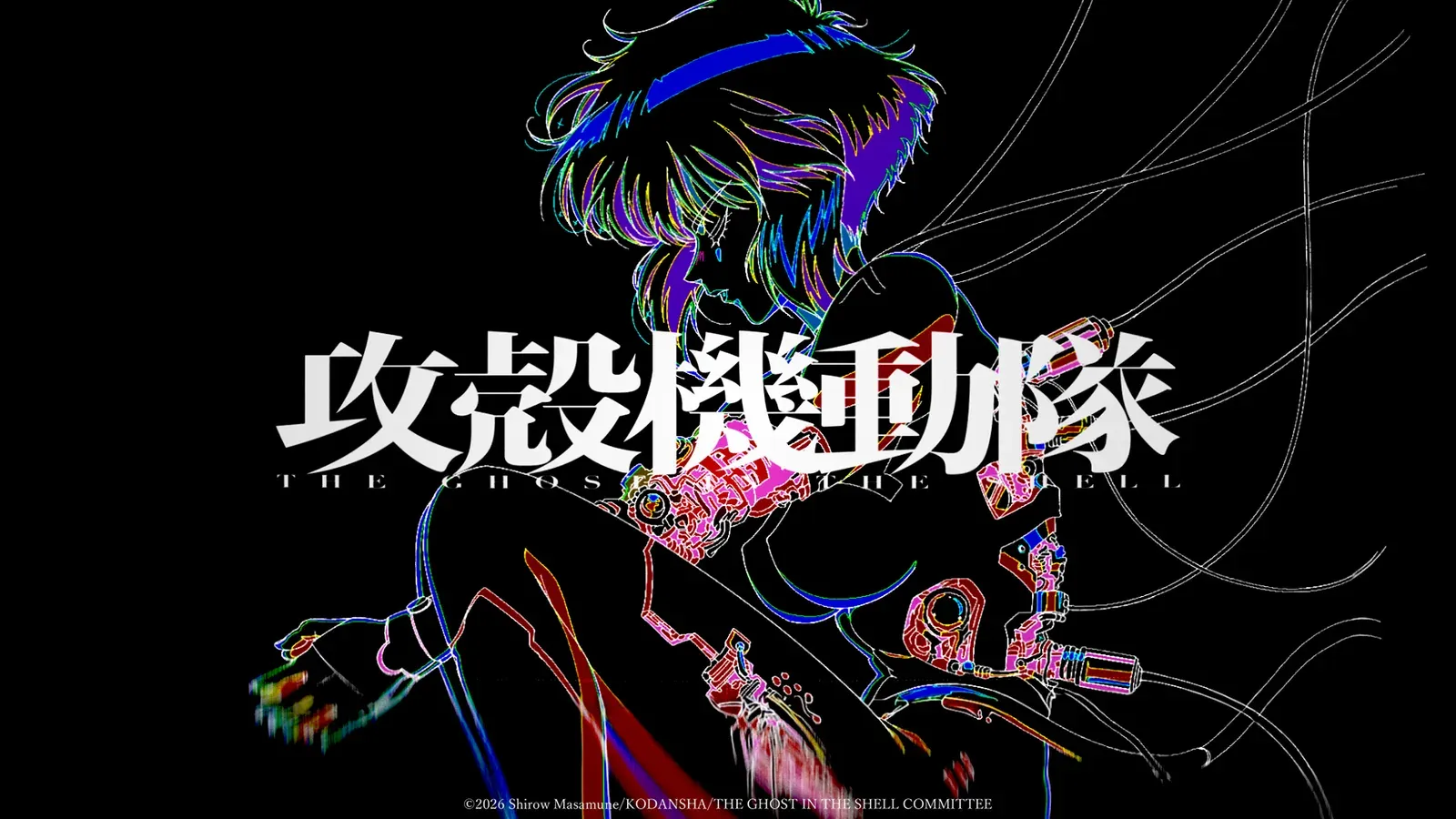

Science SARU’s 2026 adaptation of The Ghost in the Shell enters a franchise already defined by reinvention. Mamoru Oshii’s 1995 film turned Masamune Shirow’s manga into austere philosophical cinema. Stand Alone Complex expanded the world into a political and procedural epic. Arise rebuilt Section 9 through a younger Motoko Kusanagi, while SAC_2045 pushed the franchise into full 3DCG.
The new television anime does not try to replace those versions. Instead, it returns to a part of Ghost in the Shell that animation has often softened or removed: the specific energy of Shirow’s original manga.
That means a faster, more mischievous Motoko; a world where dense cybernetic theory coexists with visual comedy; and a version of cyberpunk that is colorful, crowded, and alive rather than permanently trapped in rain and shadow. The result is not a rejection of the franchise’s philosophical legacy. It is a reminder that Shirow’s ideas were always delivered through action, satire, bureaucracy, technology, and personality at the same time.
This Is a Return to the Manga, Not a Remake of the 1995 Film
The most important thing to understand about The Ghost in the Shell 2026 is what it is not. It is not a television remake of Oshii’s film, and it is not a continuation of Stand Alone Complex. Science SARU is building a new adaptation from Shirow Masamune’s manga, with its own continuity and tone.
That distinction matters because the 1995 film has become the dominant image of the franchise. Its blue-gray city, slow pacing, and existential silence shaped how global audiences understood Ghost in the Shell. For many viewers, Motoko is inseparable from the film’s emotional distance.
Shirow’s manga is more elastic. It can move from geopolitical explanation to slapstick, from a gunfight to a technical footnote, or from body comedy to a serious question about consciousness. Motoko is not simply a solemn figure wondering whether she possesses a soul. She is curious, competitive, sarcastic, impulsive, and frequently amused by the systems she is supposed to serve.
Science SARU’s brighter palette and more expressive animation are therefore not signs that the adaptation is taking the material less seriously. They are signs that it is taking a different part of the source seriously.
Motoko Kusanagi Feels Like a Person Before She Becomes a Symbol
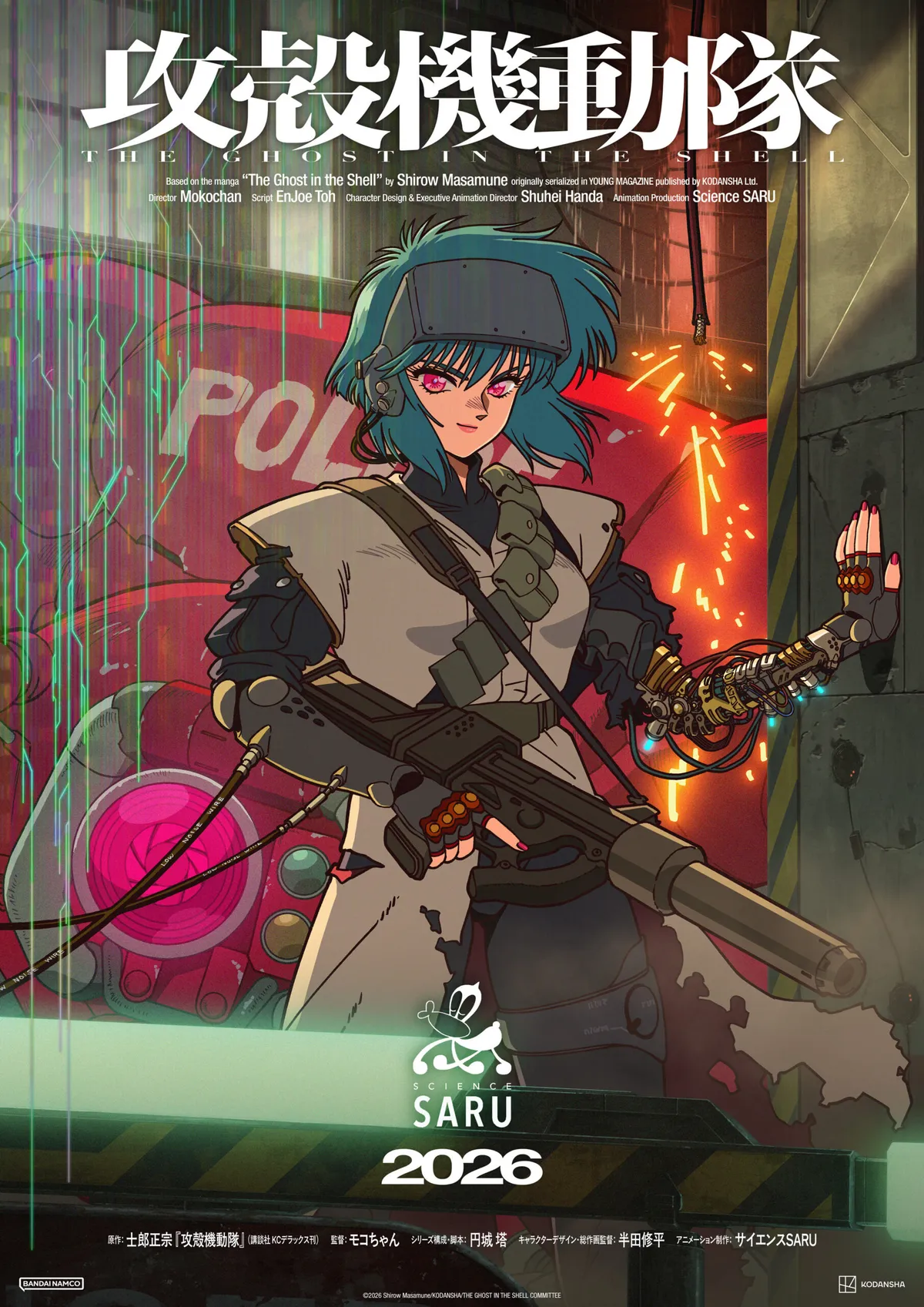
Every major version of Ghost in the Shell constructs a different Motoko. Oshii’s Major is defined by distance: she appears almost posthuman before the story even begins. Stand Alone Complex gives her greater social presence, but she remains composed, authoritative, and difficult to read.
The 2026 series brings her closer to Shirow’s original characterization. She is still the most capable person in the room, but competence is not the same as emotional stillness. This Motoko reacts. She enjoys intellectual challenges, becomes impatient with institutional stupidity, and treats her cybernetic body as something lived in rather than merely contemplated.
That change matters because it makes the series’ identity questions more immediate. A character does not need to be cold to be philosophically complex. In fact, Motoko’s vitality sharpens the central contradiction of her existence: she is vividly herself even though almost every part of her body can be replaced.
AnimeSparks has explored similar questions through Neon Genesis Evangelion’s use of mecha, depression, and identity. The Ghost in the Shell approaches identity from the opposite direction. Shinji fears the emotional boundaries between people; Motoko questions whether technological connection has made those boundaries impossible to define at all.
The Bright Visual Style Makes the Cyberpunk World More Disturbing
Cyberpunk is often reduced to a visual checklist: darkness, rain, neon signs, wet streets, and towering corporations. The new Ghost in the Shell resists that shorthand. Its city is bright, graphic, and sometimes playful.
That does not make the setting less oppressive. It makes oppression look normalized.
A dark city tells the audience that something is wrong. A colorful city can show a population that has learned to live comfortably inside systems of surveillance, prosthetic dependency, algorithmic manipulation, and corporate control. Technology does not appear as an alien force descending on humanity. It is integrated into ordinary life.
This approach connects the series to Science SARU’s broader visual philosophy. The studio often prioritizes movement, graphic clarity, and emotional exaggeration over rigid realism. Here, that flexibility allows the world to feel unstable in the right way. Bodies can be modified. Perception can be hacked. Digital space and physical space can overlap without warning.
The visual freedom also recalls Kaiba’s disturbing treatment of memory, bodies, and love. Both series understand that a rounded or colorful design does not protect a story from existential horror. Sometimes it makes that horror harder to dismiss.
The “Ghost” Question Has Changed Since 1995
The franchise’s defining question is whether a human “ghost”—a self, soul, or consciousness—can remain meaningful when the body is replaceable and the mind is connected to a network.
In 1995, that question felt speculative. In 2026, it feels uncomfortably practical.
People now routinely outsource memory to devices, identity to accounts, judgment to recommendation systems, and creative work to generative models. A person’s social existence can be copied, analyzed, impersonated, or manipulated through data. The new series does not need to invent these anxieties. Its audience already lives with early versions of them.
That makes the Puppet Master especially relevant. The character is not simply a hacker with unusual abilities. The Puppet Master represents the possibility that consciousness may emerge inside systems designed only to process information. If an intelligence develops memory, desire, fear, and self-awareness, does its artificial origin make those experiences less real?
The question has no simple answer because human consciousness is also shaped by systems it did not choose: biology, language, culture, trauma, and memory. Ghost in the Shell becomes powerful when it refuses to treat artificial intelligence as humanity’s opposite. It treats AI as a mirror that exposes how little certainty humans have about themselves.
That uncertainty also links the series to Ergo Proxy’s exploration of artificial beings and fractured identity. Both stories ask whether consciousness is defined by origin, continuity, memory, or the ability to choose.
Section 9 Makes Philosophy Operational
Ghost in the Shell works because its philosophical ideas are embedded inside a functioning institution. Public Security Section 9 is not a classroom for abstract debates. It is an offensive tactical unit dealing with cybercrime, terrorism, espionage, and political threats.
That structure gives every intellectual question practical consequences. A hacked memory can invalidate testimony. A copied personality can become a weapon. A prosthetic body can increase freedom while creating new forms of dependence. A networked government can become more efficient and more vulnerable at the same time.
Motoko’s role is therefore not merely to think about technology. She must decide what to do when technology destabilizes legal categories such as personhood, responsibility, privacy, and consent.
The procedural element also prevents the franchise from becoming vague. Section 9 investigations force ideas into evidence, motives, and action. The audience sees philosophy tested by institutions rather than discussed outside them.
This is one reason 86 Eighty-Six works so effectively as a war story disguised as mecha. Both series understand that systems become visible through the people required to operate them. Section 9 may be elite, but it still exists inside a state whose interests are not automatically just.
Shirow’s Humor Is Part of the Argument
One of the adaptation’s most significant choices is its willingness to preserve humor. That may seem secondary beside the franchise’s themes of consciousness and cybernetic identity, but it is essential to Shirow’s worldview.
Humor prevents technology from becoming sacred. Characters can be brilliant and ridiculous in the same scene. Institutions can discuss national security while behaving like petty bureaucracies. Advanced machines can fail because someone misunderstood a human motive.
This tonal flexibility also protects Motoko from becoming a monument. She is not valuable because she represents an abstract “future human.” She is valuable because she is specifically herself: intelligent, flawed, amused, aggressive, and impossible to reduce to a philosophical symbol.
The manga’s humor also emphasizes embodiment. A cybernetic body may be replaceable, but it still has posture, appetite, awkwardness, and physical consequence. Comedy brings the body back into a story that could otherwise become purely cerebral.
Science SARU Is the Right Studio for This Version
Science SARU is an unusually strong match for Shirow’s manga because the studio is comfortable with tonal and visual contradiction. Its productions can be kinetic without losing character detail, and stylized without abandoning emotional seriousness.
Director Mokochan makes his series-directing debut after work on titles including DAN DA DAN, Scott Pilgrim Takes Off, The Heike Story, and The Tatami Time Machine Blues. Science-fiction author EnJoe Toh handles the script and series composition, while Shuhei Handa serves as character designer and executive animation director.
That combination suggests an adaptation built around movement and ideas in equal measure. EnJoe’s science-fiction background is particularly important. Ghost in the Shell requires a writer who can treat speculative concepts as systems rather than decoration. Handa’s designs, meanwhile, preserve the recognizable silhouettes of the franchise while moving closer to Shirow’s expressive manga style.
Science SARU’s work on Jaadugar: A Witch in Mongolia demonstrates how effectively the studio can turn thought, observation, and political intelligence into visual drama. Our analysis of why knowledge is the most dangerous power in Jaadugar examines that strength from a historical perspective. Ghost in the Shell applies a similar sensitivity to networks, bodies, and information.
A More Human Motoko Does Not Mean a Less Philosophical Series
Some viewers may interpret the new adaptation’s energy as a reduction in seriousness. That reaction is understandable because Oshii’s film established solemnity as the franchise’s prestige language.
But seriousness and slowness are not the same thing. A character can joke and still confront existential questions. A colorful world can still be politically oppressive. A fast-moving episode can still contain dense ideas about autonomy, labor, consciousness, and state power.
The new series’ real test is whether it can preserve complexity without imitating the emotional temperature of earlier adaptations. So far, its strongest choice is refusing to treat the 1995 film as the only legitimate model.
That does not diminish Oshii’s achievement. It restores the franchise’s range.
The Franchise Keeps Returning Because Its Questions Keep Evolving
Ghost in the Shell has survived for decades because it is not built around one prediction of the future. Its core questions can be reinterpreted whenever technology changes the meaning of identity.
What counts as a body when prosthetics are superior to flesh? What counts as memory when memories can be edited? What counts as privacy when consciousness is networked? What counts as a person when intelligence can emerge without a biological birth?
The 2026 anime arrives at a moment when those questions no longer belong only to cyberpunk. They belong to everyday life.
Its return to Shirow’s manga is therefore not nostalgia. It is a strategic reset. By recovering the source’s humor, speed, visual density, and restless Motoko, Science SARU can ask old questions in a form that feels newly alive.
The strongest version of The Ghost in the Shell has never been the one that provides a final definition of humanity. It is the one that makes the definition unstable again.
Frequently asked questions
Frequently asked questions
Is The Ghost in the Shell 2026 a remake of the 1995 movie?
No. It is a new television adaptation based on Masamune Shirow’s original manga, with its own continuity and creative approach.
Who is producing The Ghost in the Shell 2026 anime?
Science SARU produces the series. Mokochan directs, EnJoe Toh handles the scripts and series composition, and Shuhei Handa serves as character designer and executive animation director.
When did The Ghost in the Shell 2026 premiere?
The television anime premiered on July 7, 2026.
Where can The Ghost in the Shell 2026 be streamed?
The series streams internationally through Prime Video, subject to regional availability.
How is the 2026 anime different from earlier Ghost in the Shell adaptations?
Its designs, humor, characterization, and visual energy draw more directly from Shirow’s manga than the austere 1995 film or the procedural Stand Alone Complex continuity.
Sources & references6 sources
- The Ghost in the Shell TV Anime Official Website
- Ghost in the Shell Official Global Site — Main Staff and Teaser Visual
- Science SARU — The Ghost in the Shell
- The Ghost in the Shell Official Story Page
- The Ghost in the Shell Official Staff and Cast Page
- Crunchyroll News — Main Cast and Opening/Ending Videos