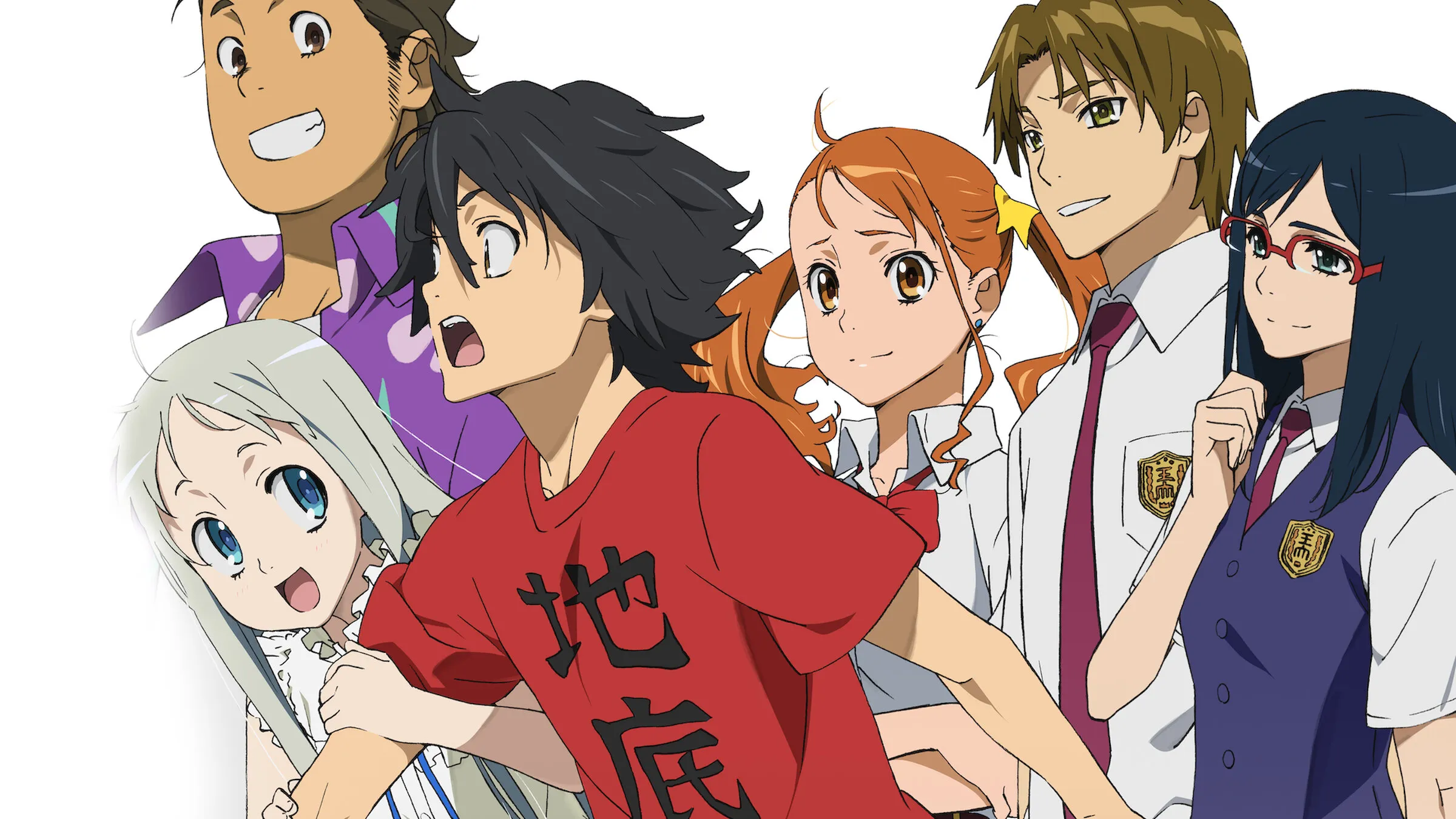

Anohana: The Flower We Saw That Day (2011) follows six childhood friends called the "Super Peace Busters" who drift apart after member Meiko "Menma" Honma dies in an accident. Five years later, Menma's ghost appears to reclusive Jinta "Jintan" Yadomi, asking him to fulfill her wish so she can pass on. Unable to remember what that wish is, Jinta reunites his estranged friends to solve the mystery. What unfolds isn't a supernatural story but an unflinching examination of how children process grief differently—through isolation, guilt, denial, and romanticized memory. The series demonstrates that unresolved trauma doesn't fade with time, it festers. With stunning A-1 Pictures animation and an 8.1 IMDb rating, Anohana remains one of anime's most emotionally devastating coming-of-age stories because it refuses to offer easy answers about loss, instead showing how healing requires confronting pain you've spent years avoiding.
Where to Watch: Anohana: The Flower We Saw That Day is streaming on Crunchyroll with English subtitles and dub. 11 episodes. A sequel film was released in 2013.
Since its 2011 premiere, Anohana has earned recognition for portraying grief with uncommon honesty and emotional depth, avoiding typical anime melodrama while delivering genuine catharsis.
The Setup: When Childhood Ends Violently
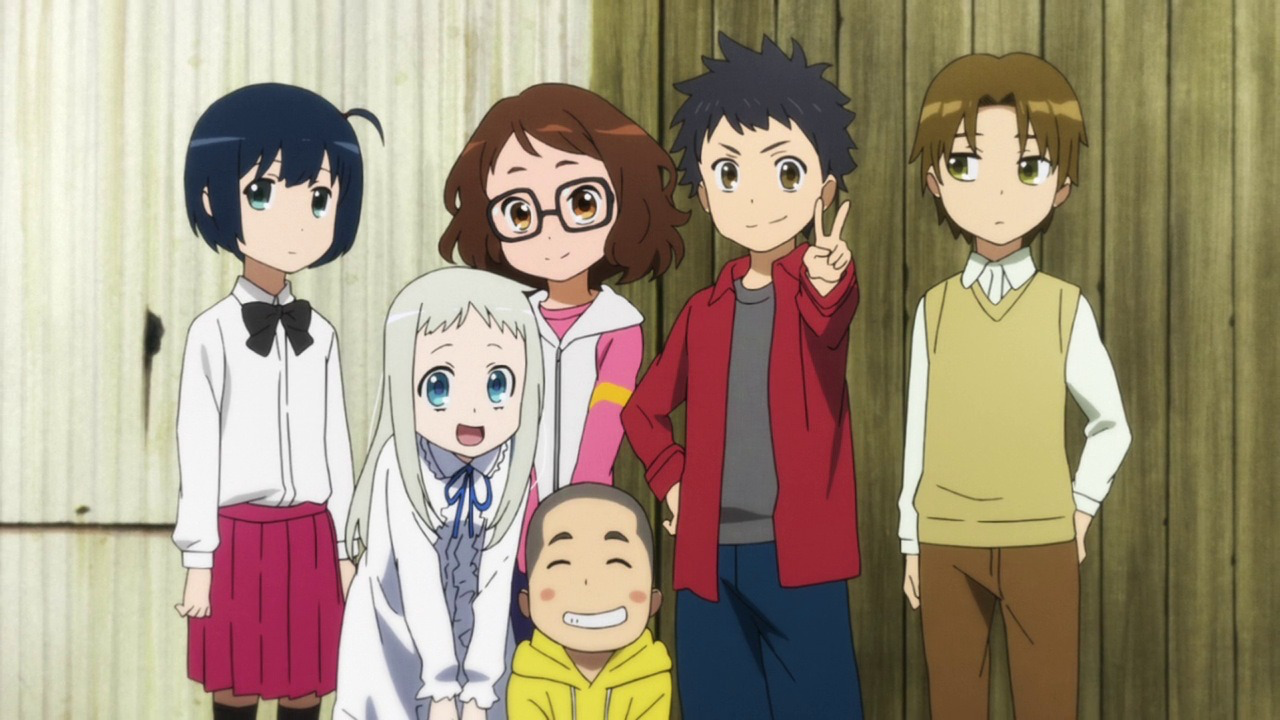
The Super Peace Busters were six elementary school friends who spent summer days at their secret hideout playing Nokemon, pretending to be heroes protecting their small town.
Then Menma died.
The series doesn't show the accident until later episodes, opening instead five years after—with the aftermath still poisoning everyone's lives.
Jinta: The Leader Who Became a Shut-In
Jinta was the outgoing leader, the kid everyone followed. After Menma's death and his mother's passing shortly after, he withdrew completely. By high school, he's a hikikomori—refusing to attend school, barely leaving his room, playing video games while his concerned father works to support them both.
When Menma's ghost appears asking for help, he initially dismisses her as heat-induced hallucination. But she's persistent, physically interacting with the world—cooking food, opening doors, triggering reactions he can't ignore.
The series establishes immediately that Jinta's isolation isn't laziness or rebellion. It's unprocessed grief calcified into identity. He stopped being "Jintan the leader" and became "the boy broken by loss."
Similar to how Welcome to the NHK portrays social anxiety as paralysis, Anohana shows mental health struggles rooted in trauma rather than character flaws.
How Grief Manifests Differently in Each Character
The genius of Anohana lies in showing that the same trauma affects people in completely different ways. There's no "correct" way to grieve, just various coping mechanisms—some healthier than others.
Poppo: The Happy Mask Hiding Guilt
Tetsudō "Poppo" Hisakawa appears the most well-adjusted. He's cheerful, works part-time jobs, travels frequently, always smiling.
He's also the most broken.
Poppo witnessed Menma's accident. He saw her die and couldn't save her. The guilt consumes him silently while he performs happiness for everyone else, afraid that admitting his pain would burden others.
His constant traveling isn't adventure—it's escape. He can't stay still because staying still means remembering.
Yukiatsu: Unhealthy Obsession as Denial
Naruko "Yukiatsu" Matsuyuki was jealous of Jinta even as children. He had a crush on Menma, resented that she liked Jinta instead, and never got to resolve those feelings before she died.
Years later, he's secretly been buying clothes identical to what Menma wore and dressing in them, playing out scenarios where she's still alive.
This isn't portrayed as comedic. It's disturbing, desperate, and heartbreaking—a teenager so unable to process loss that he's trying to physically become the person he lost.
Tsuruko and Anaru: Repression and Self-Destruction
Tsurumi "Tsuruko" Chiriko deals with grief through emotional repression, maintaining perfect composure while secretly harboring feelings for Yukiatsu that she can never express.
Anjou "Anaru" Naruko tries to fit in with popular girls who mock her, seeking validation from people she doesn't even like because her actual friends remind her of trauma she wants to forget.
Both are functional on the surface, shattered underneath—which connects to how March Comes in Like a Lion explores therapy in anime form through depicting how people hide depression behind normalcy.
The Scene That Breaks Everyone
Episode 10 contains Anohana's emotional apex.
The Super Peace Busters have built a rocket firework to help Menma pass on, believing that launching it will fulfill her wish. They gather at night, prepared for closure.
Menma writes each of them a letter. They write letters back to her, saying everything they never got to say when she was alive.
Then, as the rocket launches, they realize they don't actually want her to go.
The Confrontation They Needed
What follows is raw, ugly emotional catharsis. Everyone breaks down simultaneously, screaming admissions they've buried for years:
Jinta admits his childhood crush on Menma and the guilt that his rejection the day she died might have caused the accident.
Yukiatsu confesses his jealousy and self-hatred for resenting someone who died.
Anaru reveals she was jealous of Menma for being effortlessly lovable while she always felt inadequate.
Poppo finally screams that he watched her die, that he saw everything, that he's been carrying the image of her death for five years without telling anyone.
The scene has no background music during the confessions. Just voice actors delivering lines through genuine tears, the sound of cicadas, and characters sobbing uncontrollably.
It lasts nearly ten minutes. The animation shifts to rotoscope-smooth fluidity for Menma's movements, making her feel more real than ever precisely as they're losing her again.
This moment defines what Anohana achieves—not manufactured drama, but authentic emotional collapse after years of suppression.
Similar to how 86 Eighty-Six refuses to sanitize trauma, Anohana doesn't pretty up grief or make it palatable.
Why Menma Works as Character and Symbol
Menma could have been a Mary Sue—perfect ghost girl with no flaws who exists only to heal others. The series avoids this through specific choices.
She's Still a Child
Menma died at age 5 or 6. Her ghost appears as a teenager because that's how old she would have been, but her personality remains childlike. She speaks in third person, gets excited about simple things, doesn't fully understand complex emotions.
This creates uncomfortable tension. She looks like a teenage girl. She acts like the elementary schooler she was when she died. The friends relate to her as both—their childhood companion and a stranger wearing a familiar face.
Her arrested development forces them to confront that she didn't grow up with them. They changed. She's frozen. The gap between their memories and her presence is devastating.
Her Wish Reveals Everything
Throughout the series, Menma insists she has a wish preventing her from passing on but can't remember what it is. The mystery drives the plot.
In the finale, she remembers: her wish was to make Jinta cry.
Not because she wanted to hurt him. Because on the day she died, Jinta was too embarrassed to cry at her funeral. He internalized that boys don't cry, that leaders stay strong, that showing emotion equals weakness.
Menma's wish was for him to let himself grieve. To feel. To stop pretending he's okay when he's shattered.
But that's the wish she remembered. Her actual wish—revealed through context rather than words—was simply for her friends to be together again, supporting each other instead of suffering alone.
The series argues that sometimes we can't articulate what we need. Sometimes the wish itself is connection.
How the Series Uses Visual Contrast
Anohana employs brilliant visual storytelling to differentiate past and present, memory and reality.
Romanticized Past vs. Sharp Present
Flashbacks to the Super Peace Busters' childhood are saturated with warm light, soft focus, gentle colors. Everything looks idealized, beautiful, safe.
Present-day scenes use sharper focus, darker tones, realistic lighting. The contrast emphasizes that the characters have romanticized their memories—turning childhood into a perfect past that never existed quite as warmly as they remember.
This visual technique shows how grief distorts memory. We don't remember things as they were. We remember them as we needed them to be.
This approach parallels how Made in Abyss uses beauty to amplify horror—visual contrast creates emotional impact that dialogue alone can't achieve.
Menma's White Dress
Menma's ghost wears the same white sundress from the day she died. She's always barefoot. She never changes clothes.
This constant visual reminder that she's frozen in time, that she can't move forward, mirrors how the other characters have been frozen too—unable to change because they're still living in the day she died.
When they finally let her go, they're letting go of the version of themselves that died with her.
The Music That Destroys You
Composer Remedios creates a gentle, bittersweet score that never overwhelms scenes but adds profound emotional weight.
The opening theme "Aoi Shiori" by Galileo Galilei shows the cast as children, then teenagers—except Menma, who remains absent, visually establishing the loss driving everything.
Secret Base: The Song That Ends You
The ending theme "Secret Base ~Kimi ga Kureta Mono~ (10 years after Ver.)" is performed by the voice actresses for Menma, Anaru, and Tsuruko.
It's a cover of a 2001 song about childhood friends promising to meet again in ten years. The original is cheerful and nostalgic.
This version is slower, more wistful, carrying the weight of a promise that can never be kept because one of them died before the reunion could happen.
By the final episode, hearing this song becomes unbearable. It transforms from ending theme to emotional devastation through accumulated context.
What Anohana Gets Right About Grief
The series avoids common pitfalls in grief narratives by refusing easy resolution or inspiration porn.
No Timeline for Healing
Five years after Menma's death, none of the Super Peace Busters have "moved on." Society expects people to grieve for acceptable periods then return to normal. Anohana rejects this completely.
Unresolved trauma doesn't have an expiration date. It doesn't conveniently resolve itself. It requires active confrontation, which is terrifying, which is why people avoid it for years.
Collective vs. Individual Grief
The series shows both how people grieve alone and how shared grief creates different dynamics. Each character's individual trauma is valid, but they also wounded each other through their isolation—choosing to suffer privately rather than support each other.
Menma's mother provides contrast. She never processed her daughter's death, instead trying to freeze time by keeping Menma's room unchanged, wearing her daughter's favorite perfume, sometimes calling her son by Menma's name.
The series doesn't judge her. It shows compassion for how unbearable losing a child is while also demonstrating that avoiding grief makes it grow toxic.
This nuanced portrayal connects to how Ranking of Kings shows trauma manifesting differently in different people—there's no universal grief experience.
Why the Ending Works
The finale resolves Menma's story but leaves the characters' healing incomplete—which is exactly right.
After the hide-and-seek scene where Menma finally becomes visible to everyone and they all break down together, she passes on. The Super Peace Busters read her letters to them, cry together one final time, and separate.
The epilogue shows them slowly reconnecting. Jinta walks to school with Anaru. Yukiatsu and Tsuruko grow closer. Poppo resumes studying.
But they're not "fixed." They're just functional again. The trauma remains. They've simply accepted it as part of who they are now instead of letting it control them.
The Bittersweet Truth
Menma's final words—"I found you, Jintan"—refer to the hide-and-seek game but also to something deeper. She found the version of him that could feel again. That could cry. That could let people in.
The series ends with them gathering at their hideout one more time, looking at the sky together.
No dramatic resolution. No promise that everything's okay now. Just the quiet acknowledgment that grief never fully leaves, but connection makes it bearable.
This honest approach to healing mirrors how Run with the Wind explores adults who missed their prime—sometimes the point isn't triumph, it's acceptance.
Who Should Watch This
Watch If You:
- Have experienced loss and want validation of how hard it is
- Appreciate character-driven emotional storytelling
- Can handle crying during/after episodes
- Value authentic grief portrayal over manufactured drama
- Want coming-of-age stories about processing trauma
Skip If You:
- Can't handle prolonged emotional heaviness
- Need happy endings or complete resolution
- Find melodrama off-putting even when earned
- Prefer action or plot over character exploration
What Anohana Actually Achieves
Anohana: The Flower We Saw That Day doesn't offer answers about how to grieve properly. It shows six different people grieving imperfectly and eventually finding their way back to each other.
The series argues that grief is bearable only when shared. That isolation turns trauma toxic. That healing doesn't mean forgetting or "moving on"—it means learning to live with loss instead of being controlled by it.
In just 11 episodes, the series delivers emotional devastation and catharsis in equal measure, proving that sometimes the most powerful stories aren't about saving the world.
They're about saving yourself from the person you became when you stopped letting yourself feel.
Menma's ghost was never the real haunting. The real ghosts were the versions of themselves the Super Peace Busters became after deciding to suffer alone.
And sometimes the bravest thing you can do is admit you're not okay and let people help carry what you've been holding by yourself for too long.